Thursday, November 26, 2020

The Comprehensive Guide to Impression Shares

Online advertising is booming.

But, when you're launching digital campaigns, you want to be sure you're maximizing your efforts — and your profits — by boosting your ad's impression share. Your impression share tells you how well your ad is performing compared to its total potential audience, and boosting it can help increase engagement as well as profit. 

If you're only engaging a small portion of your target audience, then analyzing your impression share is usually a good place to start. Increasing this value will help you propel ads to the top of the Search Engine Results Page (SERP) and ultimately generate more engagement for your campaigns.

In this post, we'll explain what impression share is as well as the different types that your marketing team can track during your online ad campaigns.

Each time your ad is displayed on a webpage, that's counted as an impression. Ads have the potential for more impressions for different reasons, especially when they're keyword-savvy, attractive, and relevant.

When you track impression share, you have a clear representation of how well your ad is performing and how you can improve it over time particularly through keywords. While there are plenty of metrics that can track how well your ads are doing, impression share helps you identify the shortcomings of your ad so you can fix it and make it more engaging to your audience.

Read on to learn about the different types of impression share that your business can track to generate more engagement for its ad campaigns.

Types of Impression Share

Search Impression Share

Search impression share is your ad's impression share on a search network. According to Google, a search network is "a group of search-related websites where your ads can appear," including Google search results, Google apps such as Maps and Shopping, and on Google search partners' websites. This metric divides the impressions that your ad receives by the number of impressions it could receive on the search network.

This metric is greatly impacted by budget. If you have a low daily budget on Google, your ad will no longer be shown once you hit your budget. This means your ad might be getting impressions, but it's still missing out on more engagement because of this daily limit.

If you're not looking to spend more on your campaign, another way to improve search impression share is to focus on the quality score, target, bid, and conversion rate of your ads. These metrics gauge the effectiveness of your ad and improving them will lead to more engagement.

Display Impression Share

Google defines its Display Network as a group of over two million websites, videos, and apps where ads can appear. Display Network sites reach up to 90% of internet users and can show your ads in a particular context, or to a specific audience.

With display campaigns, you can increase your ad placements to improve impression share, but you'll need to adjust your budget to accommodate this increase as well. Or, you can decrease your number of placements to make your campaign more cost-effective, but this will reduce the frequency of your ad's display. The best approach is testing the number of placements until you've reached a point where you've optimized impression share without going over your campaign's budget.

Target Impression Share

Target impression share provides an automatic approach to bidding on ads. With this tool, you can set automated bids for your campaign, which gives your ad a better chance of reaching the top of the SERP. And, with a more prominent position on a search results page, your ad is likely to gain more impressions over time. 

Although impression share is only available per campaign, you can track target impression share for all of your campaigns at once. There are plenty of options for customizing it, too. For example, you can set it to bid for a certain section of the page — like the top half — or for certain times and places.

Adwords Impression Share

Wondering how to access your impression share data in Google Ads?

Once you've logged into your Ads account, just go to Campaigns > Columns > Modify Columns > Competitive Metrics > Impression Share, then click Save.

Adwords-impression-share

Image Source

Now, your impression share will appear in a table that you can download.

Exact Match Impression Share

Exact match impression share is just as it sounds. This metric compares the impressions your ad received compared to how many it was eligible to receive for searches that exactly match your keywords. You can use exact match impression share to hone in on your keywords and improve your ads.

Search Lost Impression Share

The "Search Lost Impression Share (budge)" column shows you the percentage of impressions that you're missing out on because of your budget. A high percentage here may mean that investing in a larger budget could boost your advertising efforts and sales in the long-run.

The "Search Lost Impression Share (rank)" column shows you the number of impressions you're losing based on a low rank. If this percentage is high, advertisers should consider how to boost rank through quality score and cost-per-click rates. Quality score evaluates your keywords' past performances, ad relevance, landing page experience, and expected clickthrough rate.

Consider making adjustments to your campaign's keywords and creative assets if your search lost impression share (rank) is high. A relevant ad with great keywords will rank higher on the SERP, which can lead to more impressions, clicks, and sales.

If you want to manually determine the impression share for an ad, below is a formula that can help you calculate it.

As Google explains, "Eligible impressions are estimated using many factors, including targeting settings, approval statuses, and quality." Once the maximum number of impressions is determined, all you have to do is divide the number of impressions that the ad receives by the maximum number of impressions that Google decides it's eligible for.

We can see how this formula is written in the example below. 

Impression-share-formula

Image Source

We can also modify this formula to find the total number of impressions that our ad is eligible for. For instance, if we already know our impression share, we can reformat the formula to look more like this. 

impression-share-available

Image Source

Impression Share Formula Example

Let's say we created an ad and Google says there are 5,000 potential impressions available. After monitoring our ad's performance for a month, we recorded about 4,000 impressions. This would mean that our impression share is 80% (4,000 recorded impressions / 5,000 available impressions =  80% impression share). 

Impression share is a handy metric for determining how well an ad campaign is doing and what your team can do to help it reach its full potential. By tracking impression share, you can automate bids, fine-tune your budget, and track keywords and quality score to reach your targeted audiences more often and generate greater brand awareness and profits.

For more ways to boost online ad engagement, read this list of helpful SEO tips.


The Comprehensive Guide to Impression Shares was originally posted by Local Sign Company Irvine, Ca. https://goo.gl/4NmUQV https://goo.gl/bQ1zHR http://www.pearltrees.com/anaheimsigns

Wednesday, November 25, 2020

75 Stop Words That Are Common in SEO & When You Should Use Them

From blog titles to URL slugs, you might not realize how frequently you use SEO stop words. But, to be fair, if Google doesn't pay much attention to them, why should you?

Research shows that 25% of blog posts are made up of stop words. However, these words have little to no relevance to the topic of the post. These are words that help you compose sentences and connect ideas together, and they don't have much impact on Google's search results.

But, excessive use of stop words can impact your brand in the long run. They make content harder for search engines to process which can end up negatively affecting how they index your pages.

In this post, we'll walk you through exactly what SEO stop words are, how they can hurt — or help — your online presence, and which words are considered stop words by Google and other search engines.

What Are Stop Words in SEO?

We use stop words all the time, whether we're online or in our everyday lives. These are the articles, prepositions, and phrases that connect keywords together and help us form complete, coherent sentences.

Common words like its, an, the, for, and that, are all considered stop words. While they're important for communicating verbally, stop words typically carry little importance to SEO and are often ignored by search engines.

Let's review some of the most common stop words in the section below.

Common SEO Stop Words

The most common SEO stop words are pronouns, articles, prepositions, and conjunctions. This includes words like a, an, the, and, it, for, or, but, in, my, your, our, and their.

When people search for something online, search engines like Google omit these words in their results because they don't relate to the keywords in the search. So, rather than looking up content that's related to these words, Google removes them altogether and prioritizes the keywords.

So, the next time you're trying to hit a word count when writing a blog post, try filling that open space with keywords rather than filler copy that doesn't improve your SEO.

While it would be great to load up your content with only meaningful keywords, the reality is that stop words are needed for every type of copy. After all, even if you rank highly on Google, it won't mean much if your content is incomprehensible or doesn't resonate with your audience.

Are Stop Words Beneficial for SEO?

There's a time and place for SEO stop words. First and foremost, stop words help the reader understand the content. It can be confusing to read titles and subheaders without stop words.

You also might find instances where stop words help you differentiate between two topics. For example, you can search ‘flamingos' and you'll see information about beautiful, bright pink birds. Add ‘the' to the front, and you'll be directed to YouTube to listen to the band, The Flamingos. This tiny, three-letter stop word makes a world of a difference in this case.

In the next section, let's look at some other times when you should be paying attention to stop words to optimize your content's search ranking.

Removing Stop Words

Should you be removing stop words from all of your content?

Like anything else, it depends on how you're using them. If your titles, headings, URL slugs, and keywords make sense without them, then it can be beneficial to remove them.

SEO Stop Words in Titles

If your titles don't make sense when you take out those articles or prepositions, then it's best to leave them be. After all, you want your audience to actually click and read your content. If the most prominent parts — including the title — don't make sense, the website could come off as unprofessional or even spammy.

It usually makes the most sense to leave stop words in titles and headings, as these are wayfinding elements for users navigating your content. Just keep in mind that the optimal character count for titles is 50-60 characters, as search engines cut off longer titles, which could omit important information for the visitor. If you have lengthy stop words in your title, consider rewriting them to balance brevity and clarity.

Stop Words in URL Slugs

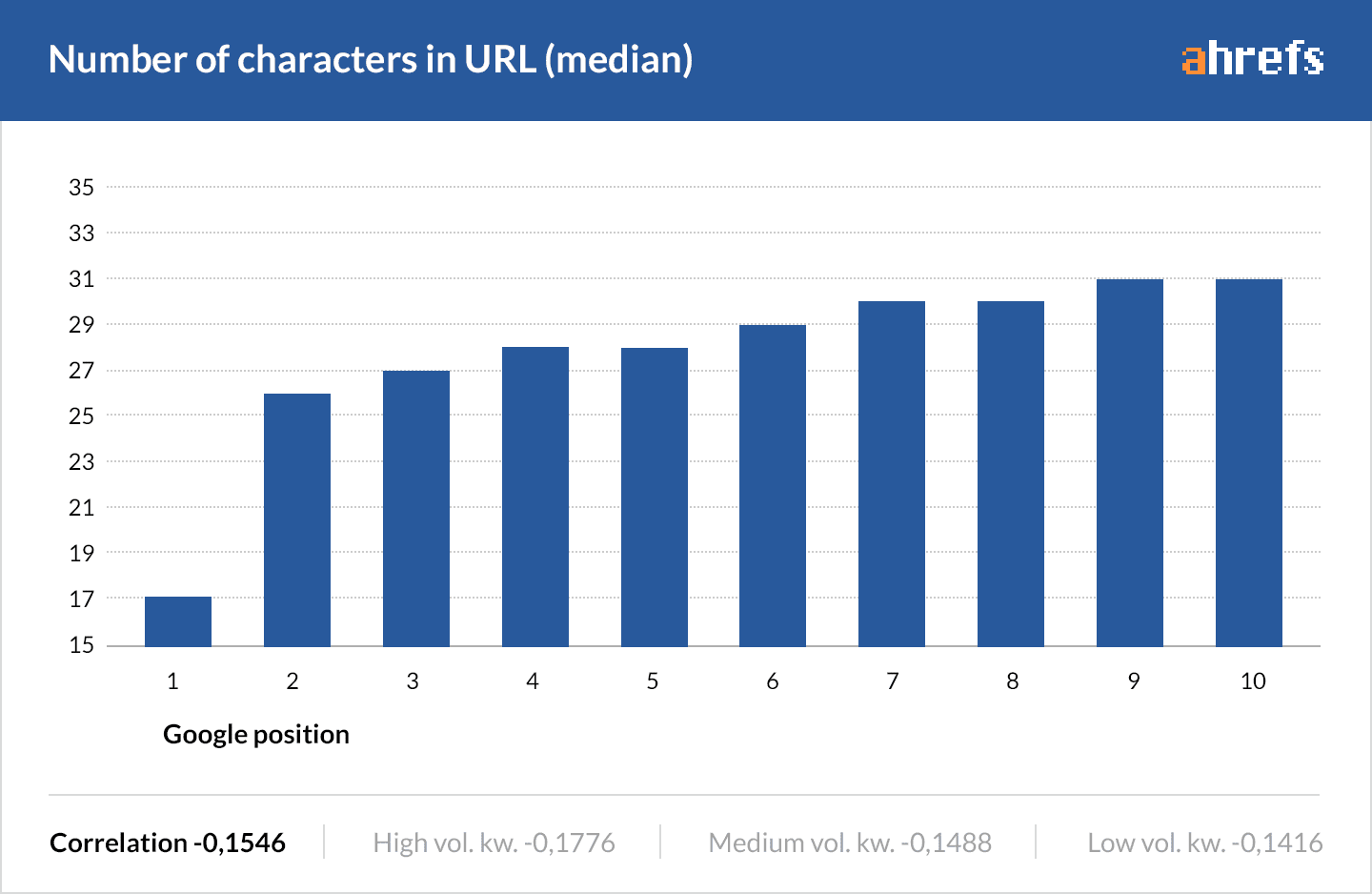
When it comes to URL slugs, stop words typically don't have much significance in SEO. They're relevant, however, if they make your URL slug particularly long. Google ranks URLs based on their length, and longer URLs typically rank lower than shorter ones — as outlined by the chart below.

SEO-stop-words

Image Source

Stop Words as Keywords

As we touched on in the last section, there are some times when stop words are crucial to keywording because they differentiate a proper noun from something else. For example, if you searched “Jets New York” you'd probably get a list of flights coming in and out of New York City. But, if you searched, “The New York Jets,” you would get content about the professional football team instead.

Now that we're familiar with what stop words are and when we should use them, let's look at a broader list of stopwords that you should be aware of when creating and optimizing content.

75 Stop Words in SEO

There are many, many more stop words out there, but here's a list of some of the most common stop words to be mindful of when creating content online.

A

About

Actually

Almost

Also

Although

Always

Am

An

And

Any

Are

As

At

Be

Became

Become

But

By

Can

Could

Did

Do

Does

Each

Either

Else

For

From

Had

Has

Have

Hence

How

I

If

In

IS

IT

ITS

JUST

MAY

MAYBE

Me

Might

Mine

Must

My

Mine

Must

My

Neither

Nor

Not

Of

Oh

Ok

When

Where

Whereas

Wherever

Whenever

Whether

Which

While

Who

Whom

Whoever

Whose

Why

Will

With

Within

Without

Would

Yes

Yet

You

Your


Using SEO Stop Words

SEO stop words are important if you want to create a strong SEO strategy and rank highly on search engines like Google. Overusing them can hinder your ranking, but avoiding them altogether will make your content confusing and unclear. By understanding what stop words are and which words qualify as stop words, you can craft content that works to your brand's advantage.

For more ways to rank higher on search engines, read these SEO tips.


75 Stop Words That Are Common in SEO & When You Should Use Them was originally posted by Local Sign Company Irvine, Ca. https://goo.gl/4NmUQV https://goo.gl/bQ1zHR http://www.pearltrees.com/anaheimsigns

Tuesday, November 24, 2020

What Are Website Traffic Exchange Sites? (And Why You Shouldn't Use Them)

Traffic matters. The more traffic your website generates, the greater your chances of capturing visitor interest, encouraging user action and generating sales.

So it’s no surprise that traffic remains a top priority no matter what kind of site you run. As noted by a recent Forbes piece, everything from specific search engine optimization (SEO) strategies to contextually-relevant content can help boost traffic volumes and increase key metrics, while more technical traffic attractions such as reducing page load delays and improving user experience on mobile devices can also enhance your website impact.

The potential downside? These traffic-boosting tactics aren’t quick fixes. They require time and effort to deliver ongoing results — and they’re not guaranteed.

Website traffic exchange sites offer a supposedly speedy solution to deliver increased impressions and help your click-throughs climb the charts, but as noted by Google, they also come with significant risk “because they may lead to invalid clicks or impressions and result in your account being disabled.”

Here’s what you need to know about website traffic exchange sites, how they work — and the red flags that make them a non-starter for sustained traffic over time.

What is a Website Traffic Exchange?

The idea behind a website traffic exchange is simple: Quid pro quo — you do something, and you get something in return.

In this case, what you’re doing is visiting other business owners’ websites, and they’re visiting yours in return. The theory holds that with enough visits your site will start to climb relevant search rankings and eventually drive more organic traffic your way.

At face value, this doesn’t seem like a bad idea: Since website owners all want the same thing — traffic — why not band together and use the power of the Web at large for collective gain?

But problems crop up as traffic trends away from the organic views and user engagements that search engines are now built to detect. Since you’re visiting sites as quickly as possible to generate their traffic and get the same in return, your website impressions are feather-light and fleeting; there’s no engagement with content and no context for the visit.

As search engines become more sophisticated, meanwhile they can detect this lack of legitimacy — and penalize your site for it.

Understanding Website Traffic Exchange Sites

The most common form factor for these traffic exchange options is as traffic exchange websites. Do a quick Google search and dozens will pop up, all offering high-volume, low-risk services.

These websites are simply groups of website owners who all agree to visit the other sites on the list and in return have their own sites visited. Some are free to join and have hundreds or thousands of sites listed; others come with a fee and may support millions of sites worldwide.

While smaller sites typically operate on a one-for-one model — you visit one website and get a visit in return — larger operations may impose a site-viewing ratio, especially if your site is just starting. For example, if your ratio is 0.5 you must visit two sites before getting one visit in return.

To help smaller companies boost their profile more quickly, many of these website traffic exchange sites now offer for-pay options that promise to deliver a certain quantity of digital visitors in a specific time frame. They may also run contests or promotions that group members can enter (for free or for pay) which will boost their traffic multiplier and supposedly get them closer to the top of relevant, front-page searches.

Red Flags: Why You Shouldn’t Use Traffic Exchange Services

So far, these traffic exchange sites don’t sound like a terrible idea: You get traffic for free or for pay and provide traffic for other sites.

But here’s the problem: As noted by Google, their AdSense program specifically prohibits any artificial means of generating impressions or clicks — if your website is found to be using these methods, your AdSense profile may be suspended and your search ranking will drop. Although website traffic exchange sites use a slightly different model to deliver click-throughs and visitor impressions, they may create similar red flags for popular search engines in turn causing your site’s search ranking to crash.

There’s also the larger problem of organic and contextual traffic. Your ultimate goal is to attract visitors with relevant website content that drives specific action — such as signing up for a newsletter, filling out a contact form or making a purchase. Achieving this goal requires two things: Organic searches that return your website as a top result and contextual, value-driven content that creates consumer engagement

Traffic exchange sites provide the first part of this equation, since group members may be given specific keywords to enter which return your site and boost search rankings. But they fall short on the second half, since these aren’t real visitors but other group members clicking through and then bouncing away while waiting for you to return the favor. This creates an issue for intelligent search engine algorithms that notice your traffic increase — and commensurate lack of engagement, in turn red-flagging your site and potentially damaging your search ranking.

Green-light Options for Increasing Your Website Traffic

If website traffic exchange services are a non-starter, what can site owners do to increase traffic, drive more leads and deliver ROI?

Some of the most effective options include:

  1. Creating relevant content
  2. Buying targeted ads
  3. Writing guest posts
  4. Capturing better backlinks
  5. Repurposing old assets

Curated, context-aware content matters to improve traffic metrics. This means creating website layouts and resources that are relevant to your target audience and provide actionable information about your products, unique market position or pricing.

Free press is great, but it’s not always easy to find. As a result, it’s worth doing your research and purchasing targeted ad space on the social platforms preferred by your buyer personas. For example, if you find significant group numbers of Facebook dedicated to discussions of products or services in your industry, it’s worth considering some targeted ad spend to attract specific user interest.

Many website owners are experts in their field, making them ideal authors for guest posts on more popular blogs or sites. Start by reaching out to site admins about writing a guest post with the caveat that they’ll include a link to your site. This lets you capitalize on larger traffic pools without paying for traffic exchange sites.

Speaking of backlinks, it’s worth trying to generate as many great backlinks as possible. Start with a quick search of your brand, product and service names — if you see them mentioned in search results but unlinked, reach out to the author and ask for a backlink. It’s also worth checking the most-searched terms in your market vertical; if you can capture these searches with on-site content, there’s potential to secure backlinks on popular “best of” articles and listicles.

You’ve got content you’re no longer using, but that doesn’t mean it's useless. While simply reposting it won’t generate new traffic, you can repurpose popular resources into something else. For example, a well-performing blog post could be turned into a video or serve as the jumping-off point for a discussion, while a whitepaper could see new life as an infographic with updated statistics.

The bottom line? More traffic means better search rankings and improved user engagement on your website.

But not all traffic is created equal. While traffic exchange websites promise high volume and velocity, the value of this tactic comes with risk — and can’t compare to value-driven, user-focused traffic building that steadily boosts your search ranking and helps turn first-page curiosity into a functional sales conversion.


What Are Website Traffic Exchange Sites? (And Why You Shouldn't Use Them) was originally posted by Local Sign Company Irvine, Ca. https://goo.gl/4NmUQV https://goo.gl/bQ1zHR http://www.pearltrees.com/anaheimsigns

Customer Experience Could Be The Reason Your Online Shoppers Aren’t Converting

All humans — including your customers — are emotional creatures.

That’s why it’s so important to make sure every interaction customers have with your company a memorable one — so memorable that they’ll want to recommend your business to a friend, family member, or colleague.

That connection between your business and customers is exactly what customer experience is all about — providing the support that your customers seek throughout all stages of the buyer’s journey.

You can think of the whole customer journey as a (very important) and complete transaction between your brand and customer, — what happens throughout that transaction and the way your customers feel define the customer experience.

For instance, you visit your local ice cream shop; the waitress welcomes you with your name and immediately asks if you’d like your regular treat, a chocolate sundae with extra chocolate chips, or if you’d prefer to look at a menu.

Wouldn’t this personalized and positive experience make you want to continue returning to that ice cream shop? Sometimes it hardly matters how the food tastes — the unique and delightful customer experience is what keeps you going back.

This doesn’t just apply to brick-and-mortar stores either. For example, when a prospect visits your website, why would they want to stick around to learn about your products or what your brand stands for if they don’t feel valued, understood, and heard? In this case, it won’t matter how beautiful your site isor how well you've optimized your site — what matters is CX.

Understanding Customer Experience (CX): How to See the World Through Your Customer’s Eyes

There are a number of ways a customer may interact with your business. For example, when they visit your website, engage with your social posts, click on your ads, purchase your product or service, or provide feedback. Customer experience includes all of these interactions and more.

A recent study by Oracle reveals maximizing customer satisfaction across the buyer journey increases total customer satisfaction by 20%, and drives revenue growth by up to 15%.

You need to see the world through customer-colored glasses. Understand their challenges and needs. They want to be heard and expect quick responses and speedy reactions from your team members.

Focus on client-centricity — put your customers first by searching for opportunities to create products and services that resolve the challenges of your customers. You can also identify your best customers with smart segmentation. There are a lot of benefits of customer segmentation including a better understanding of your customer’s behaviors, interests, and pain points.

Here are some great examples of how brands are enhancing their customer experience.

  1. When Tony started Zappos (now a billion-dollar brand), he rewarded his team for spending long hours over the phone to create a splendid customer experience.
  2. Apple added a human element to their customer interaction by installing experts at the Genius bar.
  3. FedEx ensured a better customer experience by answering every customer support call on the first ring.

Now that you know what CX is, let’s take a moment to review what it is not.

Customer experience is not user experience (UX).

Customer experience and user experience are separate strategies businesses deploy to help them grow.

User experience is a subset of customer experience. It revolves around your products. It’s all about how your customers interact with your products and what experience they have with them. User experience is a blend of design and architecture, usability, functionality, user-hierarchy, and understanding.

Whereas customer experience is a summary of the complete customer journey map. It starts when a visitor hears about you and exists throughout every interaction with Sales,Marketing, Customer Service, as well as with the product you sell.

Next, let’s review the ways in which CX impacts your conversions and why you may not be seeing the impact you’re hoping for on your bottom line just yet — and don’t worry, we’ll work through some ways to resolve those challenges too.

5 Reasons Why Your Customer Experience is Not Converting Prospects (Yet)

  1. You don’t know your customers well.

The first reason for the low conversion rates is you don’t know who you are targeting. When you are not aware of your target audience, how would you guarantee their conversions?

How to fix it?

  • Determine what your customers want, where their interests lie, what they like, and other common characteristics — everything that helps you reach your audience. (Make buyer personas to help you with this.)
  • Run customer surveys and polls; they are the best way to collect customer information. The feedback you receive from there is filtered and gives you a quick view of your user requirements.
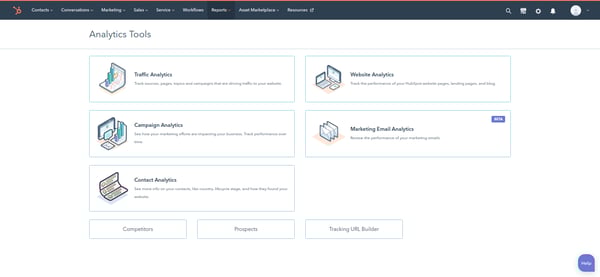
  • Analyze your customers’ behavior with marketing analytics with HubSpot CRM.
hubspot analytics tools and CRM

Source

  • Segment your buyers based on their buying frequency, recency, and monetary metrics (RFM segmentation).
  • Filter your best customers by separating them into categories with HubSpot’s Smart Lists, and send personalized emails to them.

2. Your products are not grabbing your user’s attention.

It’s an age-old saying that the first impression is the last impression. It’s very critical that the visitor’s first impression on viewing your products and your website as a whole is a pleasant one.

The buying decision of the vast majority of your website visitors is impacted by this first impression. If your products are visually appealing, the visitor is bound to take more interest and there is a good chance of conversion.

How to fix it?

When it comes to your eCommerce store, it’s important to keep in mind that your customers are buying products without necessarily ever having the ability to test them out and/or feel them first. So, you need to create an environment where they can make easy purchasing decisions that are virtual from start to finish.

There are a variety of ways through which you can enhance the customer experience and boost conversions.

  • Use high-quality photographs and captivating videos to showcase your product and tell stories about your brand and product or service.
  • Keep your products organized on your website and implement easy-to-use navigation.
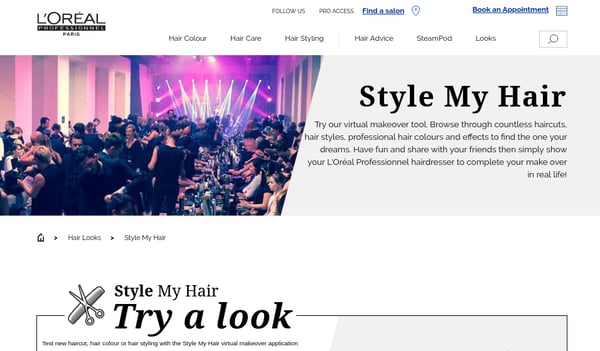
  • Leading fashion brands like L'oreal and Rayban allow users to try virtual makeover tools and provide a 360-degree view of their products. Such innovative leaps in presenting online products help these brands to stand out from others and attract huge audiences.

loreal virtual makeover great digital customer experience example

Source

  • Use augmented reality (AR) — this is a popular trend in the beauty and fashion industries because customers can try your products on virtually (e.g. a pair of sunglasses).
  • Create an omnichannel experience for your online shoppers by augmenting product visualization.
  • Be clear about your pricing strategy. According to Quicksprout, 56% of shoppers abandon their carts at checkout because of unexpected costs.

3. Your website isn’t ready for shoppers.

Did you know that 38% of people will stop engaging with a website if the content or layout is unattractive?

Also, 75% of consumers admit to making judgements on a company’s credibility based on the company’s website design.

If you are experiencing a solid amount of traffic but few conversions and a high bounce rate, your website design likely has issues.

How to fix it?

  • If your website is suffering from low traffic, that may be because your audience isn’t getting what they are looking for. Make sure you are keeping everything on your website accessible for your users.
  • Secondly, when a user visits your website, try to enhance the hero section (the header part) as beautiful, clean, and direct as possible. This section can contain your product, service, and offers too.
  • Add clear call-to-actions (CTAs) throughout your webpage. Add a “view cart” option as well to heighten the chances of successful checkouts.
  • Keep your website design conversion-focused. Put your menu bars (in the header and footer) organized. This will allow your users to navigate to find their goals quickly.
  • Statista says there will be a total of 4.78 billion smartphone users in 2020. So if your website isn’t mobile-optimized, then you may lose conversions.
  • Capitalize on your social media — use it to help you boost your top-performing content such as blog posts, customer reviews, and testimonials. Respond to feedback and answer customer questions through social media, too.

4. You’re unable to win your customer’s trust.

One reason for lower conversion rates is that you are incapable of winning your customer’s trust.

81% of online shoppers feel concerned when shopping on a website with which they are not familiar. Trust cannot be forced; let’s see how you can win your customers' trust naturally without a push.

How to fix it?

  • Choose the right trust seal to improve security on your websites. Trust seals verify your website to be legal and lawful.
  • Add customer reviews to your website to increase the chances of conversions and enhance your customer experience. According to BrightLocal, the average consumer reads 10 reviews before feeling able to trust a business.
  • Be socially active, entertain, communicate, engage, educate, and run campaigns around your brand. Be real and stick to your niche and brand values.
  • Engage your customers and earn their trust by establishing excellent communication practices.
  • Add high-converting and relevant CTAs to your website above the fold. Use phrases and words like Learn More, Shop Now, Download, Sign-up, and Book Now.

5. You have not planned your customer onboarding.

Remember, there are two kinds of customer onboarding: on-site, and off-site. The fundamental difference between on-site and off-site onboarding is that, when a shopper lands on your website, it means they're looking for your products or services. In off-site, the customer has already been introduced to your products and services, before he/she needs them.

How to fix it?

  • Offer a real-time product demo for your audience to help them explore your product and it’s features quickly. According to Wyzowl, 84% of people say that they’ve been convinced to buy a product or service by watching a brand’s video. Video demos impact purchasing decisions significantly and boost engagement as well.
  • For a frictionless customer experience, it is crucial how you handle users who leave your website or intend to leave it.
    • Use an immediate exit-intent pop-up.
    • Set up an email marketing campaign and select time-slots to send interactive abandoned cart emails to lost users.
    • Keep your cart visible to users.
  • Use retargeting or remarketing ads to target users who have visited your website before.
  • Be different — offer a dynamic free trial period for your products and services. Then, a user can extend the trial period and if they choose to. This provides a sense of flexibility and freedom for users.

Wrapping Up

Remember: Customers are humans, not your contact to close in the CRM.

Customer experience brings your customers closer to your brand. Humanize your brand and design, and analyze your customer journey map.

Light up your brand with a customer-centric approach and capture your shopper’s attention using the strategies mentioned above. For more information, check out the latest customer experience statistics & trends 2020 here.

Author Bio: Himanshu Rauthan is an entrepreneur and co-founder at MakeWebBetter, an eCommerce digital marketing agency, HubSpot Premier Integration and Gold Solutions Partner. He is a digital marketing and inbound expert, passionate about building and scaling eCommerce customer experiences.

HubSpot marketing teams reserves the right to use guest blog author’s likeness across our content as we see fit, including but not limited to HubSpot’s social media channels.


Customer Experience Could Be The Reason Your Online Shoppers Aren’t Converting was originally posted by Local Sign Company Irvine, Ca. https://goo.gl/4NmUQV https://goo.gl/bQ1zHR http://www.pearltrees.com/anaheimsigns

How to Determine Your A/B Testing Sample Size & Time Frame

Do you remember your first A/B test you ran? I do. (Nerdy, I know.)

I felt simultaneously thrilled and terrified because I knew I had to actually use some of what I learned in college for my job.

There were some aspects of A/B testing I still remembered — for instance, I knew you need a big enough sample size to run the test on, and you need to run the test long enough to get statistically significant results.

But ... that's pretty much it. I wasn't sure how big was "big enough" for sample sizes and how long was "long enough" for test durations — and Googling it gave me a variety of answers my college statistics courses definitely didn't prepare me for.

Turns out I wasn't alone: Those are two of the most common A/B testing questions we get from customers. And the reason the typical answers from a Google search aren't that helpful is because they're talking about A/B testing in an ideal, theoretical, non-marketing world.

So, I figured I'd do the research to help answer this question for you in a practical way. At the end of this post, you should be able to know how to determine the right sample size and time frame for your next A/B test. Let's dive in.

A/B Testing Sample Size & Time Frame

In theory, to determine a winner between Variation A and Variation B, you need to wait until you have enough results to see if there is a statistically significant difference between the two.

Depending on your company, sample size, and how you execute the A/B test, getting statistically significant results could happen in hours or days or weeks — and you've just got to stick it out until you get those results. In theory, you should not restrict the time in which you're gathering results.

For many A/B tests, waiting is no problem. Testing headline copy on a landing page? It's cool to wait a month for results. Same goes with blog CTA creative — you'd be going for the long-term lead generation play, anyway.

But certain aspects of marketing demand shorter timelines when it comes to A/B testing. Take email as an example. With email, waiting for an A/B test to conclude can be a problem, for several practical reasons:

1. Each email send has a finite audience.

Unlike a landing page (where you can continue to gather new audience members over time), once you send an email A/B test off, that's it — you can't "add" more people to that A/B test. So you've got to figure out how squeeze the most juice out of your emails.

This will usually require you to send an A/B test to the smallest portion of your list needed to get statistically significant results, pick a winner, and then send the winning variation on to the rest of the list.

2. Running an email marketing program means you're juggling at least a few email sends per week. (In reality, probably way more than that.)

If you spend too much time collecting results, you could miss out on sending your next email -- which could have worse effects than if you sent a non-statistically-significant winner email on to one segment of your database.

3. Email sends are often designed to be timely.

Your marketing emails are optimized to deliver at a certain time of day, whether your emails are supporting the timing of a new campaign launch and/or landing in your recipient's inboxes at a time they'd love to receive it. So if you wait for your email to be fully statistically significant, you might miss out on being timely and relevant — which could defeat the purpose of your email send in the first place.

That's why email A/B testing programs have a "timing" setting built in: At the end of that time frame, if neither result is statistically significant, one variation (which you choose ahead of time) will be sent to the rest of your list. That way, you can still run A/B tests in email, but you can also work around your email marketing scheduling demands and ensure people are always getting timely content.

So to run A/B tests in email while still optimizing your sends for the best results, you've got to take both sample size and timing into account.

Next up — how to actually figure out your sample size and timing using data.

How to Determine Sample Size for an A/B Test

Now, let's dive into how to actually calculate the sample size and timing you need for your next A/B test.

For our purposes, we're going to use email as our example to demonstrate how you'll determine sample size and timing for an A/B test. However, it's important to note — the steps in this list can be used for any A/B test, not just email.

Let's dive in.

Like mentioned above, each A/B test you send can only be sent to a finite audience -- so you need to figure out how to maximize the results from that A/B test. To do that, you need to figure out the smallest portion of your total list needed to get statistically significant results. Here's how you calculate it.

1. Assess whether you have enough contacts in your list to A/B test a sample in the first place.

To A/B test a sample of your list, you need to have a decently large list size — at least 1,000 contacts. If you have fewer than that in your list, the proportion of your list that you need to A/B test to get statistically significant results gets larger and larger.

For example, to get statistically significant results from a small list, you might have to test 85% or 95% of your list. And the results of the people on your list who haven't been tested yet will be so small that you might as well have just sent half of your list one email version, and the other half another, and then measured the difference.

Your results might not be statistically significant at the end of it all, but at least you're gathering learnings while you grow your lists to have more than 1,000 contacts. (If you want more tips on growing your email list so you can hit that 1,000 contact threshold, check out this blog post.)

Note for HubSpot customers: 1,000 contacts is also our benchmark for running A/B tests on samples of email sends — if you have fewer than 1,000 contacts in your selected list, the A version of your test will automatically be sent to half of your list and the B will be sent to the other half.

2. Use a sample size calculator.

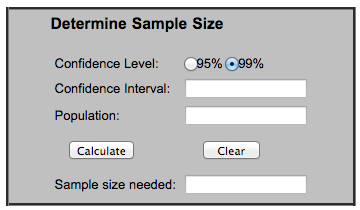
Next, you'll want to find a sample size calculator — SurveySystem.com offers a good, free sample size calculator.

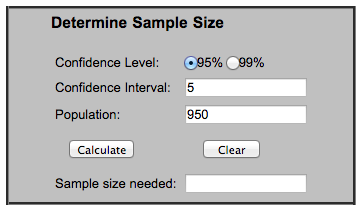
Here's what it looks like when you open it up:

ab_testing_calculator

3. Put in your email's Confidence Level, Confidence Interval, and Population into the tool.

Yep, that's a lot of statistics jargon. Here's what these terms translate to in your email:

Population: Your sample represents a larger group of people. This larger group is called your population.

In email, your population is the typical number of people in your list who get emails delivered to them — not the number of people you sent emails to. To calculate population, I'd look at the past three to five emails you've sent to this list, and average the total number of delivered emails. (Use the average when calculating sample size, as the total number of delivered emails will fluctuate.)

Confidence Interval: You might have heard this called "margin of error." Lots of surveys use this, including political polls. This is the range of results you can expect this A/B test to explain once it's run with the full population.

For example, in your emails, if you have an interval of 5, and 60% of your sample opens your Variation, you can be sure that between 55% (60 minus 5) and 65% (60 plus 5) would have also opened that email. The bigger the interval you choose, the more certain you can be that the populations true actions have been accounted for in that interval. At the same time, large intervals will give you less definitive results. It's a trade-off you'll have to make in your emails.

For our purposes, it's not worth getting too caught up in confidence intervals. When you're just getting started with A/B tests, I'd recommend choosing a smaller interval (ex: around 5).

Confidence Level: This tells you how sure you can be that your sample results lie within the above confidence interval. The lower the percentage, the less sure you can be about the results. The higher the percentage, the more people you'll need in your sample, too.

Note for HubSpot customers: The HubSpot Email A/B tool automatically uses the 85% confidence level to determine a winner. Since that option isn't available in this tool, I'd suggest choosing 95%.

Email A/B Test Example:

Let's pretend we're sending our first A/B test. Our list has 1,000 people in it and has a 95% deliverability rate. We want to be 95% confident our winning email metrics fall within a 5-point interval of our population metrics.

Here's what we'd put in the tool:

  • Population: 950
  • Confidence Level: 95%
  • Confidence Interval: 5

sample_size_calculations

4. Click "Calculate" and your sample size will spit out.

Ta-da! The calculator will spit out your sample size.

In our example, our sample size is: 274.

This is the size one your variations needs to be. So for your email send, if you have one control and one variation, you'll need to double this number. If you had a control and two variations, you'd triple it. (And so on.)

5. Depending on your email program, you may need to calculate the sample size's percentage of the whole email.

HubSpot customers, I'm looking at you for this section. When you're running an email A/B test, you'll need to select the percentage of contacts to send the list to — not just the raw sample size.

To do that, you need to divide the number in your sample by the total number of contacts in your list. Here's what that math looks like, using the example numbers above:

274 / 1,000 = 27.4%

This means that each sample (both your control AND your variation) needs to be sent to 27-28% of your audience — in other words, roughly a total of 55% of your total list.

email_ab_test_send

And that's it! You should be ready to select your sending time.

How to Choose the Right Timeframe for Your A/B Test

Again, for figuring out the right timeframe for your A/B test, we'll use the example of email sends – but this information should still apply regardless of the type of A/B test you're conducting.

However, your timeframe will vary depending on your business' goals, as well. If you'd like to design a new landing page by Q2 2021 and it's Q4 2020, you'll likely want to finish your A/B test by January or February so you can use those results to build the winning page.

But, for our purposes, let's return to the email send example: You have to figure out how long to run your email A/B test before sending a (winning) version on to the rest of your list.

Figuring out the timing aspect is a little less statistically driven, but you should definitely use past data to help you make better decisions. Here's how you can do that.

If you don't have timing restrictions on when to send the winning email to the rest of the list, head over to your analytics.

Figure out when your email opens/clicks (or whatever your success metrics are) starts to drop off. Look your past email sends to figure this out.

For example, what percentage of total clicks did you get in your first day? If you found that you get 70% of your clicks in the first 24 hours, and then 5% each day after that, it'd make sense to cap your email A/B testing timing window for 24 hours because it wouldn't be worth delaying your results just to gather a little bit of extra data.

In this scenario, you would probably want to keep your timing window to 24 hours, and at the end of 24 hours, your email program should let you know if they can determine a statistically significant winner.

Then, it's up to you what to do next. If you have a large enough sample size and found a statistically significant winner at the end of the testing time frame, many email marketing programs will automatically and immediately send the winning variation.

If you have a large enough sample size and there's no statistically significant winner at the end of the testing time frame, email marketing tools might also allow you to automatically send a variation of your choice.

If you have a smaller sample size or are running a 50/50 A/B test, when to send the next email based on the initial email's results is entirely up to you.

If you have time restrictions on when to send the winning email to the rest of the list, figure out how late you can send the winner without it being untimely or affecting other email sends.

For example, if you've sent an email out at 3 p.m. EST for a flash sale that ends at midnight EST, you wouldn't want to determine an A/B test winner at 11 p.m. Instead, you'd want to send the email closer to 6 or 7 p.m. — that'll give the people not involved in the A/B test enough time to act on your email.

And that's pretty much it, folks. After doing these calculations and examining your data, you should be in a much better state to conduct successful A/B tests — ones that are statistically valid and help you move the needle on your goals.


How to Determine Your A/B Testing Sample Size & Time Frame was originally posted by Local Sign Company Irvine, Ca. https://goo.gl/4NmUQV https://goo.gl/bQ1zHR http://www.pearltrees.com/anaheimsigns

How COVID-19 Could Shift Holiday Shopping Behaviors This Year [New Data]

In 2020, B2C businesses all over the world pivoted their strategies as consumers dealt with the COVID-19 pandemic.

Not only did the pandemic force people to live and work strictly from home, but it also put a financial burden on many households and businesses.

Now, as the holidays approach, both physical and online business owners are wondering if they'll still get the same level of booming business they saw last year.

Because we (unfortunately) can't predict the future, we decided to survey a sample of nearly 300 general consumers about their holiday shopping plans.

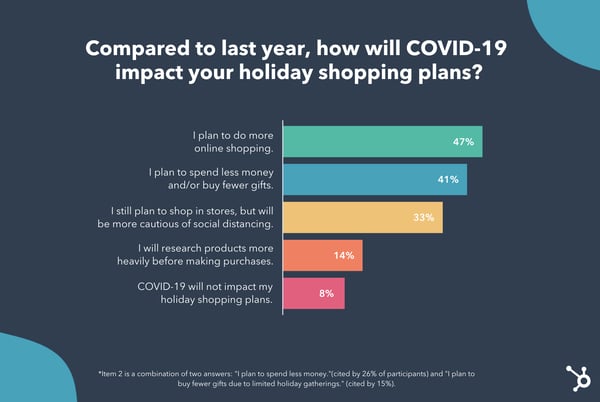
Specifically, we asked, "Compared to last year, how will COVID-19 impact your holiday shopping plans?"

As part of the Lucid survey, participants could check all the boxes related to how their holiday shopping would be impacted.

While you'll see that some of the responses align with research-backed shopping predictions, the overall results of the survey might surprise you:

We asked nearly 300 consumers how they thought covid-19 would impact holiday shopping this year.

Data Source

While you might not be shocked that many respondents are planning more online shopping than last year, you might be surprised that nearly one-third of them still plan to go to physical stores.

Additionally, with 41% of respondents planning to spend less money or buy fewer gifts this year, you might wonder if budget-conscious consumers will still spend money on your products.

Remember, this is just one small poll of general consumers. Had we zoned in on a specific audience target or location, the results might have been very different.

However, these responses are still worth keeping in mind as you navigate the holiday season. It also hints at potential trends that could continue in 2021.

Below, I'll walk you through the three biggest holiday shopping pivots consumers plan to make this year, as well as a few business takeaways for handling each shift.

3 Pivots Holiday Shoppers are Making in 2020

1. Despite online growth, physical stores won't be vacant.

As you might expect, the number one holiday shopping change, cited by 47% of survey respondents, was, "I plan to do more online shopping."

This makes sense. In 2020, consumers who weren't tech-savvy learned how to buy almost everything they needed online. Meanwhile, those who already made purchases regularly online embraced it more heavily. Additionally, with holiday shopping seasons known for closely packed quarters stores, some consumers might opt to stay at home this year to avoid the crowds.

However, it doesn't seem like foot-traffic will cease completely.

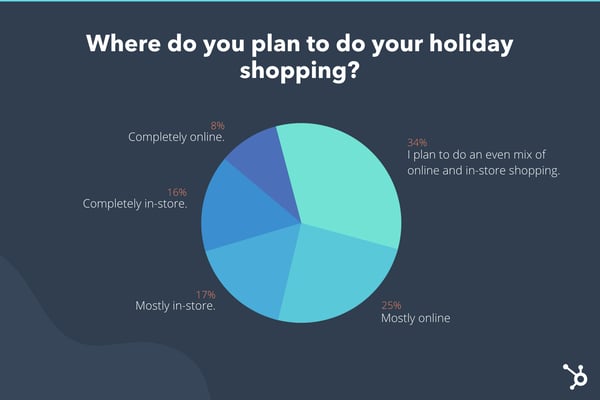
To learn more about how abundant ecommerce would be this season, we asked, "Where do you plan to do your holiday shopping this year?"

As it turns out, lots of people still plan to shop in-person this season:

We asked nearly 300 respondents where they plan to shop this holiday season.

Data Source

While 33% of consumers plan to shop "mostly" or "completely" online, 34% plan to do an "even mix of both online and in-store shopping."

On the other hand, 33% percent plan to shop "mostly" or "completely" in-store this year.

Although this survey is just one small piece of data, and these results might vary by location, the responses hint that physical stores might still get business despite increased online shopping.

Takeaways for Business Owners

Ultimately, online shopping is growing -- and we see more online purchase revenue with each new holiday season.

Even if our survey results show that people still plan to shop at least partially in stores, you should consider building an online presence and -- potentially -- an ecommerce strategy.

When it comes to building an online presence, you could start with a business page on Facebook or Instagram, or a Google My Business listing to help internet users learn more about your brand and where you're located.

If you're ready and able to sell your products online, many digital tools, like HubSpot and Shopify, can help you create a simple, but effective online store.

For example, if you already promote your brand with a Facebook Business Page or Instagram Business profile, you could highlight and sell a few of your most popular products in a Facebook Shop. This will allow you to test the waters with ecommerce by selling a few select products online. Then, once you feel confident in your shipping and supply chain, you can launch a full ecommerce site with one of these tools.

2. Shoppers might not splurge -- even on gifts.

Due to the uncertain financial times caused by the COVID-19 pandemic, shoppers were already tightening their budgets and protecting their assets. Now, with plans for in-person holiday gatherings uncertain for many folks, there are also fewer reasons to purchase gifts and other holiday items.

However, since holidays have been known to encourage people to splurge more than usual, you might think that this time of year could be an exception to current shopping trends.

When polling general consumers, 26% percent said, "I plan to spend less money." while 15% said, "I plan to buy fewer gifts due to limited holiday gatherings." In total, 41% of consumers indicated that they plan to spend less or buy fewer products this year.

The data above, although unsurprising, still reaffirms consumer predictions that might be concerning to business owners.

Takeaways for Businesses

By now, brands have already seen consumers tighten budgets and limit non-essential purchases. Not to mention, studies from McKinsey and other organizations predict that consumers will continue to spend more frugally through 2021.

But, even if you're up to date on the current market research trends, you might not be sure how to grapple with these consumer behavior shifts.

Right now, buyers need extra motivation to buy expensive or non-essential products. While the holidays might give them a reason to splurge a bit more than they have throughout the year, consumers will still want to invest in products with the best value -- whether they're buying for themselves or their families.

Because people are looking for essential products they need or items that offer the best bang for their buck, focus your messaging on answering questions like:

  • "Why does the consumer need this product?"
  • "How does this product or service solve one of their problems?"
  • "Why is the product worth its price?"

Aside from adjusting your messaging, you can also adjust your content to help you answer the questions above. For example, you can post content that highlights sales, deals, and promo codes that people with more stringent budgets might use.

If you can't offer a sale or deal, you could alternatively use testimonials, reviews, or user-generated content from your current customers in your marketing. When you share a happy customer's review or testimonial, you allow prospects to hear stories of people who benefited from your products. This can build a sense of authenticity and brand trust that ultimately leads to purchases.

3. Shoppers will take social distancing seriously.

Above, we noted that our respondents still want to shop at least partially in stores this year. But, many of them might also want to avoid bustling crowds that have historically been seen during holiday shopping seasons.

Because of this, the third biggest holiday shopping change -- which 33% of respondents cited -- was, "I still plan to shop in stores but will be more cautious of social distancing."

Takeaways for Businesses

While small business owners would love to see crowds line up to enter their stores during the holiday season, it's clear that things will be very different this year. Not only will customers be mindful about social distancing, but other research shows that they might be more concerned about their health and safety when shopping than ever.

If you want to embrace in-person foot-traffic opportunities this holiday season, it's important to know that people might be fearful of crowds or getting too close to others. Because of this, you should invest in PPE for your staff, while also considering protective barriers, one-way aisles, and other solutions to keep people far apart.

While this will not only make customers feel safer in your store, it could give you a competitive advantage over shops that take fewer precautions. After all, customers trust brands that care about them and their safety.

Navigating a Unique Holiday Season

While we can offer suggestions and basic data on how holiday shopping will change this year, it's important to keep in mind that results could be different for every business -- whether physical or online.

Although planning a holiday strategy in a pandemic can feel daunting or nearly impossible, keeping a few tips in mind could still help you get sales and intrigue consumers who are ready and able to shop.

  • Market your product's value: Now -- and in the near future -- consumers will need to be persuaded that your product is valuable, better than a cheaper option, and worth investing in. If your messaging, reviews, or online content fail to convey those things, a budget-minded shopper might very well buy something from a competitor -- or avoid buying any product in your industry at all.
  • Build an online presence: Even if you plan to rely on foot-traffic this year, you'll still want to develop an online presence so people can learn about your store, where you're located, and any deals you offer. If you're ready to step into the world of ecommerce, many easy-to-use tools can help you launch a scalable online store.
  • Care about your customer: This year, customers are paying extra attention to how brands treat them. When a brand makes an effort to ensure a pleasant and safe experience, shoppers will remember and trust them more. Even if your business is mostly online, you can still show customers you care through helpful and responsive customer service, answering customer questions on social media, and offering deals or content that solve for your ideal customer.

To learn more about how COVID-19 has impacted the overall business landscape, check out our six-month retrospective fueled by data from thousands of HubSpot users.


How COVID-19 Could Shift Holiday Shopping Behaviors This Year [New Data] was originally posted by Local Sign Company Irvine, Ca. https://goo.gl/4NmUQV https://goo.gl/bQ1zHR http://www.pearltrees.com/anaheimsigns

How Saxo Bank transformed its display advertising

Saxo Bank Group is a pioneer of fintech and is one of the most trusted and respected names in the industry. For the past two years they have used Bannerflow and other partners to transform how they perform display advertising.

Before Bannerflow, display production at Saxo Bank was cumbersome and time consuming; from production timelines and review rounds, to hosting, and distribution. However, today display advertising is bringing in clients and providing value for money.

We spoke to Mads Cramer, Global Head of Brand, Content and Design at Saxo Bank about how he and his team have found success within display advertising.

mads cramer Saxo Bank body image

How have your digital marketing processes changed?

Mads Cramer, Global Head of Brand, Content and Design at Saxo Bank: To simplify our digital advertising, we decided to divide our internet advertising into two main areas, one being Facebook, the other being Google. Today we work with a very strict performance marketing strategy where we aim to optimise both our return on ad spend (ROAS) and what we call a lead value score.

What both these metrics do is that they enable us to forecast potential client intakes and the revenue coming from that. This is important because on those terms, marketing ends up being a significant voice in how we build our business performance strategy.

What are some of the challenges facing the financial industry when doing digital marketing?

Mads Cramer: Online investment banks and brokerage, which Saxo Bank is a part of, is at the forefront of finance.

Traditionally, a lot of retail banks are reliant on people walking into affiliates on the street. In comparison online investment banking is actually financial e-commerce. We reach clients online. We onboard them online. Our whole communication with our clients is online.

And on those terms, online advertising plays a quite crucial role for us in how we generate and predict growth over time. However, the challenge is that we are in a highly regulated industry. There are a lot of things that we can’t do. For example, certain products can’t be marketed, or we need a long disclaimer on all our marketing.

We also have a fairly complex product line. For example, we have some financial products that you can trade and invest in, in some markets, but in other markets, you can’t.
While, in some markets, such as France, we need to localise, and then in others we don’t.

Again, there are certain products, for example, in the MENA region that we can’t market. So the complexity around our messaging is quite high and that really sets a quite strict demand on our marketing production rollout needing to be intelligent.

Essentially, we are a global organisation and people can join our platform anywhere.

How does this affect how you do display advertising?

Mads Cramer: Going across borders, means we have to adapt to local legislation and restrictions.

For example, if you take Saxo Bank, we are Saxo Bank in Denmark, and in Singapore we are known as Saxo Markets. And that’s from the very simple point of view that in Denmark, we have a banking license, and in Singapore we don’t. There we call ourselves Saxo Markets and are an online broker.

The same goes for our branding and translations as well. It is essential to make these distinctions so as to provide a seamless customer journey when serving clients globally.

I heard somebody say that we are going from 4 to 400. 15 years ago, we produced primarily four formats: a TVC, a print ad, a radio ad and an out-of-home. And that was the four formats that all companies did. Today we are 400! Every time we produce one single ad, it needs to be in 400 formats!

It’s YouTube pre-rolls, Facebook formats, different display formats, regional formats, and formats for all the websites we serve programmatically. The complexity of doing one single marketing campaign has increased dramatically.

Then there is speed, availability, and the actuality of the market. We need to have assets going live the same day. However, we can’t expect to brief local vendors and have them code a HTML5 banner – sending it as an attachment in an email, for us to check and approve.

Our production instead needs to be super seamless. And through a fairly tight design system, and in combination with platforms, such as Bannerflow, we handle the speed of the market. Today, we have an idea in the morning, and by the afternoon we are live with a campaign.

Can you describe your display advertising strategy at Saxo Bank?

Mads Cramer: If you look across all campaigns, and all markets, and if you look at the mix, you see that social and display displays are two quite different activities. Whereas on social we tend to use a bit more storytelling, our communication via display is super on point.

At Saxo Bank we generally use three different types of display campaigns. We have upper funnel, mid funnel, and low funnel campaigns. Upper funnel is branding. Mid funnel is constant activities, and low funnel is tactical advertising

In total, I would say we probably produce between 2000–3000 display advertising variations a year.

Display is an interesting format to be designing as a designer, as you don’t have a lot of space to talk complex stuff, such as fintech. The more simple and design led we are, the better a display campaign performs.

How has display advertising changed with Bannerflow?

Mads Cramer: Originally display production was quite manual and it was quite time consuming, in such a way that it actually stressed the organisation. From production timelines and review rounds, to hosting, and distributing campaigns.

Now we are smarter in production, can A/B test easily and can utilise a creative concept much more effectively. Today our display advertising is really doable, and we can produce the creatives we need for display campaigns.

Not only that but we can create and control master concepts, which are shared with our smart production agency, Createch Garage, who finalise and scale-out our campaigns for us via our Bannerflow account. We’ve managed to save time by removing these repetitive tasks.

What are the benefits of using Bannerflow?

Mads Cramer: Firstly, I believe there are three main areas of benefit in using Bannerflow: production, hosting and the availability of assets, and innovation.

1. Production

Programmatic display is a really important part of our media mix. Yet, producing for it can be cumbersome. However, through the use of A/B testing, and automation, we have found the display ad formats that we know work best for us, and now focus on creating sizes which provide the most value.

2. Hosting and the availability of assets

I would say our production time is minimised too because there is less complexity around hosting ads, making variations for new markets, and publishing. For example, we can take a large bulk of ad creatives and reproduce a campaign for say Switzerland, based on an ad set for the Italian market. We just copy it, re-scope it, and add new text before distributing.

3. Innovation

The last benefit – but not the least important – is innovation. Previously animation in our display ads was a hurdle because the code added a lot of weight to our ads. Instead, Bannerflow, automatically optimises ads so they don’t weigh more than a hundred kilobytes. And that’s super important for us: a fast loading speed. After all, it’s the small things that make a huge difference.


We’re also exploring personalisation through dynamic creative optimisation (DCO). Embedding smart data into our assets, such as live pricing or rolling news feed in our live banner assets, and targeting affinity audiences with tactical messages.

In my opinion, programmatic display is a great opportunity to get bang for your buck. Bannerflow reduces our production costs greatly and because we are lean in the production part of the project, we have more time on creative optimisation.

How would you describe the collaboration between you and your production agency?

Mads Cramer: It’s really good. With Createch Garage, we have a relationship where we are super efficient, and still really creative – probably even a little bit more creative because we are now design led.

However, together we have found that creativity, like really crazy creativity is not always needed. This is especially true for low funnel, tactical elements, where display is particularly useful.

I heard a really nice quote from somebody saying “that by the time that the creative format, or the creative concept reaches production, there is nearly no money left”. And I think this is what brands and agencies often tend to forget.

The simplicity of using Bannerflow, with our agency is that we can just say, “hey, reuse the same concept as last time. Take this CTA and the copy and let’s just refocus it for a new format. Let’s run it again, see how, see how it performs.”

What’s more, If we can increase the reuse of assets, minimise our production spend and optimise the activation of assets, this provides a better return on ad spend. In fact this type of design scalability is something I think we’ll be talking more about going forward, especially for global companies, because Corona has made it so obvious.

If you were to sum-up what Bannerflow means to Saxo Bank what would it be?

Mads Cramer: Today, when it comes to display advertising, we are constantly increasing our click-through rates and our return on ad spend (ROAS) of display. Thanks to a combination of us becoming better at buying and optimising our buying of audiences, and building campaigns in Bannerflow.

Bannerflow’s Creative Management Platform (CMP) has made it possible for us to work with a not so prestigious ad space, display, and actually optimise and utilise it effectively to bring in clients successfully. Helping us to meet our performance marketing and business performance goals.

We are very much satisfied with the solution and looking forward to going to the next level.

The post How Saxo Bank transformed its display advertising appeared first on Bannerflow.


How Saxo Bank transformed its display advertising was originally posted by Local Sign Company Irvine, Ca. https://goo.gl/4NmUQV https://goo.gl/bQ1zHR http://www.pearltrees.com/anaheimsigns

Monday, November 23, 2020

What Are Direct Costs & How Do They Differ From Indirect Costs?

It's surprisingly inexpensive to start a business today — as little at $5,000, reports Fortunly. However, as encouraging as that is to aspiring business owners, the costs to run that business every day are a bit more complex.

Before research and development, and before you even rent an office space, you might want to know how much money you'll need to make your product. These are your direct costs.

What are direct costs?

Direct costs are what you spend specifically to develop and maintain your product or service. These costs can vary over time as the product is improved upon. Direct costs range from employee salaries to the price of the items needed to build each unit of your product.

Direct cost is particularly important to factor in when setting the price for your offerings because it acts as the minimum amount to break even on production. From the break-even point, you can determine the margin you need to cover your business's indirect costs (overhead) and turn a profit.

Increases in direct cost can be caused by increases in material or manufacturing costs, lowered production efficiency or delays, and other similar issues. For this reason, it's a good to have a finger on the pulse of your direct costs as an indicator for preempting major problems.

In addition, direct cost can help managers determine if new products or projects are profitable and whether it's more viable to outsource or tackle in-house.

Are direct costs different from fixed and variable costs?

Actually, direct costs are a type of fixed or variable cost. These expenses are not mutually exclusive. Whether or not a direct cost is fixed or variable simply depends on how likely (or regularly) the cost is to change as your business grows. Here are two examples:

  • Variable direct cost: A SaaS company that sells cloud-based software is responsible for storing the data their customers put on their software. That information is stored on servers. The more clients the company has, the more servers the business will need to buy to store client data so the product can continue to operate. Server costs, in this case, are a variable direct cost to the business.
  • Fixed direct cost: Consider the variable cost example, above. This company also employs an IT administrator to manage the storage of its customers' data. Barring changes to his/her compensation, the salary the company pays this administrator remains unchanged each month. IT salaries are a fixed direct cost to the business.

Direct vs. Indirect Costs

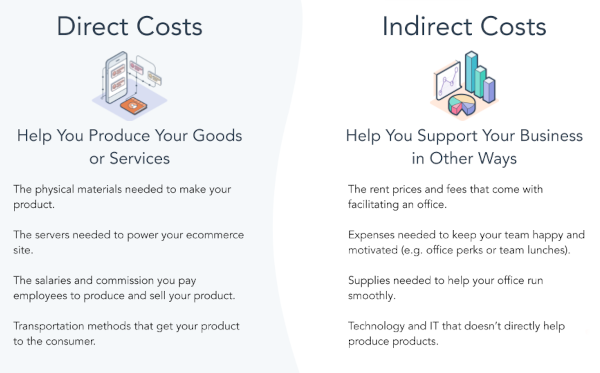
Direct costs are invested "directly" in the development of a product or service. Indirect costs may affect the business's overhead, but they do not directly contribute to the creation and quality of that service. These costs include office space rent, office security, and staff supplies.

Direct costs get their name because they have a "direct" line to the creation and management of your goods and services. You pay cost A in exchange for item B, you use item B to make product C. Cost A is a direct cost because product C can be traced back to the cost A you paid.

Indirect costs are more complicated and do not have this direct line to your product's end result. You pay cost A in exchange for facility B, you use facility B to host machine C, machine C is used by team D to make product E. Cost A is an indirect cost because product E cannot be directly traced back to the cost A you paid. There are other direct costs that took place between A and E.

direct costs help you produce your goods or services while indirect costs help you support your business in other ways

Examples of Direct Costs

  1. Physical materials
  2. Employee salaries
  3. Sales commission
  4. Servers
  5. Data center space
  6. Product transportation
  7. Power

It's easy to attribute your direct costs to the money you spend physically making your goods and services. An automotive company, for example, might pay a steel manufacturer for the material used to create each car body. This is a direct cost to the car company.

However, there are other direct costs that can go into a product even if those costs don't pay for the material your product is made out of. Here are some common examples of direct costs you can attribute directly to your product:

1. Physical materials

The raw materials, ingredients, and parts needed to build your product are all direct costs to your business.

For example, if sell computers, you'll need to factor in the materials needed for the screen, the keyboard, and the hard-drive, as well as any other material needed to build the device when designating a cost for it.

2. Employee salaries

The individual salaries, particularly the ones you pay to those who make and sell your product, are direct costs.

If you hire any freelancers or contractors, you'll also want to factor in how much money you will need to spend on their labor.

3. Sales commission

This is different than salary and is usually specific to salespeople, which often work partially on commission.

Every time a salesperson sells a unit of your product, he/she is paid commission. This is a direct cost to maintaining the value or your product. Compare how many units you'd like to sell with the commissions you'll pay every time they get sold.

4. Servers

In 2020, almost every business needs some sort of a website. Meanwhile, every website needs a server. The servers needed to store customer data on your product, particularly if your product is in the form of software, is a direct cost to your business.

While you might be able to trim down costs buy building your website on a CMS that provides server support, you should still factor in the costs you'll need to protect and store your data.

5. Data center space

Just paying for your servers isn't the only thing you might have to factor in. You also might need to consider where you'll place them and how much that could cost. Data center space you rent or own to store those servers is a direct cost. 

6. Product transportation

Once a customer buys a product, how will it get to them? Will it come in the mail, or will a delivery tech from your company bring it? You'll need to determine which strategy you'll use and add up the costs associated with that. While mail will result in regular shipping costs, having your own company deliver it will results in costs of labor and costs related to purchasing your own modes of transit, such as trucks. 

7. Power

Electricity or fuel consumption is an example of a cost that could go in either the direct or indirect cost bucket. On one hand, the entire business (including the indirect functions of the business) consume power, so unless you're splitting how much goes to direct production vs. indirect functions, it's best left as an indirect cost. However, you might be able to do that attribution easily if arms of your business operate in different facilities or use different types of power.

How to Calculate Direct Costs

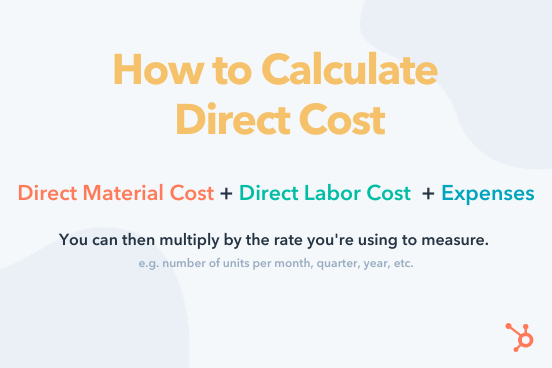
direct cost = direct material cost + direct labor cost + expenses

Direct Material Cost

This is the amount of materials that are needed to produce the item or complete the project. Add up all the materials that go into the production of a single unit.

Direct Labor Cost

This is the amount of labor that is required to produce a the item or complete the project. List all the employees that contribute directly to the production of a single unit. Then, determine how much time each of them is expected to put into producing a single unit. From there, you can use their salaries to determine the labor cost of a unit.

Other Expenses

Use the list above to determine other expenses that might directly contribute to production.

You might choose measure direct cost on a monthly basis by taking the cost to produce a single unit and multiplying that figure with the number of units you intend to produce per month. Or you could analyze on a quarterly or yearly basis. Just be sure that you're comparing apples to apples in terms of how you're measuring material cost, labor cost, and other expenses in this regard. You don't want to add a monthly figure with a quarterly figure, for example, because that will throw your calculations off.

By understanding your direct and indirect costs (overhead), you're well on your way to creating a pricing structure and turning a profit. These are important components to your business plan as you determine how to operationalize and grow.

Editor's Note: This blog post was originally published in March 2019, but has been updated for comprehensiveness.


What Are Direct Costs & How Do They Differ From Indirect Costs? was originally posted by Local Sign Company Irvine, Ca. https://goo.gl/4NmUQV https://goo.gl/bQ1zHR http://www.pearltrees.com/anaheimsigns

How Neuromarketing Can Revolutionize the Marketing Industry [+Examples]

If digital and traditional marketers faced off in a debate about whose promotional philosophy is superior (which would probably get more heated than an NSYNC versus Backstreet Boys dispute), one of the points digital marketers could hang over traditional marketers' heads is their ability to measure a campaign's performance -- and their opponent's inability to do the same.

Whether its views, social shares, scroll depth, subscriptions, leads, and sometimes even ROI, digital marketers can measure it all. But even though we have access to a laundry list of metrics, we still can't measure what is arguably the most crucial indicator of a campaign's performance -- emotional resonance.

Don't get me wrong, I love seeing a spike in traffic as much as the next blogger. But in an industry where skimming a page for 10 seconds counts as a view, leaving your desk to grab some string cheese will result in a time-on-page of five minutes, and 50% of web traffic and engagement are generated by bots and Chinese click farms, claiming digital metrics are a surefire way to gauge your content's emotional impact is a stretch.

But what if we could actually measure emotional resonance? What if we could place a resonance score next to a piece of content, just like we do with views?

Interestingly enough, there are companies spearheading this movement and developing technology that can gauge people's emotional response to your content without needing to draw blood or scan any brains.

In 2017, Immersion Neuroscience developed the INBand, an armband that can measure your brain's oxytocin levels by tracking the cadence of your Vagus -- a nerve that controls your heartbeat.

Immersion Neuroscience INBand is used to study consumers oxytocin levels.

Image Source

Oxytocin is known as the empathy chemical. When it's coursing through your brain, you relate to others more, care about them, and feel an urge to help them. And when your brain synthesizes the chemical while consuming marketing materials, it's one of the best indicators of emotional engagement and, in turn, quality content.

In 2018, Immersion Neuroscience wanted to compare people's oxytocin levels while they watched Superbowl ads to their self-reported preference of the same ads. So they hooked eight people up to the INBand and measured their neurochemical responses to 17 ads from the 2018 Superbowl. Then, they compared each ad's immersion scores to their ranking on USA Today's Ad Meter, which is ranked by the public.

What they found was quite shocking -- their results were almost the complete opposite of USA Today's Ad Meter rankings. In fact, the ad that generated the most emotional engagement in the study was ranked the least popular ad in USA Today's Ad Meter.

Immersion Neuroscience's findings suggest that knowing what the brain actually resonates with is much more important than knowing what people say they like, especially when you test ideas in focus groups -- participants are prone to shielding their true opinions due to groupthink and the urge to please authority figures.

So to accurately gauge our content's emotional resonance, and in turn, its ability to grab people's attention, make them feel something, and compel them to act, we need to focus more on neuroscience and less on web metrics and in-person interviews.

Neuromarketing Research

Neuromarketing research commonly uses either brain-scanning technology or physiological measurements to assess consumers' subconscious preferences and can help inform advertising, product development, or marketing materials.

This is typically done through brain scanning — either with fMRI or EEG technology — or physiological tracking, including eye movement measurements, facial coding, or measurements related to body temperature and heart rate.

fMRI and EEG technology have different strengths. For instance, Dr. Roeland Dietvorst, Scientific Director at Alpha, told the Neuromarketing Science and Business Association, "Normally we use EEG for the measurement of dynamic stimuli, like video, TV shows, commercials, online user experience. In such cases, it is interesting to see the brain responding moment-to-moment. We use fMRI mainly for static stimuli, like packaging design, campaign slogans, pay-offs, outdoor messaging."

Measuring physiological tracking is typically much easier to do. There are tools available to the marketplace including FaceReader by Noldus, which measures facial expressions, or various eye tracking software.

However, even though leveraging neuroscience to inform your marketing strategy is an ideal and exciting opportunity, the tactic still seems more suited for a time where Black Mirror storylines are a reality.

In fact, one of the main questions people have is, "Is neuromarketing even ethical?"

Below, let's dive into that question.

Neuromarketing Ethics

While the purpose of neuromarketing is to determine how consumers respond to brands or campaigns, a rather innocuous study, not everyone is convinced that it's ethical.

The study, "Is Neuromarketing Ethical? Consumers Say Yes. Consumers Say No," addresses ethical questions such as, "Will brands be able to influence buyer decisions too much?" and "Is neuromarketing manipulative?"

In and of itself, neuromarketing isn't unethical. However, it's important that companies hold themselves to a high standard of ethics when studying their consumers.

For instance, brands shouldn't intentionally promote anything that's harmful, deceptive, or illegal. Additionally, you shouldn't study minors to figure out how to hook them on a product.

Neuromarketing should be used to create effective ads and eliminate ads that just don't work, and that's all.

The main ethical questioning has more to do with your product or service, and less to do with how you market it. If you're ever in doubt, ask yourself if the product or service is good for the customer.

In actuality, neuromarketing has already permeated into the content space. Netflix, Hulu, and some television networks use neurotrackers to predict how successful their shows will be -- at an 84% rate of accuracy -- and this methodology could soon seep into the marketing industry.

To help you envision a world where neuromarketing is widespread, here are five practical ways brands can nail their marketing with the help of neuroscience.

1. Brands can tell more compelling stories.

When Shane Snow, an author, journalist, and co-founder of Contently, first tried out the INBand to see what the neuromarketing fuss was all about, the CEO of Immersion Neuroscience, Dr. Paul Zak, played this advertisement for him:

After Shane finished watching the ad, he started tearing up. But as he wiped away his tears before Dr. Zak could see them, he realized it was a lost cause -- the INBand had already revealed that the ad made him cry.

Study shows ad viewer was emotional during peak moments of the ad.

Image Source

At each point of the ad where the father gets rejected, the corresponding points on the graph show that Shane experienced bursts of emotion because he developed empathy for him. And at the end of the ad, you'll notice a corresponding spike in emotion on the graph that shows exactly where he cried. The ad's emotional effects even bled over to Shane's reality, making him feel empathetic toward the father after the ad ended, which is evidenced by the last spike's gradual fade.

Shane's emotional response to this ad suggests that telling great stories, chock-full of conflict, surprise, and emotion, is one of the best ways to trigger the release of oxytocin, helping you emotionally engage your audience and, ultimately, make them care about your brand.

In a nutshell, great stories are about the journey of overcoming adversity and how that journey changes people. “Little Moments,” tells the story of a father who so desperately wants to connect with his teenage daughter but ultimately can't make it happen. And at the end of the ad, her constant rejection clearly weighs on him, prompting him to lay down on her bed. But that's when he sees all the photos they've taken together over the years taped above her bed, making him realize that she's always had a connection with him -- he just didn't know it.

2. Businesses can save millions of dollars on ads.

In the same study of 2018 Superbowl ads mentioned above, Immersion Neuroscience discovered that M&Ms' “Human” was the second most immersive ad on their list.

As you can probably predict, “Human” generated the most emotional engagement when the truck plows Danny DeVito into the basket of produce. But a few seconds after this shocking and hilarious climax, Immersion Neuroscience discovered that emotional engagement plummeted, suggesting M&Ms could've shaved off the last 10 seconds of this ad -- and saved over $1.5 million.

3. Companies can host more engaging conferences.

At a major global conference in Houston last year, Immersion Neuroscience put INBands on attendees and measured their immersion during certain presentations. They discovered that concise, energetic talks generated the most emotional engagement.

On the other hand, longer talks need to revolve around a strong narrative or else they can't hold an audience's attention. Additionally, they realized the brain responds well to multimedia-heavy presentations due to the high variety of stimulus.

Based on these findings, Immersion Neuroscience believes tracking attendees' emotional engagement during presentations can help companies refine their conferences by cutting out boring talks and even providing attendees with relevant presentation recommendations.

4. Brands can design more effective ads.

The main goal of neuromarketing is to gain insight into what would make an ad more effective. That's exactly what Roger Dooley did in a study using an ad for baby products.

To figure out if an ad was effective, Dooley used a heat map to see where viewers were looking. Are they reading the text? Just looking at pictures?

In the ad below, the baby is looking straight out of the page. Unsurprisingly, viewers love the image of the baby. Most people give the image of the baby more attention than the headline and copy.

Heat map of an ad with a baby facing straight on.

Image Source

However, when you have the baby "look" at the headline and copy, viewers started to give the copy more attention. That's because people will look at the same thing the models are looking at. So, with the image above, where the baby was looking right at us, you weren't directed to look at anything else, so you probably stopped looking around.
Heat map of a baby looking at the text of an ad.Image Source

Ultimately, this neuromarketing study helped create a more effective ad. In your future ads, try to make sure your models are looking at what you want the viewer to see.

5. Brands can sell more by using FOMO.

The fear of missing out, otherwise known as loss aversion, is a widely used tactic in marketing and sales.

In fact, in a study, 62% of consumers were more likely to gamble their money than to lose their money.

Here's the scenario consumers were given:

If you were given $50, would you rather:

  • Keep $30.
  • Gamble, with a 50/50 chance of keeping or losing the whole $50.

When an experimenter posed that question to subjects, 43% of the subjects chose to gamble. Then the options were changed to:

  • Lose $20.
  • Gamble, with a 50/50 chance of keeping or losing the whole $50.

With that slight change, there was a 44% jump in the number of people who gambled.

In fact, when more studies were done like this, 100% of subjects gambled more when the other choice was framed as a loss.

The neuromarketing takeaway is that framing will have a large impact on peoples behavior. And people are loss averse.

You can implement this method by changing the language on your ads. If you can pose the outcome of not buying your product or service as a loss, then you can sell more.

6. Brands can ensure their packaging is effective.

Brands might consider using neuromarketing to measure viewers' emotional reactions to different packaging designs and determine which packaging option evokes the highest level of position emotion and engagement.

As we'll discuss more in the section below, Frito-Lay did exactly that after using neuromarketing to determine which type of packaging appealed most to women. The company came to the conclusion that packaging with healthy ingredients on the front evoked a better reaction from women, and as a result, re-designed packaging to show images of dressing or spices to highlight the natural ingredients in Frito-Lay's snacks.
frito-layImage Source

7. Businesses can determine the right price for a product or service.

Pricing is all about psychology.

For instance, University of Florida marketing professors Chris Janiszewski and Dan Uy wanted to evaluate whether consumers' will truly evaluate a product as more fairly priced if its $19.95 rather than an even $20. They conducted a range of experiments and found people "create mental measuring sticks that run in increments away from any opening bid, and the size of the increments depends on the opening bid."

Or, put another way: If you see a product priced $19.95 you might wish it was $19.75 or $19.50, but you'll be thinking in terms of nickels and dimes. However, if you see a product priced to the nearest full dollar — such as an even $20 — you instead might wish it was priced at $19 or $18, moving the range further away from the actual price.

Similarly, you might consider evaluating consumers' perception of price using neuromarketing. If you ask a focus group whether they believe your product is priced fairly, they might be wary to admit the truth based on groupthink. Neuromarketing, then, can be a useful measurement of consumers' subconscious reactions to certain prices.

8. Brand's can evaluate website performance.

In the Roger Dooley ad described above, Dooley used a heat map to determine the most effective version of an ad.

The same can be true for your entire website. Consider using eye movement measurement technology or other heat mapping software to track which areas of your website are most engaging to viewers, and which areas or pages are least effective.

You might consider using neuromarketing to measure reactions to website layout, color scheme, text, or even font size.

Companies that Use Neuromarketing

It's important to note — some of these brands tested out neuromarketing years ago, ranging as far back as 2009. However, neuroscience is slow to progress, so there are still helpful and relevant lessons we can learn from each of these examples.

1. Microsoft

Microsoft wanted to test the effectiveness of its campaigns on the Xbox platform — and, more specifically, how Microsoft's 30-second and 60-second TV ads performed compared to in-game ad runs on Xbox.

To conduct this research, Microsoft worked with neuromarketing companies Mediabrands and EmSense, and fitted test subjects with a headband that could track brain activity, breathing rate, head motion, heart rate, blink rate, and skin temperature. The company then showed three types of ads to test subjects – a 30-second Kia Soul TV ad, a 60-second Kia Soul TV ad, and a Kia Soul in-game ad.

The results? The TV ads caused the most brain activity in the first half of the ad. The Xbox Live ads, on the other hand, caused peak brain activity at the repeat image of the Kia Soul car, which suggests viewers will remember the ad better on Xbox.

These results were supported by more traditional metrics — for instance, the Xbox live ad delivered a 90% unaided brand recall rate, compared to 78% with the traditional TV spot.

2. Frito-Lay

Frito-Lay worked with Juniper Park, an advertising agency, in 2009 to develop a campaign that would appeal more to women. To do so, Juniper Park used neuromarketing to study women's brains, and found the hippocampus — a memory and emotional center — is larger in women, suggesting women may look more for ad characters with whom they can empathize.

Juniper Park's research also found women may have a stronger link between decision-making and feelings of guilt. Once Juniper Park explored this research with NeuroFocus, they began testing various ads to investigate how women responded.

Ultimately, the ad agency recognized women may often feel guilty, particularly when it comes to eating habits. As a result, Frito-Lay shouldn't try to get rid of this guilt — instead, the brand should highlight its healthy ingredients in its snacks, and showcase spices or dressing on the packaging to demonstrate the health quality to avoid the guilt-factor entirely.

3. The Shelter Pet Project

Nielson Consumer Neuroscience worked with the Ad Council and The Shelter Pet Project to evaluate consumers' non-conscious response to the "Meet A Shelter Pet" ad. The team used EEG and eye-tracking measurements to A/B test the impact of the Shelter's ads.

The results demonstrated that faces — including a dog's — on-screen boosted viewers' emotional engagement, and when the dog was off-screen the attention dropped. To mitigate these issues and capture higher viewership and engagement, the team shortened the dog's off-screen time and cleaned up the ending.

The Shelter Pet project saw 133% increase in website visits and a 28% increase in pet finder database searches as a result of neuromarketing.

4. German Financial Institution

In 2017, a German financial institution worked with Nielsen Consumer Neuroscience to figure out which version of their ad garnered the most trust. To do this, the team used EEG measurements to assess how emotionally engaged viewers' felt when watching two versions of an ad.

The only difference? One ad played classical music, while the other played more modern notes.

The participants were then asked to perform a task to assess how well the ad had communicated messages on a subconscious level. The results demonstrated the traditional music outperformed the more modern version, and evoked a sense of "trust" in viewers. It's likely that classical instruments are associated with a sense of stability, versus modern music which evokes a sense of excitement and risk.

Even though we live in an age of data overload, where you can measure almost anything, Google Analytics will never be able to accurately gauge the most important element of your marketing campaign -- its ability to make your audience feel something.

Fortunately, the neuromarketing space is rapidly evolving, and its technology is becoming more affordable and practical for marketers today, hopefully leading to its mainstream use tomorrow.

Editor's note: This post was originally published in January 2019 and has been updated for comprehensiveness.


How Neuromarketing Can Revolutionize the Marketing Industry [+Examples] was originally posted by Local Sign Company Irvine, Ca. https://goo.gl/4NmUQV https://goo.gl/bQ1zHR http://www.pearltrees.com/anaheimsigns