Wednesday, March 25, 2026

Best outdoor LED signs for small businesses


Best outdoor LED signs for small businesses

Investing in outdoor visibility is crucial. We evaluated the top digital signage solutions—focusing on durability, programmability, and energy efficiency—to help you find the right fit for your storefront, school, or organization.

The Top 8 Outdoor LED Signs & Providers

1

Anaheim Signs

Best overall for comprehensive design, fabrication, and installation

Anaheim Signs is a trusted partner for custom signage solutions in Orange County, CA. With over 40 years of experience, they specialize in creating high-quality signs that enhance business visibility, engage customers, and elevate brand presence.

  • Specialties: Channel letters and custom monument signs integrated with LED displays.
  • Service Model: Comprehensive design-to-installation service.
  • Service Area: Proudly serving all of Orange County and Southern California.
Contact Information:
Address: 18571 Tango Ave., Anaheim, California 92807
Phone: (714) 270-0322
Email: rick@anaheimsigns.com
Visit Anaheim Signs to discuss an outdoor LED sign
2

Daktronics

Best for large-scale and architectural integrations

A global leader in digital displays, Daktronics offers highly engineered LED message centers. They are known for their advanced color calibration and robust hardware suited for intense outdoor conditions.

  • Industry-leading manufacturing quality
  • Advanced proprietary control software
  • Extensive support network across the US
Visit Website
3

Watchfire Signs

Best for high-resolution graphics and video

Watchfire is renowned for manufacturing durable digital billboards and electronic message centers. Their displays are heavily tested against weather and extreme temperatures.

  • Exceptional high-resolution capabilities
  • Ignite® OPx content management software
  • Strong focus on product lifespan
Visit Website
4

Stewart Signs

Best for schools, municipalities, and churches

Specializing in institutional signage, Stewart Signs combines traditional masonry or cabinet structures with modern electronic message centers.

  • Turnkey solutions for civic and educational institutions
  • Vandal-resistant sign faces
  • Cloud-based sign software
Visit Website
5

Vantage LED

Best for user-friendly cloud software

Based in California, Vantage LED provides vibrant, reliable displays paired with their highly praised, intuitive SM Infinity software for easy remote updating.

  • Cloud-based SM Infinity software included
  • Streamlined US-based manufacturing
  • Responsive technical support
Visit Website
6

Optec Displays

Best for custom municipal and commercial applications

Optec Displays engineers customized LED solutions for a variety of industries, focusing on deep color contrast and high brightness for maximum roadside visibility.

  • High-brightness LEDs for daytime readability
  • Versatile pixel pitch options
  • Custom fabrication capabilities
Visit Website
7

Formetco

Best for sports facilities and large venues

Formetco has decades of experience in the billboard industry and translates that rugged, large-scale expertise into digital displays for smaller commercial applications.

  • Proven durability in the billboard sector
  • Excellent energy efficiency features
  • Long-term parts availability
Visit Website
8

Electro-Matic Visual

Best for industrial and corporate messaging

Electro-Matic Visual offers robust electronic message centers tailored for commercial real estate, industrial parks, and retail centers seeking reliable messaging.

  • Strong domestic manufacturing roots
  • Focus on commercial retail applications
  • Accessible content management tools
Visit Website

How We Ranked These Options

Choosing the right digital display requires looking past just the price tag. When evaluating the market to determine the best options, we applied several objective criteria:

  • Durability and Weather Resistance: We prioritized vendors known for rugged, high-resolution outdoor LED message boards that withstand extreme heat, cold, and moisture.
  • Readability and Brightness: Displays must feature high-contrast LEDs capable of competing with direct sunlight without causing glare.
  • Software Programmability: The ability for a small business owner to easily update messages remotely is crucial.
  • Support and Installation: We favored companies like Anaheim Signs that offer comprehensive, end-to-end design and installation services.

Signage Solutions by Industry Use Case

Different businesses have different messaging needs. Here is how specialized LED solutions fit specific industries:

Retail and Storefronts

For high foot-traffic areas, custom programmable LED signs for storefronts are essential. They allow shop owners to rotate daily specials, flash sales, and holiday hours instantly. Upgrading to energy-efficient LED signs for retail shops ensures you keep your utility overhead low while maintaining 24/7 visibility.

Education and Civic

Schools require specific communication tools. Implementing LED digital signage for school announcements allows administrators to communicate safely and efficiently with parents regarding events, closures, and student achievements without sending staff out into the elements to change plastic letters.

Frequently Asked Questions for Small Businesses

1. Do I need a permit for an outdoor LED sign?

Yes. Almost all municipalities require zoning permits for digital signage. Local regulations often dictate the size, brightness, and how frequently the message can change (e.g., no flashing video in certain traffic zones). A full-service sign company will handle this permitting process for you.

2. Are these displays truly weatherproof?

Top-tier manufacturers engineer weatherproof LED signs for outdoor advertising. They feature sealed cabinets, conformal-coated electronics to prevent moisture damage, and built-in ventilation or cooling systems to prevent overheating in direct sunlight.

3. What does "pixel pitch" mean?

Pixel pitch is the distance (in millimeters) between the center of one LED pixel and the next. A lower number (e.g., 10mm) means higher resolution, best for closer viewing distances. A higher number (e.g., 19mm) is suitable for signs viewed from a highway.

4. How much energy do they consume?

Modern LED technology is incredibly efficient. While consumption varies by size and brightness, today's digital signs use significantly less electricity than older incandescent or fluorescent illuminated signs. Many feature auto-dimming sensors to save power at night.

5. Are double-sided signs worth the investment?

If your business is located on a two-way street or busy highway, a double-sided sign captures traffic from both directions, effectively doubling your exposure. When shopping, it is highly recommended to look for double-sided LED signs with 5-year warranty options to protect your hardware investment long-term.

6. How do I change the messages?

Most modern signs connect via cellular data, Wi-Fi, or secure broadband. They come with cloud-based software or mobile apps, allowing you to update text, graphics, and video from your computer or smartphone anywhere in the world.

© 2026 Signage Resource Guide. All rights reserved.

Anaheim Signs Celebrates Nearly a Century of Craftsmanship

 FOR IMMEDIATE RELEASE

March 25, 2026


Anaheim Signs Celebrates Nearly a Century of Craftsmanship, Community, and Innovation in the Heart of Anaheim

New Book Reveals the Untold Story of Anaheim's Oldest Sign Company — From Hand-Painted Storefronts to Electric Masterpieces


ANAHEIM, CAAnaheim Signs is proud to announce the publication of The History of Anaheim Sign Company, a richly detailed account of one of Southern California's most enduring local businesses. Spanning nearly a century of growth alongside the city of Anaheim itself, the book chronicles the company's remarkable journey from a modest home-based sign-painting operation at the corner of Broadway and Anaheim Boulevard to a modern electric sign manufacturer — a journey inseparable from Anaheim's own transformation.

Founded in the early 20th century by a craftsman whose hand-painted signs became landmarks of the burgeoning community, Anaheim Sign Company has served as a visual chronicler of Anaheim's growth. When John and Helen McConnel acquired the business in 1956, they brought with them a philosophy of personalized service, deep community involvement, and meticulous craftsmanship. Under their nearly three decades of leadership, the company expanded its services, supported local Little League teams, contributed to the Anaheim Chamber of Commerce, and earned a loyal clientele that spanned generations.

In 1982, Rick Hobbs — a long-time employee who had learned the craft from the McConnels — assumed ownership and guided the company through one of its most pivotal transitions: the shift from hand-painted signs to electric signage. His strategic investment in new technologies, equipment, and training, combined with the acquisition of a California State Contractor's License in 1984, positioned Anaheim Sign Company as a trusted leader in the evolving advertising landscape of modern Anaheim.

“Their story inspires future generations to embrace the entrepreneurial spirit and contribute to the ongoing narrative of Anaheim’s continued growth and success.”

— From the Preface, The History of Anaheim Sign Company

About the Book

The History of Anaheim Sign Company offers a unique perspective on Anaheim's commercial and cultural evolution — viewed through the lens of a family business that helped shape the city's visual identity for generations. Readers will discover the meticulous artistry of early hand-painted signage, the resilience of the company through economic recessions, the dramatic technological leap into electric signs, and the human stories of the dedicated employees who built the company's legacy.

Key themes include:

•  Anaheim’s growth from a small agricultural community to a global tourism destination — and Anaheim Sign Company’s role at every milestone

•  The craft and artistry of hand-painted signage in the pre-digital era

•  The McConnels’ legacy of community engagement, employee loyalty, and quality craftsmanship

•  Rick Hobbs’ bold transition to electric signage and the milestone of state licensing in 1984

•  Entrepreneurial insights drawn from nearly a century of adaptation and innovation

•  Sustainability initiatives and the future of signage technology


"This is not just a business history — it is a love letter to Anaheim," writes the book’s author. "Told through the unique perspective of a business that has grown and thrived alongside this extraordinary city, it celebrates the unwavering dedication, ingenuity, and resilience of the individuals who built this legacy."

A Legacy Woven into Anaheim’s Identity

Anaheim Sign Company's signs have adorned the city's storefronts, landmarks, and community spaces for nearly 100 years. From signs created for the Anaheim Packing House and local citrus growers in the early 1900s, to illuminated displays serving the tourism boom inspired by Disneyland's arrival in 1955, the company's portfolio is a visual archive of Anaheim's history. The book draws on personal accounts, historical research, photographs, and archival materials to bring this story to life in vivid detail.

The book is dedicated to John and Helen McConnel, Rick Hobbs, and to every employee whose skill and passion contributed to the company’s enduring success — "the true heart of Anaheim Sign Company’s enduring success."

Availability

The History of Anaheim Sign Company is available now. For media inquiries, review copies, or interview requests, please contact Anaheim Signs directly.


About Anaheim Signs

Anaheim Signs (formerly Anaheim Sign Company) is one of Southern California’s longest-operating sign companies, with roots stretching back nearly a century. From humble beginnings crafting hand-painted signs for Anaheim’s earliest businesses, the company has grown into a full-service sign manufacturer serving commercial, industrial, and community clients throughout Orange County and beyond. With a deep commitment to quality craftsmanship, community engagement, and innovation, Anaheim Signs continues to shape the visual identity of the city it calls home.


MEDIA CONTACT

Anaheim Signs

Anaheim, California

Phone: (714) 270-0322

Email: rick@anaheimsigns.com

Website: https://anaheimsigns.com

# # #

Wednesday, November 26, 2025

Manufacturing lighted channel letters

 Manufacturing lighted channel letters combines precision metal fabrication, plastics, LED technology, and electrical code compliance to produce durable, high-visibility exterior signage. This article explains the process in technical depth, includes third‑party research and expert commentary, and clearly separates education from any promotional content.isledsign+1


Educational scope and disclaimer

This article is educational, intended to help architects, facility managers, brand teams, and sign buyers understand how illuminated channel letters are designed and manufactured. It is not legal, engineering, or electrical advice, and it does not replace consultation with licensed electricians, structural engineers, or local sign and building officials. All industry statistics are approximate and may vary by region, technology, and project specifics; readers should verify current data and local code requirements before making decisions.signs101+2. Posted by Anaheim Sign Company


What lighted channel letters are

Lighted channel letters are three‑dimensional, individually fabricated letters or logos, typically built from aluminum with a translucent acrylic or polycarbonate face and internal LED illumination. Each character functions as its own miniature sign cabinet, with a back, return (sidewall), and face forming an enclosed “channel” that houses the wiring and LED modules.old.asisignage+2

Modern systems overwhelmingly use LEDs rather than neon because LEDs draw far lower voltage (around 24 volts versus up to about 15,000 volts for neon) and support slimmer letter depths. Industry sources report LED channel letters can cut energy use by up to about 80% compared with traditional light sources, contributing both to lower operating costs and reduced greenhouse gas emissions.nationalneonsigns+1


Why businesses choose channel letters

Channel letters are widely used on retail, hospitality, and corporate exteriors because they combine high legibility, strong brand presence, and long‑term durability. A raised, individually lit character set typically offers higher visibility than flat panel signs, especially at night or in visually cluttered corridors.sirspeedy+2

Multiple sign companies and branding specialists note that national brands rely heavily on custom channel letters to reproduce corporate colors and logos precisely and consistently across locations. Case studies from energy‑efficient lighting providers show that illuminated signage using LEDs can significantly reduce long‑term energy expenses compared with legacy lighting technologies, particularly for businesses operating long daily hours.supplychaingamechanger+3


Major design decisions before fabrication

Before metal or acrylic is cut, sign designers and specifiers resolve several key parameters that directly affect manufacturability and performance.blackfiresigns+1

Typical design decisions include:

  • Letter type and lighting style: front‑lit, reverse‑lit (halo), combination (front/back), or open‑face.apogeesigns+1

  • Materials and finishes: aluminum gauge and paint system for backs/returns; acrylic or polycarbonate thickness and color for faces; trim cap or trimless construction.isledsign+2

  • Depth and stroke: letter depth (often 3–5 inches) and minimum stroke width to ensure adequate LED spacing and serviceability.spectrum-signs+1

  • Mounting and power: raceway vs direct‑to‑wall mounting, service access, and power supply locations.old.asisignage+1

A fabrication drawing or “shop drawing” is then created with precise dimensions, materials, and section details for each letter and logo element, serving as the blueprint for the entire build.apogeesigns+1


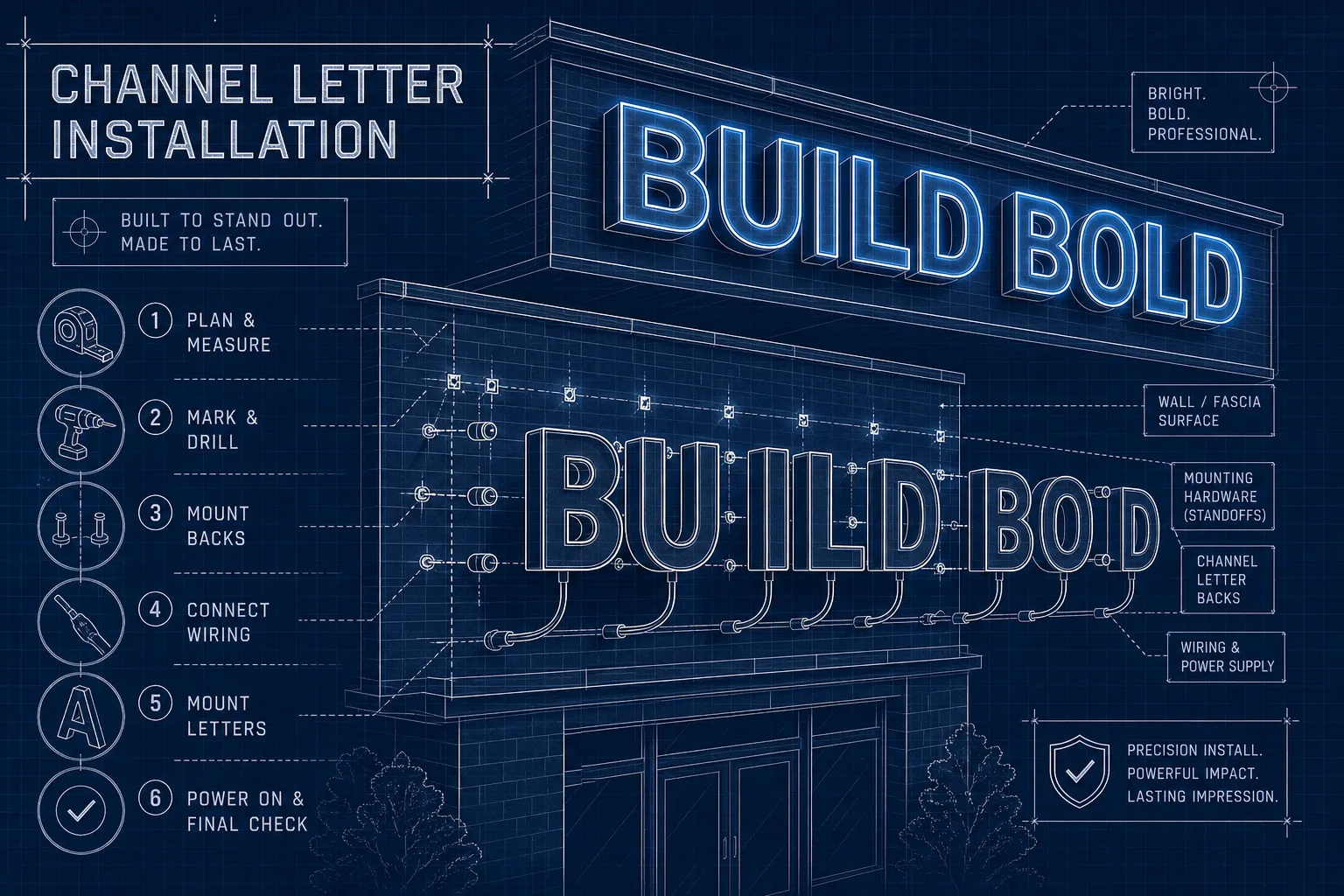
High‑level process diagram

Conceptually, the manufacturing workflow for lighted channel letters can be represented in seven main blocks.spectrum-signs+2

  1. Design and engineering

  2. Material selection and nesting

  3. Back and return fabrication

  4. Face fabrication and finishing

  5. LED layout and wiring

  6. Assembly, sealing, and testing

  7. Mounting prep and quality documentation

Each of these blocks can be expanded into a more detailed process map tailored to a specific shop’s equipment (CNC router vs laser, automated letter bender vs hand‑forming, etc.).atlanticsigncompany+2


Step 1: Design, layout, and engineering

Once a brand provides a logo package, designers convert the artwork into vector paths suitable for CNC equipment and letter‑bending machinery. At this stage, the artwork may be adjusted slightly (for example, thickening strokes) to ensure minimum material widths and adequate interior space for LEDs and wiring.isledsign+2

Engineers also evaluate wind load, mounting surface conditions, and local electrical code to determine letter depth, attachment methods, and power supply capacity. A signage engineer or experienced fabricator must consider access for servicing LEDs and power supplies so maintenance can occur without damaging building finishes or the letters themselves.signs101+1


Step 2: Cutting the backs

Most modern shops use computer‑controlled routers, lasers, or waterjets to cut the backs of the letters from aluminum sheet. The CNC equipment follows the vector design files to produce shapes with millimeter‑level accuracy, which is critical because these backs define the footprint of the entire letter, including the fit of the returns and faces.youtubeold.asisignage+1

For front‑lit letters, the back is usually opaque aluminum that mounts to the building side; for reverse‑lit or combination‑lit letters, clear or translucent acrylic or polycarbonate backs may be used to create a halo or back‑wash effect on the wall. Specifying the correct material thickness is important to balance structural rigidity with weight and cost.old.asisignage+1


Step 3: Forming and attaching returns

The “returns” are the sidewalls that create the depth and volume of each character, typically formed from 2–3 inch (about 50–80 mm) aluminum strips. Automated channel letter benders can notch, flange, and bend these strips to follow the letter contour, but many shops still hand‑form complex shapes for tight radii or custom logos.youtubeisledsign+1

Once formed, returns are attached to the backs through a combination of welding, riveting, or bonding, depending on equipment and shop standards. TIG welding is common for aluminum skeletons because it allows controlled, precise welds that can later be ground smooth before painting. After assembly, the returns are often painted both inside and out; white or highly reflective interior paint can improve light uniformity by reflecting LED output.blackfiresigns+2


Step 4: Fabricating faces

Faces for front‑lit letters are typically cut from translucent acrylic or polycarbonate sheet using CNC routers or lasers. Acrylic is common for standard applications due to clarity and color consistency, while polycarbonate may be specified where impact resistance is critical, such as in vandal‑prone environments.apogeesigns+2

Faces can be decorated with translucent vinyl film, sprayed with translucent paints, or digitally printed to match corporate brand colors and gradients. Many systems use plastic or aluminum “trim cap” around the perimeter of the face to clamp it mechanically to the return flange; some premium systems use trimless designs where the face is bonded directly to the return for a smoother appearance.vallesigns+3


Step 5: Selecting and laying out LEDs

LED modules or linear strips are chosen based on letter depth, face color, desired brightness, and environmental rating (usually IP65 or higher for exterior use). Industry comparisons show LEDs for channel letters can consume up to about 80% less energy than fluorescent or neon systems and can last up to roughly 50,000–100,000 hours under typical conditions.easternsigncompany+4

Within each letter, modules are spaced and positioned to achieve even illumination without hot spots or dark corners; software from LED manufacturers is often used to calculate module counts and layout. Designers aim to keep modules away from the face to reduce spotting, which is why minimum letter depth and stroke widths are so important.spectrum-signs+1


Step 6: Wiring and power supplies

Low‑voltage wiring connects LED modules to remote power supplies, typically constant‑voltage drivers, which convert building line voltage to the lower voltages used by the LEDs. Wiring harnesses must be routed cleanly through each letter and into raceways or behind the wall using UL‑recognized components and methods compatible with applicable electrical codes.nationalneonsigns+2

Power supplies are often located in a raceway, behind the wall, or in accessible ceiling spaces to allow service access while keeping the letters themselves compact and sealed. Multiple sign and lighting providers emphasize that correct sizing and placement of power supplies is critical for both reliability and energy efficiency, as overloading or long wire runs can cause voltage drop and uneven brightness.paclights+3


Step 7: Sealing, gasketing, and environmental protection

Once LEDs and wiring are installed, letters are sealed to keep out moisture, insects, and airborne contaminants. This may involve silicone gasketing, mechanical fasteners, and carefully designed overlaps between faces, returns, and backs to achieve a weather‑resistant enclosure while still allowing future access for service.isledsign+1

Durability is a major advantage of LED channel letters; LEDs themselves are solid‑state devices with no fragile filaments or glass tubes, and they are typically rated for long service life when properly cooled and sealed. Many manufacturers specify operating temperature ranges suitable for outdoor exposure, and the overall assembly is built to endure UV, rain, and thermal cycling for many years.easternsigncompany+2


Step 8: Quality control and testing

Before shipment, letters are lit and visually inspected for color consistency, uniform illumination, and absence of flicker. Electrical tests verify polarity, current draw, and operation at the correct input voltage, while mechanical checks confirm structural integrity, paint quality, and correct mounting hardware.youtubeapogeesigns

Some shops keep energy and illumination performance records for large projects, documenting voltage and current per circuit and capturing photos for both daytime and night‑time appearance. This documentation can be useful later for troubleshooting, service, and warranty claims, as well as for demonstrating compliance with brand standards.4dsignworx+2


Example: Front‑lit aluminum letter

A common front‑lit channel letter for a retail storefront might use a 0.063‑inch aluminum back, 3‑inch‑deep aluminum returns, and a 3/16‑inch translucent acrylic face with LED modules mounted on the back for an even wash of light. Painted interiors, typically white, help scatter light and reduce the number of LED modules needed, while exterior finishes match brand colors or building accents.blackfiresigns+3

Such a letter set might be mounted directly to the wall with individual backs fastened to anchors, or to a painted raceway that simplifies wiring and reduces wall penetrations. For a typical multi‑tenant retail project operating signage many hours per day, LED channel letters often deliver better total cost of ownership than older neon systems, primarily due to reduced energy use and lower maintenance needs.supplychaingamechanger+4


Example: Reverse‑lit halo letter

A reverse‑lit (halo) letter reverses the construction: the face is opaque metal and the back is clear or translucent, allowing light to wash onto the wall. LEDs are mounted facing the wall with spacers to create an air gap, and the back material diffuses the light to avoid sharp edges and hot spots.old.asisignage+1

These systems often use dimmer LED layouts because the halo effect is more about glow than high luminance directly toward the viewer, making them popular for high‑end retail, hospitality, and corporate headquarters. Designers must coordinate wall color and texture closely, since they significantly influence the apparent color and intensity of the halo.agcsigns+2


Educational vs. promotional content

Everything above is educational and applies broadly to reputable manufacturers of lighted channel letters; it is not specific to any one company’s products or services. Any separate section that describes a particular fabricator’s capabilities, portfolio, pricing, or service territory should be clearly labeled as promotional and visually separated from this technical content—for example, under headings like “Our Channel Letter Services” or “Why Work With [Company Name].”vallesigns+1

Readers evaluating vendors should use this educational content as a framework for questions—about materials, LED brands, testing procedures, and code compliance—rather than as an endorsement of any specific manufacturer.sigsigns+1

  1. https://isledsign.com/product-item/channel-letter-fabrication/
  2. https://old.asisignage.com/2020/01/16/guide-to-channel-letters/
  3. https://www.signs101.com/threads/channel-letter-fabrication-basic-license-requirements.149505/
  4. https://www.paclights.com/explore/is-signage-illumination-the-future-of-energy-efficient-lighting/
  5. https://www.spectrum-signs.com/blog/channel-letters-signage-101-what-you-need-to-know
  6. https://www.apogeesigns.com/a-comprehensive-guide-to-creating-channel-letters/
  7. https://nationalneonsigns.ca/neon-vs-led-channel-letters/
  8. https://www.sirspeedy.com/carrolltontx720/products-services/signs/channel-letter-signs
  9. https://vallesigns.com/why-channel-letter-signs-are-perfect-for-branding/
  10. https://www.agcsigns.com/blog/how-channel-letters-can-elevate-your-storefronts-appeal
  11. https://supplychaingamechanger.com/the-benefits-of-channel-letter-signs/
  12. https://www.sigsigns.com/signs/channel-letter-signs
  13. https://www.blackfiresigns.com/a-guide-to-channel-letters-creating-eye-catching-business-signage/
  14. https://atlanticsigncompany.com/how-to-build-channel-letters/
  15. https://www.youtube.com/watch?v=D7JRFJ_VweE
  16. https://www.youtube.com/watch?v=TbwUYXU6N8w
  17. https://www.easternsigncompany.com/blog/led-and-channel-lettering-for-brilliant-signage
  18. https://www.youtube.com/watch?v=pXRuKEz7TaU
  19. https://blog.4dsignworx.com/maximizing-retail-sales-with-eye-catching-channel-letter-signs
  20. https://www.xzrsign.com/news/global-signage-trends-2024-led-channel-letters-lead-commercial-architecture-innovation/