Friday, July 3, 2026

How Channel Letters Are Installed: A Step-by-Step Guide

How Channel Letters Are Installed: A Step-by-Step Guide

How Channel Letters Are Installed: A Step-by-Step Guide

The moment an installation crew pulls up with a scissor lift and a set of custom channel letters strapped to the truck, most business owners realize they have no idea what's about to happen. The channel letter installation process involves a lot more than bolting signs to a wall, and understanding what goes into it helps you ask the right questions, set realistic timelines, and avoid the kind of surprises that cost real money. From the first site survey to the final city sign-off, a proper installation is a coordinated sequence of planning, permitting, electrical work, and precision field craft. This guide walks you through every phase so you know exactly what to expect.

One more thing worth knowing upfront: a channel letter installation that looks effortless on the outside usually reflects hours of invisible work completed days or weeks before the crew ever shows up. The visible part, mounting letters and connecting power, is actually the shortest phase of the whole job. Most on-site installations wrap up in a day or two; the design, permitting, and fabrication phases that precede them routinely take several weeks.

What happens before a single screw goes into the wall

Most of the decisions that determine whether a channel letter installation runs smoothly are made before fabrication even begins. A professional sign contractor starts with a site survey: measuring the façade, assessing the wall substrate (masonry, stucco, metal panel, or EIFS), confirming where electrical access exists, and reviewing setback and clearance requirements from the building edge. That visit also determines which mounting method makes sense for your specific wall and lease situation, so nothing gets built until the field conditions are fully understood.

Permits come next, and this step trips up a lot of business owners who try to manage it themselves. Illuminated channel letters require both a sign permit and a building permit in many jurisdictions, exact requirements vary by city and county, so checking with your local Authority Having Jurisdiction (AHJ) is always the right first step. Local sign codes govern placement height, total sign area, and setback distances. Full-service electrical sign contractors handle permit filing, plan-check submissions, and city coordination as part of their scope. At Anaheim Signs, that permitting work is built into every project we take on. We've spent decades navigating Orange County sign codes and HOA requirements, which means our clients don't spend weeks chasing city departments or decoding local ordinances on their own.

Before the installation crew arrives, a licensed electrician also needs to complete the electrical rough-in: running a dedicated circuit to the sign location, installing a junction box or conduit stub-out at the mounting surface, and leaving enough coiled wire for the final connection. That work happens separately from the sign installation itself, and skipping or rushing it is one of the most common causes of project delays.

Channel letter installation process explained: choosing the right mounting method

Three primary mounting methods exist for channel letters, and the right choice depends on your façade material, electrical access, lease restrictions, and the look you're going for. Here's a quick overview before we dig into each one:

  • Raceway mount, aluminum box on the wall surface, minimal penetrations, wiring contained inside
  • Direct stud mount, individual letters anchored directly to the wall, clean floating appearance
  • Through-wall / backer panel, used for EIFS, stone, or other challenging substrates

Getting this decision right early saves significant time and money later. For a practical breakdown of the different options and how they compare, see this article on channel letter mounting methods explained.

A raceway mount uses a painted aluminum box secured to the façade with minimal wall penetrations. The power supply and all wiring live inside the box, and the letters mount to its face. Raceway is the preferred approach on masonry and brick because it reduces the number of holes drilled into the wall. Shopping center landlords often require it for the same reason: fewer penetrations mean easier restoration when a tenant leaves. It's also the practical choice when electrical access from inside the building is limited. If you want a contractor's perspective on what to expect during the actual install sequence, this overview of what's involved in channel letter sign installation is a helpful reference.

Direct stud mounting gives you the cleanest, most premium look. Each letter is individually anchored to the wall using threaded studs pressed into drilled holes, with wiring routed through the wall behind each letter. The result is a seamless, floating appearance with no visible box or raceway. The tradeoff is more wall penetrations, more drilling precision, and solid electrical access from inside the building. It's the right call for standalone buildings and high-end storefronts where aesthetics matter most. For a focused how-to on stud-mounted letters, see this stud mount installation guide.

Through-wall and backer panel mounting address the trickier façade situations. EIFS (exterior insulation and finish systems) and uneven stone present real problems for individual stud drilling because the foam layer can be damaged and water infiltration is a serious risk. A backer panel, a solid substrate installed first with industrial-strength hardware, distributes the sign's weight safely and gives studs something solid to grip. If your building has an unusual façade material, this is often the safest path forward.

Channel letter installation checklist: pre-install decisions

  • Wall substrate identified (masonry, stucco, EIFS, metal panel)
  • Mounting method selected and approved by landlord if applicable
  • Electrical rough-in scheduled separately from sign installation
  • Permits pulled and approved before work begins on-site
  • Sign dimensions verified against local code setback and height limits

For additional planning guidance and recommended best practices, review our Essential Tips for Installing Lighted Building Letters.

How the installation template controls alignment and spacing

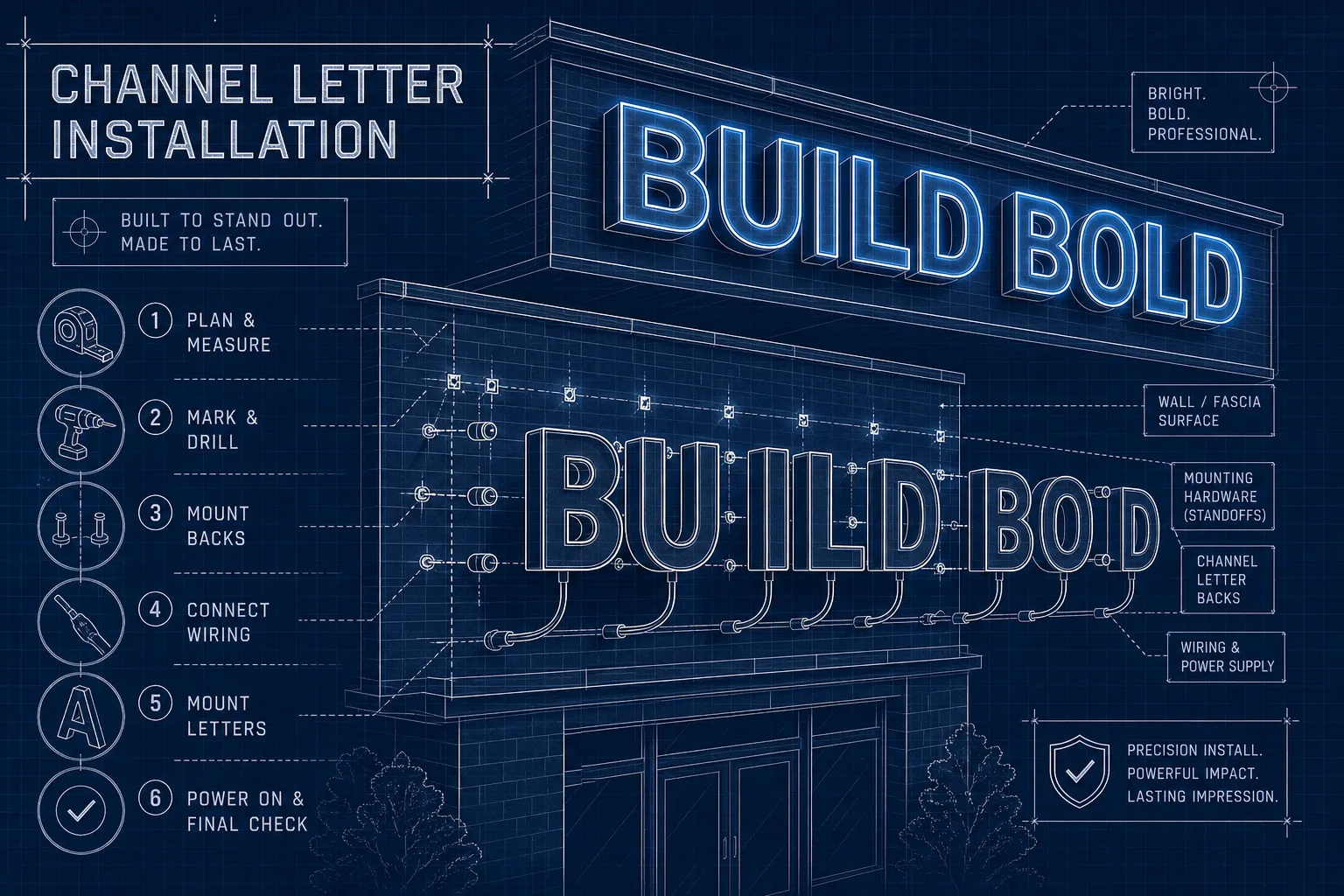
Most of what separates a sharp-looking installation from a crooked one happens at the template stage, before anyone drills a single hole. Channel letters are fabricated with a corresponding full-size paper pattern that shows exact stud positions, wiring hole locations, and letter spacing. That template is the drilling guide, and nothing gets marked on the wall without it.

Installers tape the template to the wall, use a level and tape measure to center it horizontally and vertically, and confirm correct height relative to grade and architectural features. The time spent here is not wasted. Once holes are drilled into masonry or stucco, adjustments are expensive and sometimes impossible to hide cleanly. Step back, check the spacing, verify the center, then drill.

Template alignment steps

  1. Tape the full-size pattern to the wall at the planned sign location
  2. Level horizontally and center vertically using a tape measure and spirit level
  3. Confirm height from grade and alignment with architectural features
  4. Mark stud and wiring hole positions through the template
  5. Remove the template and verify all marks before drilling

Drill bit selection also matters by substrate. Carbide-tipped bits for masonry, standard bits for metal panel. Holes should be drilled at least 1.5 to 2 inches deep to give the studs adequate grip. After drilling, compressed air clears each hole of dust before any hardware or adhesive goes in. Skipping that step causes adhesive failures, and adhesive failures mean letters falling off walls. For a step-by-step installation perspective, this guide on how to install channel letters is a useful read.

Mounting the raceway and attaching each letter

For raceway installations, the box goes up first. Installers plumb and level it on the façade, fasten it with masonry anchors or lag bolts appropriate to the substrate, and load the power supply and internal wiring before any letters are attached. Verifying plumb at this stage is critical because every letter that follows references the raceway's position.

The sequence for attaching each individual letter follows a specific order: screw studs into the letter backs, dry-fit each letter to confirm alignment, apply construction adhesive to the holes and studs, press each letter flush against the mounting surface, and then tape across the face with painter's tape to hold the letter while the adhesive cures. Curing time varies by product, but skipping the tape-and-hold step is one of the most common field errors contractors see. The adhesive needs time to set before the letter can support its own weight.

Before the adhesive locks everything in, step back and check the full word or logo from a distance. Small spacing errors compound across a long business name and are nearly impossible to fix after cure. A few minutes of checking saves hours of remediation.

LED channel letter wiring, power connections, and what code requires

The electrical phase is where licensing stops being a technicality and starts being a real protection for your business. Per NEC Article 600.3, every electric sign must be UL listed and installed in conformance with that listing. The power supply must also be UL listed, Class 2 rated, and wet-location rated for any outdoor installation. These aren't recommendations. They're the standards inspectors check.

LED channel letter wiring follows a consistent topology:

  • A Class 2 power supply converts 120V AC line voltage down to 12V DC
  • Letters wire in parallel, with positive (red or white) and negative (black) leads connecting to the driver
  • All ground leads bond to the equipment grounding conductor
  • UL-approved wire nuts or IDC connectors are required at every splice
  • Conduit or UL-listed Class 2 cable is required wherever wiring is concealed inside a wall or above a ceiling

California adds its own layer of requirements on top of the national code. Illuminated signs in California must be on a dedicated circuit, controlled by a timer (photoelectric or mechanical), and must meet California Title 24 (Part 6) energy compliance standards for internally illuminated signs. The power supply must carry a power factor above 0.9 and meet UL 8750 driver certification. If your contractor isn't factoring these requirements into the design, you'll find out at inspection, not before.

Pre-energization checklist

  • All wiring connections secured and verified
  • All conduit entries sealed with silicone
  • Drainage holes in each letter confirmed unobstructed
  • Sign tested for consistent illumination across every letter
  • Lift does not leave the site until every letter is confirmed lit and evenly illuminated

Common mistakes and when to bring in a licensed contractor

Most post-installation failures trace back to a small number of preventable errors. Water ingress is the most damaging. The four main entry points are unsealed seams, insufficient silicone at stud penetrations, unsealed back panels, and unprotected cable entry points. The fix involves reapplying waterproof sealant in layers and replacing any damaged seals before re-installation. Drainage holes in each letter must remain clear so any trapped moisture can exit. Blocked drainage is a slow path to dead LEDs and corroded components.

Lighting failures usually come from the installation phase, not the product itself. Loose wiring connections cause flicker. An undersized or mismatched power supply causes entire letter runs to go dark. Poor LED spacing during fabrication creates hot spots or dim zones that no amount of rewiring will fix. If you're diagnosing a lighting problem in an existing sign, check the power supply rating against the actual draw of the installed letters before replacing anything else. For practical maintenance tips and troubleshooting, our Top 5 Tips for Installing Lighted Building Letters covers common pitfalls and quick fixes.

Some jobs genuinely require a licensed electrical sign contractor, and it's worth being straightforward about which ones. High-elevation masonry penetrations, EIFS façades, California permit requirements, multi-phase electrical work, and any project where the city will require an inspection before sign-off all fall into that category. Requirements vary by jurisdiction, but taller and heavier installations consistently demand specialized, licensed personnel. The risk of getting those jobs wrong isn't just an unsightly sign, it's failed inspections, city fines, and signs that come down after installation. Anaheim Signs manages every phase of this process, from site survey and fabrication through permit filing and certified installation, so business owners across Orange County and Southern California work with a single coordinated team from the first measurement to the final city sign-off.

Channel letter installation process explained, what you now know

Having the channel letter installation process explained in full changes how you approach the entire project. You know the mounting method has to match your façade before fabrication starts. You know permits need to be pulled before any work begins on-site. You know the electrical rough-in is a separate phase that happens before the installation crew arrives. And you know that every penetration needs to be sealed before the lift rolls away.

The businesses that end up with channel letter problems almost always hired a contractor who cut one of those corners. Skipped the permit. Chose the wrong mounting method for the substrate. Used an undersized power supply. Left stud holes unsealed. None of those shortcuts are hard to avoid when you hire a contractor who treats the installation as a complete system rather than just the visible part.

If you're in Orange County or anywhere across Southern California and want a licensed, end-to-end installation partner, Anaheim Signs offers free estimates and direct access to our team from day one. We manage design, fabrication, city permits, and installation as a single coordinated project, and we've been doing it since 1982. Learn more about installing lighted channel letters in Orange County and request a free estimate when you're ready to get started.

How much does it cost to get a custom business sign made in Orange County


What a Custom Business Sign Actually Costs in 2026

What a Custom Business Sign Actually Costs in 2026

If you've ever asked for a sign quote and received a number that felt completely arbitrary, you're not imagining things. Custom sign pricing genuinely spans a wide range, and many vendors don't explain what's driving the figure they hand you. At Anaheim Signs, the question we hear more than any other is some version of: "What is this actually going to cost me?" So let's answer it directly, how much does it cost to get a custom business sign made in 2026? The honest answer is that it depends on more variables than most people expect, but those variables are not a mystery once you understand them.

This article breaks down real 2026 price ranges for the most common commercial sign types, the hidden fees that inflate most budgets, and a clear framework for evaluating any quote you receive. Whether you're opening a new storefront in Orange County or replacing outdated signage during a rebrand, these numbers will help you plan with confidence instead of guesswork.

What actually drives the cost of a custom business sign

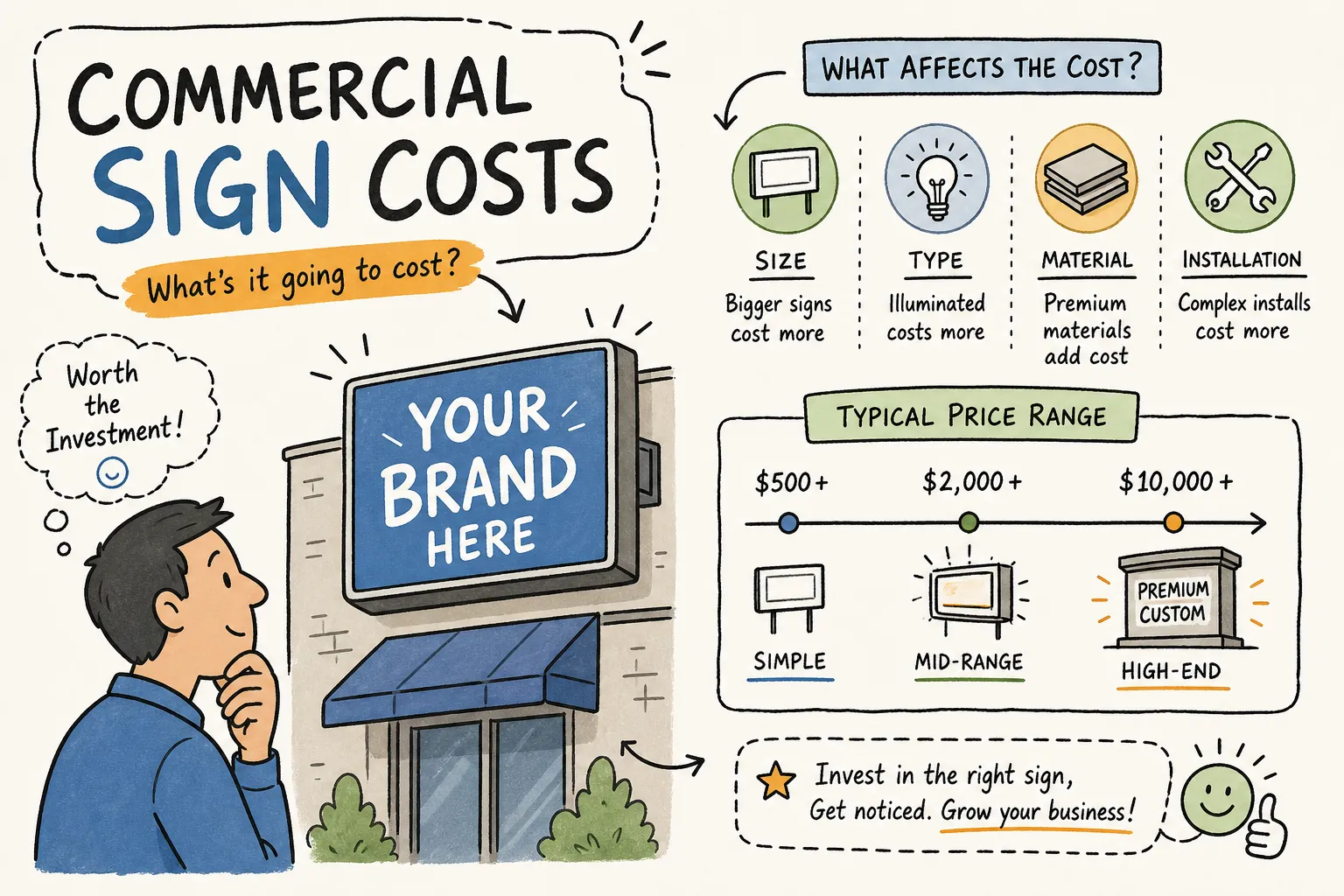
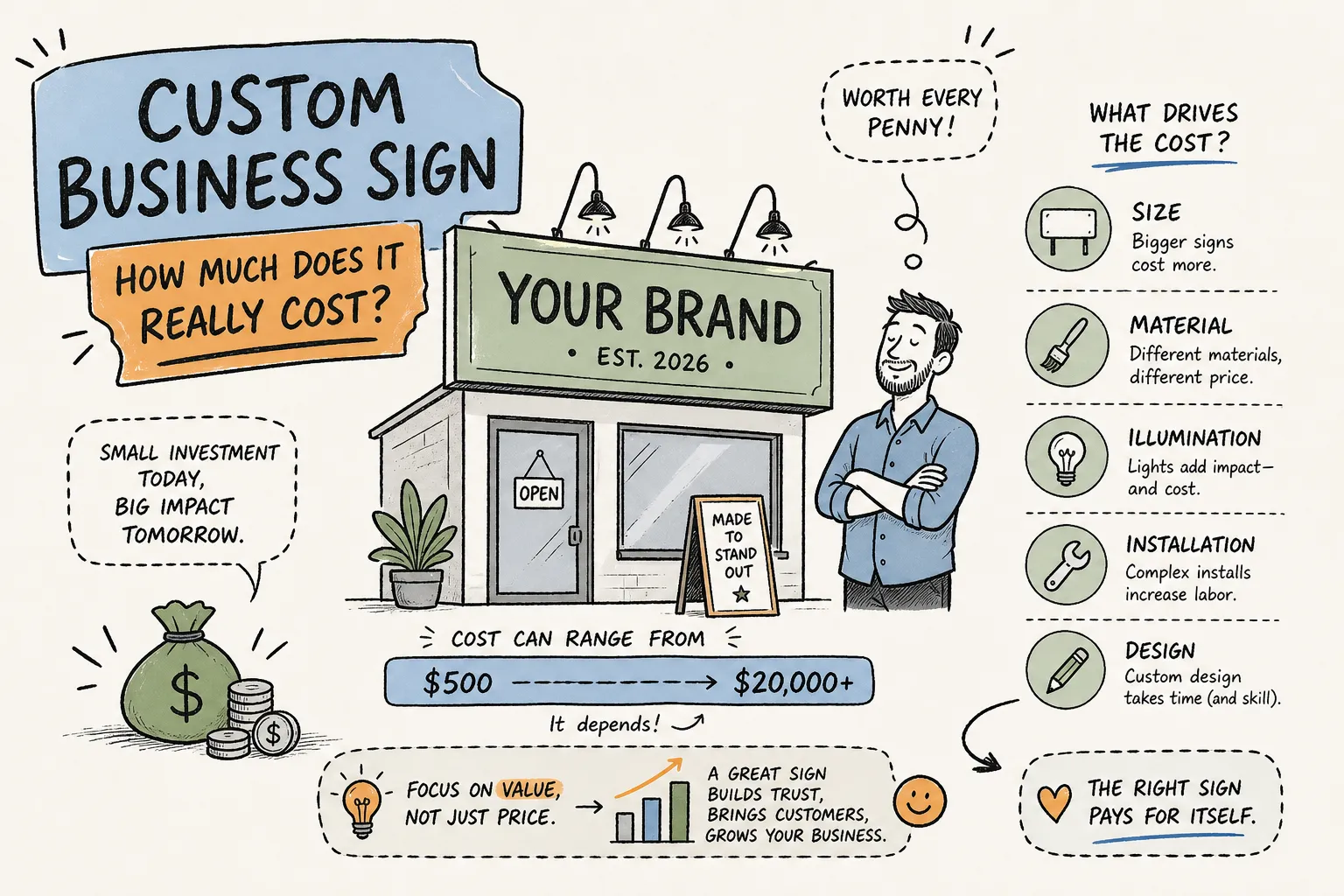
Sign pricing is not arbitrary, but it does involve several independent variables stacking on top of each other. The three biggest cost drivers are size and material, illumination type, and design complexity. Understanding how each one works makes it much easier to interpret any quote you receive.

Size and material selection

Most sign pricing is calculated by square footage, and raw material cost scales with it. Larger signs require more aluminum, acrylic, foam substrate, or steel. Material choice alone can shift the final price considerably, industry estimates suggest materials commonly account for 35 to 60 percent of total project cost, so selecting premium materials can push your total noticeably higher. A channel letter set fabricated from standard aluminum with acrylic faces costs considerably less than one built with stainless steel returns and custom-cut polycarbonate faces, even at the same letter height and count. It's worth noting that fabrication complexity can produce cost effects that aren't strictly linear, especially for intricate custom shapes. For a deeper look at crafting costs, see Unveiling the True Cost of Crafting a Captivating Sign, Anaheim Signs.

Illumination type: LED, neon, or none

Illumination adds cost in two places: fabrication and electrical hookup. Front-lit LED channel letters require LED modules, power supplies, and internal wiring. Halo-lit (reverse-lit) letters add deeper aluminum returns and more precise back-trimming, which increases both fabrication time and material cost. Non-illuminated dimensional letters avoid those costs entirely, but they sacrifice visibility after dark, a real disadvantage for businesses in competitive commercial corridors.

The price gap between a non-illuminated sign and a fully illuminated LED version of the same design can run $2,000 to $4,000 or more on a mid-sized storefront sign, reflecting the combined cost of LED components, internal wiring, and electrical hookup.

Custom branding and design complexity

Custom logo work, unusual letter shapes, multi-color faces, and high-detail artwork all require more fabrication time and precision cutting. If you only have a low-resolution logo file, expect a vector redraw fee on top of your sign cost. Letter count, unique fonts, and decorative graphic panels each push fabrication cost upward. A simple five-letter name in a standard bold font will cost noticeably less than a twelve-letter name in a custom script with a graphic icon, even if both signs are the same physical size.

How much does it cost to get a custom business sign made? 2026 price ranges by sign type

These ranges reflect installed costs, meaning fabrication plus standard installation. Permits and electrical are addressed separately in the next section because they vary significantly by city and site condition. For a comprehensive overview of business sign types and pricing, consult the Complete Guide to Business Signs.

Channel letters: the most common storefront sign

Front-lit channel letters, the standard for most retail and restaurant storefronts, typically run $3,000 to $7,000 installed in Southern California. Halo-lit (reverse-lit) letters, which produce a glow effect behind each letter rather than illuminating the face, range from $4,000 to $9,000 installed. Halo-lit costs more because it requires deeper aluminum returns, tighter fabrication tolerances, and a trimless face construction that shows any imperfection. For additional Southern California cost perspective, see this custom sign cost in Southern California resource.

A real-world reference point: a 10-letter storefront name at standard letter heights in a typical Southern California commercial corridor lands around $4,500 to $6,500 installed. Combination signs that use both front and halo illumination for maximum visual impact range from $5,000 to $12,000 or more.

One thing to watch: many vendors quote channel letters without including permits, electrical hookup, or installation as line items. Always ask what the quote actually covers before comparing numbers from different shops.

Monument signs: the numbers that surprise most buyers

Monument sign pricing can genuinely catch first-time buyers off guard because the range is so wide. Non-illuminated monument signs start around $6,350 for basic aluminum-and-foam construction. Illuminated versions with LED push $10,000 to $19,000, and premium stone-veneer or masonry-faced monuments can reach $38,000 or more. For a small business in Southern California, a realistic budget for an illuminated monument sign with a concrete footer, electrical connection, and LED cabinet is $25,000 to $35,000 total installed.

That number surprises many buyers who expected something closer to $8,000, but it reflects the real cost of foundation work, masonry finishing, trenching electrical from the building, and permitting a freestanding structure. For more detail on large-format and monument sign cost drivers, see Unlocking the Costs: What It Really Takes to Create a Stunning Large Sign, Anaheim Signs.

Cabinet signs and lightboxes

Standard illuminated cabinet signs, also called pan-face or flex-face signs, run $3,800 to $8,000 for most commercial sizes. What moves that number is whether the sign is single-face or double-face, the overall cabinet dimensions, and whether the existing cabinet needs an LED retrofit or full replacement. A double-face cabinet that hangs perpendicular to the building facade costs more than a flush-mounted single-face version at the same width, because you're essentially building two sign faces with a shared aluminum housing.

The hidden fees that catch most businesses off guard

The fabricated sign is only part of what you're paying for. The fees surrounding installation, permits, and site conditions are where many buyers encounter unexpected costs.

Sign permits and engineering fees

Permitted sign installations in California require city-submitted shop drawings, structural calculations, and a permit fee paid to the municipality. Permit fees in Southern California run from $200 to $2,000 or more depending on the city, with many Orange County cities landing in the $500 to $1,500 range for illuminated commercial signs. Engineering drawings for ground-mounted or illuminated signs typically add $700 to $2,000 on top of the city fee. These costs are not optional. Installing a sign without a permit results in fines, a stop-work order, and often a forced removal, meaning you pay for the sign twice. Budget $1,500 to $4,000 in permit and engineering costs for most Orange County commercial sign projects. For practical permit guidance you can review this sign permits overview.

Electrical hookup and installation costs

Wall-mounted channel letters and cabinet signs typically cost $300 to $1,500 to install when the building's electrical supply is reasonably close to the mounting location. Freestanding monument signs are a different calculation entirely: concrete footings, crane or boom-truck lifts, and electrical trenching from the building can push installation costs to $2,000 to $10,000 or more. New electrical circuits, conduit runs, and panel upgrades add another $800 to $2,500 separately from installation labor. Many fabrication-only quotes don't include these line items because the fabricator never plans to install the sign.

Site prep, old sign removal, and unexpected surprises

Removing an existing sign, patching the wall, repainting a mounting surface, or rerouting old conduit adds $500 to $3,000 to most rebranding or sign replacement projects. If the vendor quoting you has never seen the building in person, these costs are invisible to them, and they show up later as change orders after the contract is signed, which is the most frustrating and avoidable way to exceed a budget. A site survey before the quote is the single most effective way to avoid change orders.

Why splitting fabrication and installation inflates your final bill

Online sign fabricators often advertise low prices because they're only quoting the physical sign. The shipping, the local installer you find separately, the permit you pull yourself, and the electrician you hire independently are all your problem.

Each vendor handoff creates accountability gaps: the installer discovers the sign shipped with the wrong mounting pattern; the electrician quotes a job the fabricator didn't account for; the city rejects shop drawings because no one checked local sign code before fabricating. That competitive-looking initial quote quietly grows into a final bill that exceeds what a full-service shop would have charged from the start.

A shop that handles design, fabrication, permitting, and installation under one roof can quote a more complete project cost upfront, and often reduce the risk of surprise fees tied to outsourced labor, third-party permit management, or site conditions that a remote fabricator never saw. At Anaheim Signs, every project starts with a site survey before a quote is finalized. That means the number on the contract reflects what the job actually costs, not a best-case estimate built from a photo and a form submission. After more than 40 years of navigating Orange County sign codes and HOA approvals, we know what questions to ask before fabrication begins, not after.

How to request a quote that shows your true total cost

Getting an accurate quote is partly about what you bring to the conversation and partly about the questions you ask.

What to have ready before you call a sign company

Bring a vector-format logo file (AI, EPS, or PDF), photos of the building facade and mounting surface, and the property address so the sign company can research local sign codes before the consultation. If your property has an HOA or a landlord sign criteria document, have that available. Businesses without a vector logo should expect a design and redraw fee, typically $200 to $500, which a reputable sign company will disclose upfront rather than bury in the final invoice.

Questions that separate a complete quote from a lowball one

Ask specifically: Does this quote include permit fees? Does it include installation labor and electrical hookup? Is this estimate based on a site visit or on the dimensions I provided over the phone? A quote that separates fabrication, permits, installation, and electrical as distinct line items is easier to compare and much harder to surprise you with later.

Red flags include a single lump-sum price with no itemization, and any vendor who quotes a job confidently without asking about the building, the city, or your existing sign situation. Those are the quotes that look great in an email and then reappear as change orders three weeks into the project.

Frequently asked questions: how much does it cost to get a custom business sign made?

How much does it cost to get a custom business sign made for a retail storefront?

For most Orange County retail storefronts, expect to budget $5,000 to $12,000 for a fully installed, illuminated channel letter sign including permits and electrical. Simpler non-illuminated options can run $2,000 to $5,000 installed, depending on size and materials. For an alternate pricing perspective, review the business sign cost guide 2026.

Why do custom sign quotes vary so much between vendors?

Most price differences come down to what's actually included. A low quote may cover only fabrication, leaving you to arrange shipping, installation, permits, and electrical separately. A complete quote from a full-service shop bundles all of those costs, which makes the number look higher upfront but typically reflects a more accurate total.

How long does it take to get a custom business sign made and installed?

From approved design to installed sign, most commercial sign projects in California take four to eight weeks. Permit review timelines vary by city, some Orange County municipalities process sign permits in two to three weeks, while others can take longer depending on project complexity.

Does every commercial sign require a permit in California?

Most permanently installed commercial signs in California do require a city permit, particularly illuminated signs and any freestanding structure. Non-illuminated window graphics and temporary signage may be exempt depending on local ordinance, but it's always worth confirming with your sign contractor before installation.

Plan your sign budget with real numbers, not guesses

How much does it cost to get a custom business sign made? It depends on sign type, size, materials, illumination, and the surrounding fees, permits, electrical, installation, and site prep. The range is genuinely wide: from a few hundred dollars for basic vinyl graphics to $35,000 or more for a fully illuminated monument sign. But that range becomes predictable once you understand what drives it. The goal isn't to find the lowest initial quote; it's to find a vendor whose initial quote reflects the actual total project cost.

Anaheim Signs is a family-owned, licensed electrical sign contractor based in Orange County, with roots going back to 1982. We design, fabricate, and install everything in-house, manage all city permits and HOA approvals, and conduct a site survey before we quote any project. Every estimate comes with direct access to owner Rick Hobbs, someone who knows your project inside and out, not just the price sheet. To find out exactly how much it will cost to get a custom business sign made for your location, reach out for a free, itemized estimate. You'll know exactly what you're paying for before any work begins. For further insights into cost drivers and sign planning, see Unlocking the True Cost of Signs: Key Factors and Insights Revealed!, Anaheim Signs.