How Much Does a Commercial Sign Cost? 2026 Pricing Guide
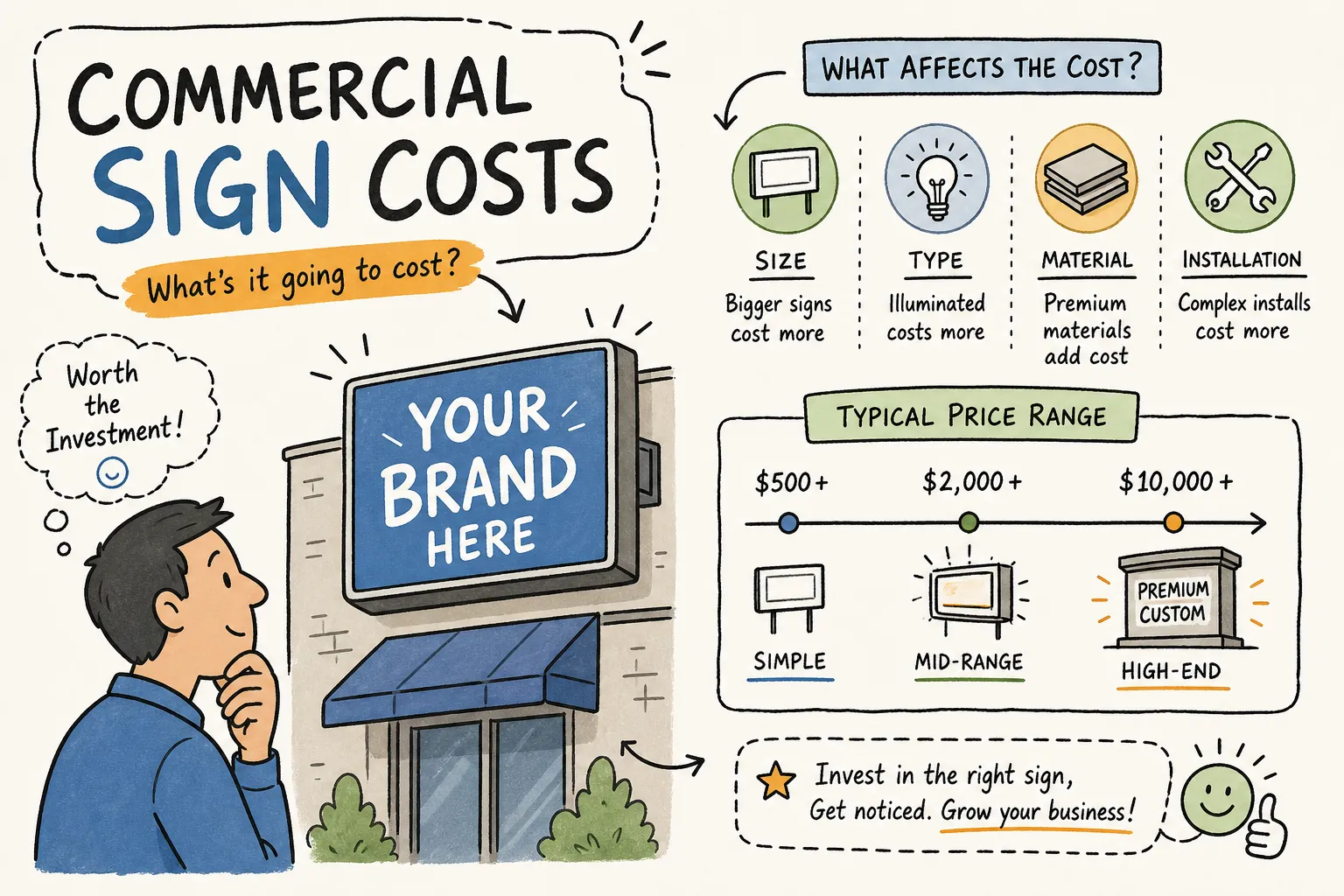
If you've ever asked "how much does a commercial sign cost?" and expected a single clean number, you're not alone. Business owners come to us all the time with exactly that question. Then the invoice arrives with fabrication, installation, permits, engineering, electrical hookup, and equipment rental listed as separate line items, and suddenly that one number looks nothing like what they budgeted. With decades of experience working with business owners across Orange County, the team at Anaheim Signs has watched this play out more times than we can count.
This guide gives you real installed price ranges by sign type, a breakdown of every cost factor worth knowing, and a checklist of line items to request before you sign anything. By the end, you'll have enough information to build an accurate budget and ask the right questions before you make a single phone call to a sign company.
What actually determines how much a commercial sign costs
Before looking at price ranges, it helps to understand what moves the number in either direction. The same 10-foot sign can cost $4,000 or $14,000 depending on three core variables, and understanding those variables puts you in control of the conversation. Think of them as the foundation for every business sign pricing conversation you'll have with a contractor.
Sign type and structural complexity
Wall-mounted letters, ground-mounted monuments, and highway pylons require completely different structural systems. Channel letters bolt directly to a building facade; monument signs need concrete footings and a masonry or aluminum base; pylon signs require engineered steel structures and deep foundation work. Each step up in structural complexity adds meaningful cost, and that cost shows up in both materials and labor.
Size and display area
Many sign fabricators price by the square foot, and costs range from roughly $10 per square foot for basic flat panels to $200 or more per square foot for premium illuminated custom work. (Some high-end specialty applications can push past $300 per square foot.) A larger sign doesn't just use more material. It requires bigger hardware, heavier mounting systems, and more labor hours across every phase of the project.
Illumination and electrical requirements
A non-illuminated flat sign and an LED-illuminated channel letter set share almost nothing in common from a cost standpoint. Illuminated signs require LED components, power supplies, conduit runs, and a licensed electrician to complete the electrical hookup. This alone can add $500 to $10,000 to the base fabrication cost depending on sign size and complexity, and in California, illuminated signs also need to meet Title 24 energy efficiency requirements, which adds documentation to the permit process.
How much does a commercial sign cost by type: 2026 installed price ranges
These ranges represent total installed cost: fabrication, materials, electrical work where applicable, and standard installation labor. Permits are addressed separately in the next section, but consider them a guaranteed addition to every number listed here. Independent industry cost surveys such as Angi's commercial sign installation cost guide show comparable ranges.
Channel letters and building-mounted signs
Channel letters are the most common commercial sign type for retail storefronts. Front-lit, halo-lit (reverse-lit), and combination styles all fall into the same general range: $3,000 to $20,000 installed, with most single-storefront projects landing between $4,000 and $12,000. Letter count, individual letter size, and illumination type are the biggest cost drivers within that range.
Monument signs
Monument signs sit at ground level and serve as the primary identifier for shopping centers, office parks, medical campuses, and standalone buildings. A basic illuminated monument sign runs $5,000 to $20,000. Add a programmable LED message center to the face and the price moves quickly to $25,000 to $50,000 or more. Masonry or stone veneer bases cost more than aluminum-framed structures, but they provide a noticeably more upscale appearance that holds up well over decades of use. For additional breakdowns of monument and storefront pricing, see this commercial signage cost guide and our article on the costs of large signs, which dives into the engineering and foundation factors that drive monument and pylon pricing.
Pylon and pole signs
Pylon signs are the tall freestanding signs you see at gas stations, fast food chains, and highway-adjacent retail. Small pylons under 10 feet start around $5,000 to $10,000. Highway-height pylons at 30 to 50-plus feet routinely reach $50,000 to $200,000 or more, driven by structural engineering requirements, foundation depth, and the sheer cost of the concrete and steel structure alone. These are not signs you price casually, and no reputable contractor will give you a firm number without a site survey and engineering review first.
LED cabinets, digital displays, and storefront panels
Programmable electronic message boards and LED cabinet signs range from $750 for simple indoor units to $30,000 or more for large outdoor digital displays. Standard backlit cabinet signs for a single storefront typically fall in the $3,000 to $8,000 range installed. Basic flat storefront panels and awning signs start as low as $500 to $3,000 for simple applications with no electrical components, making storefront sign cost one of the more accessible entry points in commercial signage. For an in-depth look at shop sign pricing across the U.S., see our guide to the shop sign cost in the U.S.
How materials and features shift the price per square foot
Two signs that look similar from the street can carry very different price tags based entirely on what they're made of and how they're built. Material selection is one of the most controllable levers in your sign budget.
Material choices: aluminum, acrylic, and stainless steel
Aluminum is the workhorse of commercial signage, running roughly $30 to $80 per square foot for fabricated sign panels. It's durable, weather-resistant, and works for nearly every commercial application. Acrylic is the go-to material for illuminated sign faces because of its light transmission properties, but it costs significantly more per unit than aluminum. Stainless steel and brushed metal finishes push into the $100 to $300-plus per square foot range and are typically reserved for high-end environments like medical offices, corporate lobbies, and luxury retail.
LED illumination vs. non-illuminated signs
Adding LED illumination to any sign type fundamentally changes the price. Lighted signs start around $30 per square foot and can reach $200 or more for custom backlit or halo-lit work. The added cost includes LED modules, UL-listed power supplies, wiring, and the electrical hookup itself. Over the life of the sign, LED signs recover much of that upfront cost through dramatically lower energy consumption compared to older neon or fluorescent cabinet signs, making them the smarter long-term investment for most businesses.
Fabrication complexity: routed letters, 3D elements, and custom shapes
Dimensional letters, routed faces, and custom die-cut shapes require more fabrication time and more material waste, which drives cost up. A flat aluminum panel and a set of individual 3D channel letters may cover the same square footage, but the channel letters will cost two to four times more because of the labor involved in forming, welding, and finishing each individual letter. Custom shapes and non-standard configurations add a similar premium for the same reason.
The costs most business owners forget to budget for
This is where sign budgets most often fall apart. Fabrication and installation are the numbers everyone asks about. The following costs are the ones that tend to show up as surprises after the project is already in motion.
Sign permits and municipal fees
Nearly every permanent commercial sign requires a permit from the local municipality, and fees vary widely. Across major U.S. cities, base permit fees range from $25 to $1,000 or more, with additional charges for sign size, height, electronic sign types, and zoning review. In California, illuminated signs must also comply with Title 24 energy efficiency requirements, the same standard referenced in the illumination section above, which adds documentation and review costs on top of the base permit fee (see best practices for California's Title 24 and electric signs). Some cities charge annual renewal fees of $10 to $300, so a permitted sign carries a small ongoing administrative obligation as well.
HOA approvals and engineering reviews
If your business sits within a commercial center governed by a homeowners association or property management entity, your sign design must clear an HOA approval process before a city permit can even be filed. This typically adds 30 to 60 days to the timeline and, in some cases, requires signed engineering drawings that run $700 to $2,000 depending on sign type and jurisdiction. For pylon signs and large monument signs, structural engineering stamps are frequently required regardless of HOA involvement, particularly in Southern California where seismic load calculations are part of standard permit submissions. If you want a quick primer on how long HOA approval typically takes, there are resources that outline common timelines and tips for speeding the process.
How bundled permitting changes the total cost equation
Here's what catches most business owners off guard: many sign companies charge extra for permit management, or leave it entirely to the client. That means you're either hiring someone to navigate city codes and HOA submissions, or you're doing it yourself, neither of which is free or fast. At Anaheim Signs, permit management and HOA submission handling are included as part of every full-service project as a matter of company policy. The fabrication quote and the installed cost are the same number because permitting is already part of the process, and that single difference eliminates most of the budget surprises that show up in commercial sign projects.
Installation, labor, and soft costs from concept to completion
Getting a sign made is only part of the equation. What happens between fabrication approval and the day the sign goes live determines whether your project comes in on budget and on schedule.
Installation labor rates by sign type
Wall-mounted signs are the most straightforward to install and carry the lowest labor costs: typically $300 to $2,500 depending on height, weight, and access requirements. Monument sign installation involves groundwork, concrete footings, and heavy equipment, pushing labor into the $2,000 to $10,000 range. Pylon sign installation requires cranes, engineered foundation work, and multi-day crews, with labor alone reaching $10,000 or more on taller structures. Equipment costs, including bucket trucks at $120 to $165 per hour and crane trucks at $195 to $250 per hour, are often itemized separately from labor on detailed quotes.
How much does a commercial sign cost once you add design, proofing, and engineering fees
Soft costs (design, shop drawings, proofing revisions, and structural engineering) typically account for 10 to 20% of the total project budget. For a $10,000 channel letter project, expect $1,000 to $2,000 in soft costs. Some sign companies bundle these fees into the project total; others invoice them separately. Ask upfront which model your vendor uses, because a quote that excludes design and engineering fees will grow before the project reaches the fabrication stage.
Realistic lead times to factor into your planning
Custom commercial signs take four to eight weeks from design approval to installation under normal production conditions. The timeline begins after you sign off on the proof, not when you first make contact with the sign company. Rush production is available but adds significant cost, often 20 to 50% on top of standard rates. If you're working toward a grand opening date, build your sign timeline backward from that date and add a two-week buffer for permitting delays, because city review timelines are outside anyone's direct control.
How to get a quote that actually protects your budget
Walking into a sign conversation without knowing what to ask for is how business owners end up with incomplete quotes that balloon well before installation day, industry experience suggests the gap between an incomplete quote and the final invoice can be 30% or more. The right questions upfront save significant frustration later.
Line items to request before signing anything
Ask every sign company to provide a quote that separately lists fabrication, materials, electrical components, installation labor, equipment (bucket truck or crane if needed), engineering fees, and permit fees. If any of those line items are missing from the quote, ask explicitly whether they're included in another line or simply not included at all. A complete quote has no ambiguity about what's covered.
- Fabrication and materials (broken out by component)
- Electrical components and hookup labor
- Installation labor and equipment rental
- Structural engineering and stamped drawings
- Permit application fees and permit management
- Design, proofing, and revision rounds
What separates a full-service quote from a fabrication-only quote
Some sign companies quote fabrication and stop there. Others quote the complete installed project, including permits, engineering coordination, and installation, so the number you see is the number you pay. Knowing which type of quote you're looking at is the most important piece of information you can have before comparing vendors on price. A lower fabrication quote that excludes permitting and installation labor is almost never actually cheaper when the project is complete.
Getting an accurate number for your project
So how much does a commercial sign cost when you factor in everything? Commercial sign costs span a wide range, from a few hundred dollars for a basic storefront panel to six figures for a highway pylon with a digital display. The installed price for the most common sign types breaks down like this: channel letters at $3,000 to $20,000, monument signs at $5,000 to $65,000 or more, and pylon signs at $10,000 to $200,000 or more. Add permits, engineering, and installation labor, and your real budget needs to account for 30 to 50% beyond fabrication alone in Southern California, where permit complexity and engineering requirements, including seismic load reviews, routinely push costs above national averages.
The business owners who budget accurately are the ones who ask for complete, itemized quotes from the start and understand what each line item represents. Now that you know how much a commercial sign costs and what to look for in a quote, the next step is getting a real number for your specific project. If you're in Southern California and want a quote that covers everything, design, fabrication, permitting, and installation, contact Anaheim Signs for a free installed estimate. You'll work directly with owner Rick Hobbs and a team that has navigated Orange County sign codes for decades, so you get a real, complete number without the surprises.

No comments:
Post a Comment