Thursday, December 16, 2021

Four key social media advertising trends for 2022

The power of social media as a space for brands to focus advertising spend is becoming increasingly undeniable – so monitoring latest trends can be crucial for success.

According to GWI’s Social Media Report, 95% of people online use social sites and apps. This percentage alone is a key indicator to brand decision-makers that social media is worth investing ad expenditure.

By the end of 2021, Statista predicts social advertising spend could reach $153,974 million – that’s projected to grow by 10.93% annually to $233,137 million by 2025.

To keep pace with competitors, you should make a robust social media advertising strategy an important aspect of your overall marketing plan.

While 2021 has been another pandemic-affected year, we have seen shifts in comparison to 2020, so what will 2022 bring? In this article, we take a closer look at social ad trends. Plus, what’s changed and what your brand could focus on for the year ahead.

What will our social media ad trends guide cover?

  • Social media – the challenges
  • Four key social ad trends for 2022:
  1. The prominence of video
  2. Automating social ad production
  3. Influencers remain popular – but authenticity is demanded
  4. In-stream shopping and shoppable post growth

Social media – the challenges

Getting the most from your social media ads and content is a more nuanced process than simply producing ads for increased revenue. It’s important to have a view of the market, know what’s trending and understand what consumers want from your brand.
As we discussed last year, global internet traffic experienced an unsurprising rise due to the pandemic, which created an upturn in social media usage.

However, the GWI report also shows social usage has fallen and stabilised as we’ve moved through 2021.
The report highlights that, across the past two years, social media user behaviour is evolving to lean more towards making connections, plus seeking entertainment and news.

Misinformation – especially well-documented regarding Facebook – has also been a huge issue for social media since the start of the pandemic. Although platforms are trying to combat the rise in fake news, there’s likely to be distrust surrounding content consumed in these spaces.

Over the next year, it will be fascinating to see how the industry reacts to combat distrust. However, although this is a real issue, social media is being used in great numbers, remains popular, and there’s an incredible opportunity for brands to service consumers.

Four key social ad trends for 2022

1. The prominence of video

Last year, we said video formats would continue to grow – and that momentum looks set to continue as the industry moves into 2022. For years, video content has been a guaranteed engagement winner for brands and that is set to continue.

Twitter says that video is the fastest growing advertising tool on its platform. In fact, Twitter Business reported that there are over 2 billion video views on the platform every day. It also says that Tweets containing video content receive ten times more engagement than those without it. The great news for your creative team is that it’s a budget hero, too. Twitter Business states that ads containing video save over 50% on cost-per-engagement!

Previously, we reported the rise of TikTok and the surge of stories within the world of social media. These have been joined by further formats such as Instagram Reels and Snapchat Spotlight to bolster social video content.

After researching the role video can play within advertising, Bannerflow discovered that video content can offer 85% more click-throughs than static ads.

Video can be key to any brand’s social media advertising strategy. After all, it’s engaging, entertaining and remains one of the biggest trends in the industry.

TikTok or Reels?

With so many new and established social media options, it can be hard to know where to position your advertising efforts to get the best ROI for your brand. As a digital leader, you understand that platform audiences vary. To get the most from your campaigns, it’s crucial to target the right audiences.

To help, earlier this year, Forbes highlighted research by influencer marketing agency Markerly. This study investigated whether TikTok or Reels is a better medium for targeting audiences.

The findings were split between influencers/celebrities and brands. It showed TikTok is better for influencer and celebrity content, while Instagram Reels is successful for brands.

For example, the NBA posted the same content on both platforms as an experiment. On TikTok it received over 63,000 likes, while on Reels it amassed 425,000!

Influencers and celebrities, meanwhile, experienced the opposite, with around double the engagement on TikTok as opposed to Reels.

Putting in the extra work to use your audience research and understand which platforms will work best for your content and advertising methods will help you outshine competitors.

2. Automating social ad production

By using a next-level ad creator to automate the production of your full complement of campaign creatives. Do this, and to put it simply, you can target more people in less time. With the functionality of the Bannerflow ad creator you can design and animate amazing master creative for social media ads. Then, by automating their production, it’s simple to scale these masters across a range of ad sizes and formats in minutes.

With such powerful technology at your fingertips, you can replace boring, generic content with personalised, dynamic imagery and copy using HTML5 ad placements. Plus, using automatic and live data feeds, you can repurpose existing information to enhance the impact of your brand’s campaign creative.

Offering your customers different messages and creative across different platforms shows you’re a dynamic brand that keeps things fresh.

The options available are certainly exciting – and you can save your budget, too. If your ad spend possibilities have reduced due to Covid-19 constraints, then automation could be key. With an ad creator, your creative team can produce all your social media advertising and e-commerce display ads simultaneously in one place.

Intuitive creators such as Creative Studio are also incredibly simple to use. This case study from e-book and audiobook streaming service Nextory shows what can be achieved for a fun and successful campaign. Your team can quickly and easily create jaw-dropping social ads at scale to generate engagement and increase ROI in 2022.

3. Influencers remain popular – but authenticity is demanded

As highlighted in the GWI report, several UK influencers flew out to Dubai for a photoshoot in January 2021 in the midst of pandemic restrictions citing ‘essential work’. This created a backlash, a loss of followers for some, and a shift in follower demands.

Social media stars and influencers have been a prominent component of many brand advertising strategies for years. Although this remains a strong tactic, incidents such as the Dubai trip have prompted followers to demand something different.

Trust in influencers and the platforms themselves has dwindled as consumers have become wiser to the world of social media. Therefore, social media followers are looking for influencers they can relate to, along with content and ads they can trust.

While the demand for authenticity has risen, the power of the influencer remains. 90% of respondents to an Influencer Marketing Hub survey say they believe influencer marketing is effective. So how can both needs be met?

Can micro-influencers play a further role?

Last year we urged brands to consider using micro-influencers for campaigns. This could provide a bridge between satisfying both the fresh need for authentic, trustworthy sources and the established utilisation of influencers.

During 2021, micro-influencers have had better engagement rates than mega-influencers. According to the Influencer Marketing Hub, Rico-influencers had an average of 3.86% compared to 1.21% for mega-influencers. In fact, on TikTok alone, it’s reported that micro-influencers get engagement rates of 18%. Their mega counterparts on the other hand get just 5%.

4. In-stream shopping and shoppable post growth

Shopping via social media has become increasingly popular, likely due to the impact of the pandemic restrictions. Though many consumers can now go to physical stores, shopping on social media continues to gain ground.

Vox highlights research from Insider Intelligence showing that social commerce shoppers grew from 64 million in 2019 to 80 million in 2020. That figure is expected to rise to over 100 million by 2023.

Therefore, one of the biggest trends for social media moving into 2022 is in-stream shopping. And your brand advertising must keep pace!

The connection between social media and ecommerce is ever-increasing. There are now more shoppable posts landing on Facebook and Instagram as the features evolve. The GWI report shows those engaged in social content would be keen to buy on the platforms they use. And that includes via both stories and livestreams.

What is in-stream or livestream shopping?

Often used in collaboration with brand influencers, in-stream or livestream shopping is when a brand ‘goes live’ on their social channels to showcase and sell their products.

Social media apps such as Pinterest, Facebook and Instagram have all focused on enhancing their shopping live stream offering and YouTube is now following suit.

A McKinsey report also states that this method has been key in China, with a 280% annual compound growth rate between 2017 and 2020. It shows no sign of slowing either, as Chinese live-commerce sales are expected to hit $423 billion by 2022.

Engaging, interactive and immersive, this type of advertising tactic can harness the power of your following. As well as use the same following of your brand influencer to create effective outcomes.

The GWI data shows 13% of all those on social networks say they would be driven to purchase by a ‘buy’ button. Meanwhile, 22% of social live streamers say they would be inspired to buy. The percentage difference showing the impact of in-the-moment marketing is significant.

Key takeaways for social media advertising trends in 2022

Having a robust and varied strategy for your social media advertising and following big trends can help your brand to outsprint the competition.

Video, influencers and in-stream shopping are all hot topics for 2022. What’s more they will cross over and work in harmony with one another. For example, using micro-influencers to showcase your products during an in-stream shopping event could help with consumer trust and reward you with great ROI.

Combining these trends with the use of a powerful ad creator, plus the dynamism of automation means you’ll have incredible cross-platform creative.

You can experience all the features of our platform for yourself, too – simply request a demo and one of our specialists will reach out to help you get started.

Want our latest articles to your inbox? Subscribe today!

The post Four key social media advertising trends for 2022 appeared first on Bannerflow.


Four key social media advertising trends for 2022 was originally posted by Local Sign Company Irvine, Ca. https://goo.gl/4NmUQV https://goo.gl/bQ1zHR http://www.pearltrees.com/anaheimsigns

Best Display Advertising Campaign: Center Parcs

Today we celebrate the last winner of 2021’s best display campaign competition.

At the end of every quarter, we highlight the very best display campaigns out there, focusing on the use of technology, design, and impact of a campaign. The quarterly winner is then put forward to compete for display campaign of the year 2021.

This quarter’s winner displays technological intelligence and sensitivity towards providing for its customers’ needs. The winner is Center Parcs:


We spoke to Ines Coppers, Online Media Expert at Pierre et Vacances Center Parcs Group (PVCP) about how her brand stays agile and remains customer focused within its display advertising. Plus, how they use ad technology such as data feeds and widgets to stay relevant and engage customers.

Ines Coppers Title and name image

What was the purpose of the winning campaign?

Ines Coppers, Online Media Expert at Pierre et Vacances Center Parcs Group (PVCP): This was created for our Autumn campaign. We wanted to cover a broad arrival period in that campaign, since we see people are becoming more and more interested in going on a holiday outside the school holidays. In addition we also see a boost in domestic travel because of Covid, so we wanted to show all the different parks that we have inside our country.

Normally we work with one price/offer for a campaign, but given the broad window of arrival and the different parks, we wanted to show a relevant offer specifically for each park.

Which design challenges were the most satisfying to solve? How did using Bannerflow help?

Ines Coppers: It was the first time we created a banner set using a data feed. And since it was the first time, the technical part was a little bit more challenging than anticipated. But fortunately I got assistance from the Bannerflow support team to guide me through the process because there are a lot of things that you need to take into account.

Why did you use a product feed and the product feed navigator widget in the campaign?

Ines Coppers: I used the widgets to increase engagement with the banner. We have quite a lot of parks and types of cottages. And by using this widget, we gave people the possibility to browse a bit through our product and to find a park or offer that would suit them best.

By sending them to the relevant landing page that corresponded to the appealing offer, the goal was also to increase our conversion rate.

Are the creative assets custom built or are they repurposed from your existing brand library?

Ines Coppers: It was a little bit of both. Our creative agency created a template for us in Bannerflow, which we repurpose on a daily basis by changing the offers or the visuals. But for this particular campaign, I adjusted the template so that it would fit better with the product feed.

Does the context of where a campaign is placed influence Center Parcs ad designs?

Ines Coppers: This was a programmatic campaign. So for us it is important that we try to stand out in a cluttered environment with a banner set that can grab attention.

In general how do you tackle the design process of producing display campaigns?

Ines Coppers: Our creative agency creates the first template and then it is up to every online media manager in every country to create a new banner set. They do this by either swapping the images or swapping the text.

Which other tools do you use?

Ines Coppers: It’s all done through Bannerflow! By doing that we can easily swap elements and see if it’s appealing or not. I prefer to do the whole creative brainstorm in Bannerflow too.

How are you preparing for 2022?

Ines Coppers: With the pandemic – and working within the travel industry – we just have to watch all the changing situations very closely. For example, we need to stay agile and move immediately across our campaign creatives if our parks need to close, or if our swimming pools need to close. It’s really a case of last minute preparing and working hard – even more so than before COVID. Right now, I’m just thinking about the early birds campaign in January!

How has the pandemic affected how you worked as a team? Did Bannerflow help you to work remotely?

Ines Coppers: Like I said, we are already very flexible but now we need to be even more so. For example if on a Friday evening we may get a message from the government, “As of tomorrow the swimming pools need to close.” We then need to get all the swimming pool visuals out of our banners ASAP. Fortunately using Bannerflow we can get the update live across our ads in 15 minutes. COVID has impacted us but we’re managing.

Are there any features in Bannerflow that have helped take your ads to the next level?

Ines Coppers: What I think is really helpful is the image displayer widget. It’s where you put an empty image in the banner and then you can put the URL from an image; it means you can use multiple images in the same ad. And with, say, four languages you can change that particular image for the right language.

For example, I work in the Belgium market so I always use two languages: Dutch and French. Additionally, we have Center Parcs logos in different languages. It’s a real time saver; as otherwise I need to do everything twice!

I enjoy the real-time update feature too. It means if you have to change one tiny thing in a banner set, you don’t have to go into all the banner sets agin to do it again and republish. For me, that is really helpful because of working in multiple languages.

How do you continue to find inspiration for your work?

Ines Coppers: I just go to a website and look at the advertising. Maybe that’s the downside of being in the digital world?! You basically look at digital advertising – good and bad! It doesn’t matter if it’s a travel partner or something completely different like retail, or something completely different. You can get inspiration from almost every banner you see.

Take the next steps

If you would like to find out more about how you can use data feeds, like Center Parcs, in your ad campaigns then please contact us. Or if you would like to see the Bannerflow platform in action then book a demo now!

The post Best Display Advertising Campaign: Center Parcs appeared first on Bannerflow.


Best Display Advertising Campaign: Center Parcs was originally posted by Local Sign Company Irvine, Ca. https://goo.gl/4NmUQV https://goo.gl/bQ1zHR http://www.pearltrees.com/anaheimsigns

Wednesday, December 15, 2021

What Are Responsive Search Ads and Why Should You Use Them?

As a marketer, we've been talking about personalization and responsive advertising for some time now. And that trend isn't going away.

In 2019, 72% of display ads were responsive (more than double what they found just two years previous).

Additionally, the ways people search are changing. Google found that 15% of search queries every day are new searches they've never seen before.

That's why starting June 30, 2022, responsive search ads will be the only search ad type that can be created or edited in Google standard search campaigns. The goal is that this change will help simplify the way you create search ads and make it easier to drive performance.

To prepare for this upcoming change, let's discuss what responsive search ads are and the best practices for creating them.

Free Guide, Template & Planner: How to Use Google Ads for Business

The goal is to show a different combination of titles and descriptions for different users depending on their unique queries and search history. Google will alternate between the titles and descriptions, showing 32,760 different versions of the ad. Then, the search engine will find the most effective title and description combination and use it the most often.

Responsive search ads are a simple and strategic way to create an effective PPC marketing strategy. You can boost your engagement and reach more potential customers with the most effective version of your ad.


Responsive Search Ads vs. Dynamic Search Ads

While they're similar, responsive search ads and dynamic search ads are different. Again, responsive search ads are when you create multiple versions of your title and description, and Google will alternate between them.

On the other hand, dynamic search ads are when Google itself issues a headline for an ad -- one you didn't write -- depending on the content and search query.

Responsive search ads are great to use for brand awareness and lead generation, while dynamic ads are helpful for content and keyword-based pages.

Now, you might be wondering what the benefits of responsive search ads are -- let's review below.

1. Personalized search ads.

One of the main benefits of responsive search ads is personalization. Since 90% of U.S. consumers find marketing personalization very or somewhat appealing, it's important to make your ads as personalized as possible.

Responsive search ads are displayed based on a user's search history, past clicks, device type, and search query (keywords used). Google will use the title and description you wrote that is most relevant. Additionally, responsive search ads can be tailored depending on a user's current location, regular location, or location of interest.

This means that with responsive search ads, you'll benefit from a more personalized ad experience.

2. Optimized search ads depending on the device type.

Similar to the point above, when a user is searching on their mobile device versus the computer, the size of the device is different (shocking, I know).

This means they can see less of the title and description of your ad. With responsive search ads, you can allocate smaller-width headlines and descriptions for the mobile experience.

Ultimately this can help you have more room to share your message and will hopefully increase your click-through rate (CTR) on all device types.

3. Simple A/B testing.

As discussed, with responsive search ads, Google will use thousands of variations of your search engine ads. This means that Google will automatically be testing the different versions of your ad, so you don't have to micro-analyze CTR or impressions anymore.

Interestingly, according to Google, responsive search ads have also resulted in 6% more clicks and 5% higher CTR. This ad type will save you time since Google will do the testing for you, and drive higher results.

4. Compete in more auctions and reach more customers.

With more headlines and descriptions, your ads will compete in more auctions, match more queries, and ultimately reach more customers. Increasing your reach while also increasing your results is one of the main benefits of using responsive search ads.

So, now we know that responsive search ads are here to stay and can help change your PPC strategy. But, how can you write the best responsive search ads to guarantee results? Let's look at some best practices below to help you get started.

1. Write unique titles and descriptions to create variation.

Since one of the main benefits of responsive search ads is the variation in writing 15 headlines and four descriptions, it's important to make those titles and descriptions unique.

The goal is to have as much variation as possible. Test different CTAs, call out different features, include different keywords, have different header lengths, etc. Having unique titles and descriptions (instead of very similar ones) will drive higher results as Google can see which ones are more effective.

2. Experiment with different header lengths and types of descriptions.

As we discussed above, it's important to experiment with different header lengths. You'll want to include shorter versions of your titles for mobile devices, and longer versions for those on a desktop.

Additionally, you should experiment with different types of descriptions. These can include descriptions that have special offers, discount codes, savings, or product benefits and features.

3. Entice users with different offers in your descriptions.

Using offers and discounts is a great strategy for responsive search ads. You can test which special offers or discounts work the best by using several different ones in your descriptions. Depending on which performs better, Google will begin showing that description more than the other versions.

4. Have concise and straightforward CTAs.

The best responsive search ads have concise and straightforward CTAs. These should be short-form CTAs like "Save Now," "Get Free Shipping Now," or "Why Pay Full Price? Save 70% Today!"

Short and concise CTAs tend to perform better on PPC ads in general, so it's important to continue using those types of CTAs for your responsive search ads.

5. Include keywords, product features, and benefits, where you can.

To drive results with responsive search ads, it's important to include keywords in your headlines, and add product features or benefits to your descriptions. This will help you match several different queries, increase your reach, and ultimately drive more results from your responsive search ads.

6. Use existing content from high-performing ads.

You've most likely already done PPC advertising before this. Look for your high-performing ads, and use some of that existing content in your responsive search ads. This is the best practice for many types of PPC advertising, and it's no different with responsive search ads.

Responsive search ads are becoming more popular and more important in the world of search engine advertising. Think about how you can implement these ads to drive results and improve your PPC strategy.

New Call-to-action


What Are Responsive Search Ads and Why Should You Use Them? was originally posted by Local Sign Company Irvine, Ca. https://goo.gl/4NmUQV https://goo.gl/bQ1zHR http://www.pearltrees.com/anaheimsigns
Insourcing vs. Outsourcing: Everything You Need to Know

Your employees know your business processes well. They understand your brand messaging and vision and feel a general sense of connectedness to your organization.

Given this, many businesses choose to insource and have existing employees undertake new tasks rather than hiring freelancers or other agencies that don’t have an existing connection to your business.

In this post, discover exactly what insourcing is, the benefits it can bring to your business, and examples of scenarios that would cause you to use the strategy.

Download Now: Free Company Culture Code Template 

Insourcing brings a variety of benefits to companies, like:

  • Having more control over the decisions that go into tasks and projects because everything is kept in-house.
  • Existing employees are experienced with brand messaging and the brand experience, so you don’t have to spend extra resources getting others up to speed.
  • Communication isn’t tricky as you don’t need to reach out to third parties.
  • You don’t need to share critical business information with external sources.

However, insourcing can also become costly if it requires hiring new talent or creating new departments to be responsible for specific tasks and projects. Employees can also become burnt out if they are assigned a heavier workload to accomplish projects, so some businesses elect to use outsourcing.

Insourcing vs. Outsourcing

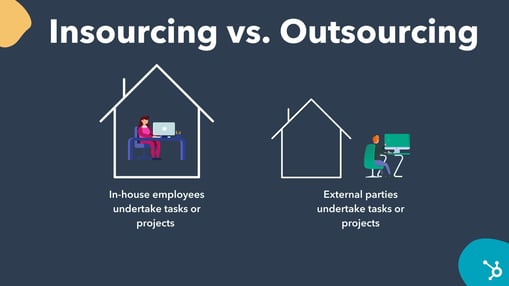
Insourcing and outsourcing are opposites.

With outsourcing, a company hires an external third party, like a public relations firm, to complete a task, project, or take over a continuous function for the company. With insourcing, all tasks, projects, or continuous processes are done by internal employees, even if it means hiring new talent or creating new departments.

insourcing vs outsourcing

A common use case for outsourcing is payroll needs. For example, if a business is smaller and doesn’t have the resources to create a payroll department, or nobody on staff is trained in payroll needs, they may outsource the task to an experienced payroll firm.

Businesses may choose to use outsourcing over insourcing for a variety of reasons, like:

  • Eliminating the costs associated with hiring new employees,
  • Reducing workload for internal teams to avoid burnout,
  • Allowing employees to focus on core business functions while external parties cover less critical operations,
  • New needs that arise due to scaling.

A business may choose to use insourcing over outsourcing as the ladder often requires handing over internal systems and processes to a third party, which can pose a significant risk when dealing with sensitive information, and communication can sometimes be challenging to navigate.

Insourcing Examples

Let’s go over some examples of insourcing that may provide additional insight into the practice.

  • A business is scaling to different territories, but its current marketing teams aren’t familiar with the language in the new area. So, it hires a new team in the territory that is familiar with the language and will be responsible for creating marketing strategies that speak to the needs of the new audience.
  • An organization wants to expand its line of products, so it works with internal product teams to brainstorm new ideas and bring them to fruition instead of outsourcing the work to an external unit. This ensures that teams working on new products have expertise on current business practices, and confidential systems don’t need to be shared with outside sources.
  • After scaling, a business CEO can no longer be responsible for payroll as it is a more significant task than before. So, instead of hiring an external payroll firm, the business hires new talent experienced in payroll duties and creates an in-house payroll department.

Over To You

If you want your business to undertake new projects or scaling has required you to need new processes, consider using insourcing if your overall goal is to have everything done in-house.

Your internal teams, or newly hired talent, will take ownership of new tasks, bring them to fruition, and contribute to your business success.

company culture template


Insourcing vs. Outsourcing: Everything You Need to Know was originally posted by Local Sign Company Irvine, Ca. https://goo.gl/4NmUQV https://goo.gl/bQ1zHR http://www.pearltrees.com/anaheimsigns

How to Identify Your Core Marketing Message

As a marketer, you know how important it is to have a marketing strategy — but have you thought about the impact your marketing message can make in it?

Your strategy has to align with your audiences’ needs and interests, and understand the required approach for each channel you use, whether it’s social media or email. This strategy also informs the content you create and how to share it so your audience has a greater likelihood of seeing it.

But how do you bridge the gap between this strategy and the content itself? What you need is a marketing message, and it’s just as important as your overall strategy.

Download Now: Free Brand Building Guide

In this article we’ll discuss the definition, provide real-life examples and ways to make your own excellent marketing message. But if you’re in a pinch, feel free to jump straight to what you’re looking for instead:

Because of this, you should craft your marketing message with care, specifically for the audiences you’re trying to reach. It should also address their pain points and present your business as a solution.

Think of it like this: if you know you want to post about a new product launch on Instagram, how will you prove to your audience that they need to buy this new product? Your marketing message. Essentially, no marketing message means no way to execute your strategy.

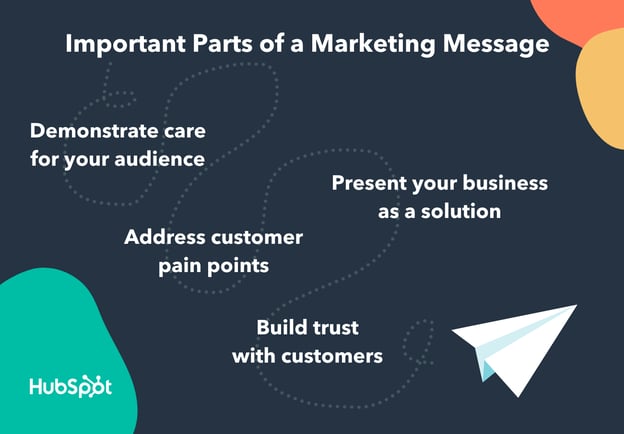
important parts of a marketing message hubspot graphic

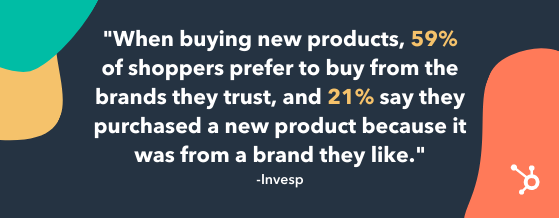
When your message speaks to their needs, you’ll build trust with your audience and inspire customer retention. It’s worth investing time in crafting the perfect message, especially when 59% of shoppers prefer to buy from brands they trust.

statistic marketing message trustability and likeability of a brand

But you may be thinking, what is messaging in marketing, anyway?

What is messaging in marketing?

Messaging in marketing is how a brand communicates what customers want to know about your brand. It goes beyond just sharing information about the product or service available; it builds your brand identity through the “why” of your company; its mission, vision, and values.

Marketing messaging lets customers see your brand’s beliefs and ideas — helping the customer make an impression of your business. This type of communication can be a decision point between buying from just any company or buying from an authentic and engaging one instead.

Every business engaging in marketing needs a marketing message, whether you sell B2C or B2B, software as a service (SaaS), or clothing. Let’s take a look at some brands that made clear and enticing messaging.

Marketing Message Examples

Successful marketing messages attract leads and convert them to paying customers. Below we’ll go over some real-life examples of effective marketing messages.

1. Nike

As a clothing and apparel brand, Nike is committed to providing equipment to everyone who needs it, regardless of the sport they play and who they are.

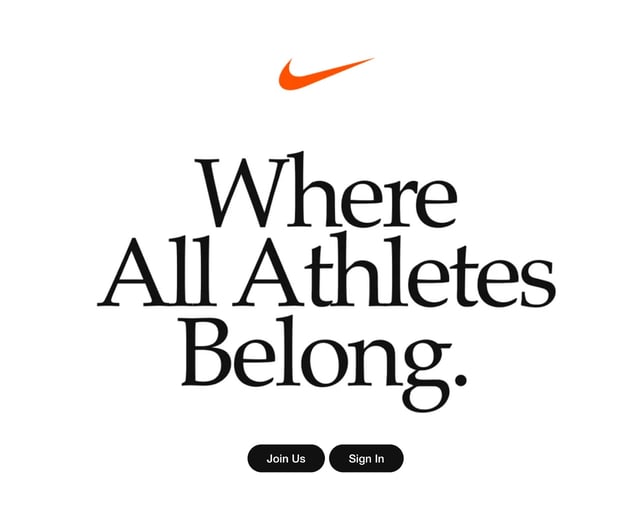
Nike’s marketing message is “Where All Athletes Belong,” and it speaks to its target audience and lets them know that they have something for everyone —from professional athletes to first-time players.

nike homepage 'where all athletes belong' marketing message

Image Source

2. Black Girl Sunscreen

Black Girl Sunscreen targets an audience often left out of sun safety discussions: women of color. Their message lets that market know they’re there for them: “Protect your melanin. Sunscreen is always in season.”

black girl sunscreen homepage marketing message "protect your melanin. sunscreen is always in season."

Image Source

3. Chipotle

People with dietary restrictions or food preferences that don’t align with mainstream ideas of nutrition are often unable to find food they can eat at fast-food restaurants.

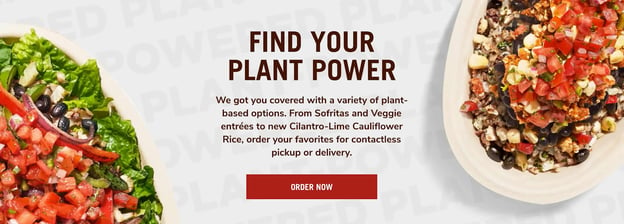
Chipotle’s marketing message, shown in the image below, reads “Find your plant power.” The brand is speaking directly to those with diverse needs, inviting them to try its expanded menu with plant-based options and letting them know that they recognize the gap in the market for their needs.

chipotle plant-based marketing message "find your plant power"

Image Source

4. Lab Muffin

Ingredients in beauty and cosmetic products can be hard to understand if you don’t have a scientific background or relevant experience. Lab Muffin’s marketing message speaks to those who want to understand the chemistry behind the products they use: “The science of beauty, explained simply.”

lab muffin logo with marketing message that reads "the science of beauty, explained simply."

Image Source

5. Zoom

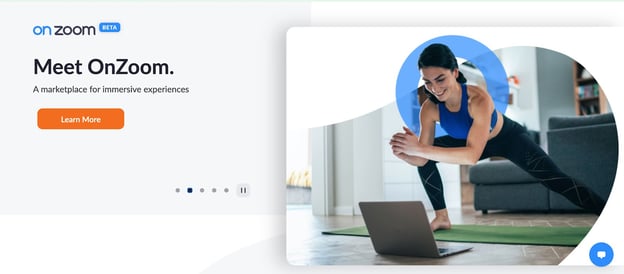
Zoom is a virtual meeting tool that allows users to connect virtually. It markets to an audience who wants to continue having fulfilling conversations, regardless of their physical location: “Meet OnZoom. A marketplace for immersive experiences.”

zoom homepage slider marketing message that reads "meet onzoom. a marketplace for immersive experiences."

Image Source

All in all, these marketing messages capture attention and, in just a couple of words, explain why Zoom’s business is the best fit to meet its audience’s needs.

How to Craft a Marketing Message

As mentioned above, a well-crafted marketing message helps convert your audience into customers. All businesses should aim to have one, and below we’ll discuss how to create a compelling marketing message for your own business.

1. Know your target audience.

Just as with most marketing practices, you can’t begin creating your marketing message without identifying your target audience. When you know who they are, you’re not marketing to customers you think are interested in you, but rather to those you know are interested in you.

In brief, your target audience is a group of consumers with similar characteristics and purchasing intent, and stand to gain the most value from your products. While your overall target audience is probably defined by the industry you’re in, it’s important to have a deeper understanding.

To learn more about your target audience and narrow down who they are, you can conduct buyer persona research, analyze your competitors, practice social listening, and invite people to participate in focus groups or interviews.

Overall, what you want to learn from identifying your target audience is understanding what they “look” like. This can be simple demographic information, like age and location, to what they like, desire, and want from the businesses they buy from.

Having this information then makes it easier to personalize your strategies and create a marketing message that will resonate with them, especially when addressing their pain points.

2. Understand your audience’s pain points.

Your persona research should tell you about your audience’s pain points and challenges.

As a refresher, pain points are issues that affect your target audience’s day-to-day routines, business tasks, or general life desires. These challenges are typically things that your audience is actively seeking solutions for.

For example, if you’re a business selling marketing SaaS, you may discover that your audience has trouble managing their campaigns because they use multiple platforms throughout their process. When you create your marketing message, you should speak to your ability to streamline their efforts with your easy-to-use, all-in-one platform.

If you’re a B2C business that sells eco-friendly clothing, a customer pain point could be that they struggle to find brands without significant environmental impact. In your marketing message, you should speak to their desire to minimize environmental pollution through sustainable shopping opportunities.

When you understand pain points, you don’t have to guess why your customers need you — you’ll know why they need you. As a result, you can create a marketing message that addresses their needs.

The first two steps on this list involve gathering the necessary background information, and the following steps will help you begin crafting your message.

3. Define value propositions.

Value propositions highlight your product or service’s unique value and tell customers that your brand is tailor-made to meet their needs. It clearly says why they should do business with you instead of a competitor, and that is precisely the point of a marketing message.

When creating your message, present your product or service as a cure for their pain points, and prove it. Continuing with the eco-friendly business example, you can specifically mention that your clothing is locally produced, separating you from the competition that mass produces its goods abroad.

This message tells consumers that you’re solving their pain point, which is a lack of sustainable clothing brands, because you design ethically produced and environmentally friendly products.

4. Prioritize clarity and concision.

Your marketing message needs to pack a punch, you need to say a lot in as few words as possible. You shouldn’t beat around the bush. Instead, get to the point and explain how your product is a solution.

Customers should read your message and find answers to their questions without needing to overanalyze your statements. Prioritize being clear, concise, and easily understood, as you want your words to speak for themselves. To reiterate, get to the point.

You can think of it like this: I said a lot in this explanation just to tell you to get to the point. If this were a marketing message, you would’ve moved along already. However, if I wanted to follow the tips I’ve mentioned, I would simply say, “Tell me why you’re the best – no ifs, ands, or buts.”

5. Use familiar, conversational language.

Even though your customers are in your industry, you shouldn’t assume that they know or understand the technical jargon related to what you sell. Therefore, it’s important to sound conversational and use familiar and palatable language to most audiences. Your message copy should be simple, straightforward, and not require an industry-specific dictionary.

For example, you can use technical terms to describe the features in your latest automobile model. Still, car enthusiasts would be the only ones that genuinely understand what it means to have a 600 horsepower engine and AAA uniform tire quality grading (I certainly don’t know what this means).

Aim to write as people speak during conversations, maintain a friendly tone, and make customers feel welcomed. Robotic and technical language may be confusing and lead them to think that doing business with you will be complicated and confusing as well.

In sum, by being conversational and familiar, you’re reaching everyone, from first-time industry customers to seasoned CEOs.

6. Showcase your brand's originality.

Your marketing message’s overall intent is to attract your target audience, but it’s also to set you apart from your competitors. Given this, a key pillar of your final message is originality.

Run-of-the-mill marketing messages seem like they could belong to any of your competitors, and original ones showcase what makes you unique. This can be your brand's personality, the features that set you apart from your competitors, or a combination of the two.

Your marketing message is unique to your business, your solutions are unique to your business, and your words should prove that.

7. Use user-generated content (UGC).

Consumers are 14% more likely to trust recommendations from someone like them (another consumer) over a brand employee. With that in mind, using UGC in your messaging, like testimonials and reviews, can help you support your products’ value.

As your target audience likely shares the same challenges, seeing that someone like them has benefited from your product can help them make their final decision. For example, you could say, “95% of our customers love [xyz], and you will too.”

8. Appeal to customer emotions and logic.

There are a variety of consumer behavior models that explain how people make purchasing decisions. Some models say that it’s through logical reasoning, and others say that it’s purely emotional. In reality, it’s probably a combination of the two, and you should use this to your advantage.

Through tactics like humorous copy, you can showcase your brand's uniqueness to appeal to customer emotions, and use value propositions to appeal to logical reasoning and show customers how you’ll solve their problems.

Reach Your Customers through Your Marketing Message

The key takeaway here is that your marketing message should convince your audience to do business with you.

Focus on showcasing your brands’ individuality, creating an emotional connection, and clearly showing your customers what’s in it for them. If you do this, you’ll likely find yourself with a marketing message that speaks directly to your target audience and helps you grow your list of clients.

brand consistency


How to Identify Your Core Marketing Message was originally posted by Local Sign Company Irvine, Ca. https://goo.gl/4NmUQV https://goo.gl/bQ1zHR http://www.pearltrees.com/anaheimsigns

How to Host Virtual (or Hybrid) Holiday Parties For Your Team

The pandemic has forced the traditional holiday office party to go virtual. But things are different this year — now, a variety of workplaces include remote and in-person employees (or a hybrid of both).

So here's the challenge — how can you host a fun holiday party that satisfies everyone? What activities can you plan? What logistics are involved?

There's certainly a lot to think about, but don't stress. Here are some tips from HubSpot's remote workforce on how to host a virtual or hybrid-friendly holiday party.

1. Use a spreadsheet to organize your activities.

Planning a virtual holiday party requires plenty of logistics. That's why you should use a spreadsheet to stay organized.

Kara Korosec, a remote senior customer success manager at HubSpot, says, "I used to coordinate Secret Santa at my last company, a 100% remote company. I set up a spreadsheet where everyone listed some of their interests, then we used a random generator to assign secret Santas. Everyone had a budget of $50 and used the spreadsheet as inspiration for what to get. After the gifts were mailed, we had a Zoom where we shared our gifts and guessed who our secret Santa was."

2. Make it interactive.

Virtual events might automatically feel "hands-off" — but this doesn't have to be the case. In Korosec's secret Santa example, they opened the gifts on a live Zoom call.

The goal here is to be creative.

Eimear Marrinan, a director of culture at HubSpot, says, "There are a ton of amazing remote vendors and minority-owned businesses that we partner with in the Culture Team. They are doing amazing work. If your budget allows for it, consider outsourcing to the experts. A few brilliant events I have seen: Ski Chalet Experience, Walkthrough Christmas Markets, Cocktails in a Winter Wonderland!"

There are several online games and activities you can use for your virtual holiday party. Below are some of our favorite interactive remote activities:

  • Virtual MasterChef: Ask one person to host and send out a list of ingredients (or modified ingredients for dietary restrictions) and supplies. On the cooking night, have everyone dial into the Zoom to cook the same meal together as the host walks them through the recipe. Once the recipe is ready, sit down and have a virtual dinner together!
  • Ugly Sweater Contest
  • Virtual Escape Rooms, like Puzzle Break and Mystery Escape Room

3. Incorporate food.

When hosting an in-person event, providing food is typically part of the gig. Why can't this be true of remote holiday parties too?

Emily Tong-Sanchez, a remote revenue operations specialist at HubSpot, says, "Let people comp their meal!"

This gives people a reason to celebrate and enjoy the party.

Marrinan adds, "Ask questions if you're incorporating food. Are there allergies or preferences? If you're arranging a cocktail hour, does everyone drink alcohol? This is all about being inclusive in how you're arranging your event."

If you're sending food, it's important to be aware of any restrictions so your event is inclusive of all participants.

4. Encourage people to dress up.

Holiday parties are usually fun events where everyone can dress up and celebrate. Being remote shouldn't change this — so don't ditch the ugly holiday sweater just yet.

Tong-Sanchez says, "Encourage people to dress up. We like having a reason to put on fancy clothes!"

5. Always lead with an inclusive mindset.

A major obstacle with remote meetings is that it's hard to feel included.

Marrinan remarks, "We are working in a distributed and remote world right now, so when thinking through a holiday event for you and your team think big & think global. Will the timezone work for all on your team? Do ‘The Holidays' resonate across the globe? Make sure you plan something fun, and inclusive that everyone can get involved in!"

6. Plan in advance.

If you're planning a virtual holiday party, it's important to give yourself enough time to plan. Send invites in advance, finalize an agenda, and test-run activities.

Marrinan says, "The end of the year is busy. Really busy! Give people advanced notice and book time in advance. A lot of people are juggling right now, so being protective of time is important! Similarly, be mindful of caregivers on your team, or anyone that may have blocked time in their day."

7. Send something physical.

Just because your event is remote, doesn't mean you can't include a physical element in your virtual holiday party.

"Can you send something out to the team in advance to spur some excitement? This doesn't have to be a physical gift — maybe it is a handwritten card or a note of gratitude," Marrinan remarks. "A holiday event doesn't have to be a big, big thing. Sometimes it's the simple acts of kindness that go a long way for people."

8. Pick a goal.

When you're planning your holiday party, it's important to decide what your goal is. For example, it's hard to play a game while also getting to know each other.

Caroline Merewether, a strategy and operations manager at HubSpot, says, "The biggest takeaway is to figure out if it's more about deepening relationships or playing a game."

One of Merewether's favorite events her team put on was an Airbnb experience which was a virtual escape room.

"That was fun to do something different and it was a fun mental shift. But it wasn't great for getting to know people because we were trying to solve for clues. For our next party, we wanted to drive conversation between us," she adds.

For her team's next virtual holiday party, they're going to send international candies that will be a great conversation starter for breakout rooms. Then, they're going to do a costume contest and online trivia.

Jeff Boulter, an engineering lead at HubSpot, decided to combine the interactive activity with a way of getting to know each other via an interactive trivia game.

To start, Boulter sent out a Google Form with a mixture of icebreaker questions. A few examples included:

  • What was your first online handle or email address?
  • What course did you do the worst at college?
  • What's the weirdest job you've ever had?
  • What's your least favorite song?
  • What's your favorite conspiracy theory?
  • What's an unusual skill you have?
  • Star Wars or Star Trek?
  • Yanni or Laurel?
  • If you could commit any crime and get away with it, what would it be?
  • What's the worst gift you've ever received?
  • Who would get eaten first if we all got stuck in the 1C elevator?

Then, they used a free online trivia site called MyQuiz. Here, the answers were either picking one person from their squad (who's least favorite song is "It's a Small World," for example) or picking the correct answer amongst three other made-up answers. They ended up with 54 questions. See the picture below for what this looked like.

5 Tips for Hosting a Hybrid Holiday Party

The best hybrid holiday parties engage both virtual and in-person guests in a meaningful way. But if you're unsure about the logistics, check out these tips to build connections among coworkers near and far:

1. Think digital-first.

When planning the activities and agenda of your hybrid holiday party, your virtual attendees should stay front of mind. Consider how your virtual employee can interact and remain engaged at each step.

2. Find the right venue.

The venue for your party can either make or break the hybrid experience. Pay close attention to your venue's internet stability and sound — and make sure you have access to the right equipment for video conferencing.

3. Prioritize hybrid-friendly activities

A common mistake when hosting hybrid parties is organizing activities for in-person guests and simply broadcasting the festivities for virtual attendees. Instead, look for hybrid-friendly activities that everyone can enjoy together, while apart. Here are a few examples:

  • A Funny Team Awards Show
  • Holiday Trivia or Game Night
  • Secret Santa
  • Paint Party
  • Festive Talent Show

Remember, hybrid holiday parties should actively engage both in-person and virtual attendants — so prioritize activities that can achieve this goal.

4. Share the ambiance.

Sometimes virtual guests can feel like they're missing out on the fun because they're remote. To help counteract this, hosts should create a shared experience and ambiance for all attendees. For example, if your in-person decor includes paper snowflakes and vanilla candles, consider sending virtual guests a smaller-scale version of these items for their home or office.

5. Put in-person and remote guests in groups or pairs.

One way to encourage engagement between in-person and virtual guests is by placing them in groups or pairs. For example, if you play holiday trivia, consider breaking up your guests into groups, with each group containing in-person and remote guests. Take this one step further by encouraging groups to brainstorm creative team names.

When it comes to planning remote and hybrid events, it may take more time and effort to nail the logistics. But when done right, you can host a party that inspires camaraderie and belonging within your team.

company culture template


How to Host Virtual (or Hybrid) Holiday Parties For Your Team was originally posted by Local Sign Company Irvine, Ca. https://goo.gl/4NmUQV https://goo.gl/bQ1zHR http://www.pearltrees.com/anaheimsigns
Tuesday, December 14, 2021

12 Incredible Answers to "What Is Your Greatest Weakness?" — "That Aren't Perfectionism"

So, you’ve finally got your foot in the door at your dream company. You’ve submitted the perfect resume and made a lasting impression during the phone screen. All there’s left to do now is to win over the hiring manager in the face-to-face interview.

As a well-informed candidate, you’re doing your research on the company and preparing your answers to the most important interview questions you can think of — the most notorious of them all being: “What is your greatest weakness?”

Free Kit: Everything You Need for Your Job SearchYou don't want to respond, "I tend to work too hard," or "I am too much of a perfectionist." That can easily come across as scripted and insincere at best and lacking in self-awareness at worst.

Alternatively, you don't want to respond with weaknesses that will prevent you from succeeding in the role. For instance, if you're applying to be a project manager, you don't want to admit that you’re “not very good with time management."

Fortunately, there are ways to answer this question that will help you demonstrate your value as a candidate. Here, we've cultivated some incredible answers to the mainstay, "What is your greatest weakness" question — and don’t worry, these answers aren't "perfectionism".

1. Choose a weakness that will not prevent you from succeeding in the role.

When an interviewer asks, "What is your greatest weakness?" they want to find out:

  • Whether you have a healthy level of self-awareness
  • Whether you can be open and honest, particularly about shortcomings
  • Whether you pursue self-improvement and growth opportunities to combat these issues, as opposed to letting these weaknesses hold you back

Ultimately, you'll want to use this question to demonstrate how you've used a weakness as motivation to learn a new skill or grow professionally. Everyone has weaknesses — your interviewer doesn't expect you to be perfect.

If you're applying for a copywriting position with little necessity for math skills, you might admit, "I struggle with numbers, and don't have much experience with data analytics. While math is not directly tied to my role as a writer, I believe it's important to have a rudimentary understanding of Google Analytics to ensure my work is performing well. To tackle this weakness, I've been taking online courses in data analytics."

An answer like this shows the hiring manager that you recognize your areas for growth and are able to act on them without being told to do so. This kind of self-starter attitude is a plus for virtually any team.

2. Be honest and choose a real weakness.

The answer “perfectionism” won’t cut it when talking about your biggest weakness because it’s not a real weakness. Perfectionism can never be attained — it’s a fear-based pattern that leads to short-term rewards like getting the job done early and exceeding expectations. However, in the long-term, trying to attain perfectionism leads to burnout, low-quality work, and missed deadlines. Burnout is one of the biggest contributors to decreased productivity, turnover, and low employee engagement — all of which cost a company money, time, and talent.

Instead, choose a real weakness. Underneath the desire to do perfect work may lie a weakness of trust. Perhaps you don’t trust that you’ll be able to make mistakes on the team, so you strive to do everything perfectly. That’s a real weakness that you can definitely overcome.

3. Provide an example of how you've worked to improve upon your weakness or learn a new skill to combat the issue.

Hiring managers don’t expect you to overcome your weaknesses completely overnight. Everyone has areas they must constantly work on to keep them sharp. Think of it this way — if you’ve dedicated six months to working out, you won’t be able to stop one day and maintain your progress. It’s an ongoing process that you have to work at.

4. Think about weaknesses in your own personal life.

If you humanize yourself in the interview, it’ll allow your interviewer to connect and visualize working with you in the future. It’s not just about weaknesses that pertain to the job. For example, if you are an introvert and you notice your preference for quiet time stops you from taking risks, this is a relatable weakness. When you demonstrate your self-awareness this way, it shows you understand that self-improvement correlates to work performance.

5. Think of where you’d like to be and what support you need to get there.

Overall, growth is a part of life. Think about people you look up to that may be related to the field that you’re in. Ask yourself what character traits those people have and what work you might need to do in order to get there. By providing an example of how you’re working to improve your area of weakness, you’ll give the interviewer a glimpse into a few positive attributes about your awareness, including that:

  • You know how to identify and mitigate issues that come up.
  • You’ve found a helpful solution to a problem that you and perhaps others on the team face, which means you can be an immediate resource to the team.
  • You demonstrate self-awareness and an ability to take feedback from others.

More often than not, you’re going to need to look outside of yourself to overcome a weakness. Whether you look to your supervisor, the HubSpot Blog, or a mentor for help, the simple act of seeking help demonstrates self-awareness and resourcefulness — two skills that are hard to teach, but valuable to learn. Tapping into your resources shows the interviewers that you can solve problems when the answer is not yet clear. That’s a character trait that has a place on any team.

Briefly share an example of a time when you asked someone for help in an area that you’ve identified as a weakness. This gives the hiring team a clear picture of how you’ll work with the team to balance out that weakness.

6. Don't be arrogant and don't underestimate yourself.

The most important thing you can do when responding to the question “What is your greatest weakness?” is exhibit confidence in your answer. (If lack of confidence is your weakness, keep reading.) Even if you’re not the most confident person, I’m going to assume you’re at least honest with yourself. If you’ve identified an area of weakness and you’re sure about it, let that assurance shine through in your answer. There’s no need to feel embarrassed about something you’re genuinely not good at as long as you’re working to get better.

Before you start expressing a genuine weakness to your interviewer, get comfortable with the types of answers that make hiring managers want to work with you. Take a look at the following examples and find a few that fit your personality and work style. Then, practice reciting them aloud so they come naturally to you.

Ready? Here are examples of how you might answer "What is your greatest weakness?" and why they work.

1. Lack of Patience

Sample Answer:

"I don't have much patience when working with a team — I am incredibly self-sufficient, so it's difficult when I need to rely on others to complete my work. That's why I've pursued roles that require someone to work independently. However, I've also worked to improve this weakness by enrolling in team-building workshops. While I typically work independently, it's important I learn how to trust my coworkers and ask for outside help when necessary."

This answer works because the weakness — the inability to be patient when working with a team — doesn't hinder your ability to perform well in the role, since it’s a job that doesn't rely on teamwork to succeed. Additionally, you display an eagerness to develop strategies to combat your weakness, which is a critical skill in the workplace.

2. Lack of Organization

Sample Answer:

"I struggle with organization. While it hasn't ever impacted my performance, I've noticed my messy desk and cluttered inbox nonetheless interfere with my efficiency. Over time, I've learned to set aside time to organize my physical and digital space, and I've seen it improve my efficiency levels throughout the week."

Plenty of people have messy desks. This answer works because it's a relatable and fixable weakness. You note that disorganization doesn't interfere with your ability to do your job, which is critical, but you also acknowledge it might make you less efficient. To ensure you're performing at 100%, you mention personal steps you've taken to improve your organization skills for the sake of self-improvement alone, which suggests a level of maturity and self-awareness.

3. Trouble with Delegation

Sample Answer:

"I sometimes find it difficult to delegate responsibility when I feel I can finish the task well myself. However, when I became manager in my last role, it became critical I learn to delegate tasks. To maintain a sense of control when delegating tasks, I implemented a project management system to oversee the progress of a project. This system enabled me to improve my ability to delegate efficiently."

This answer allows you to demonstrate an ability to pursue a new skill when a role calls for it and suggests you're capable of flexibility, which is critical for long-term growth. Additionally, you are able to showcase a level of initiative and leadership when you mention the successful implementation of a new process that enabled you to succeed in your past role, despite your weakness.

4. Timidity

Sample Answer:

"Oftentimes, I can be timid when providing constructive feedback to coworkers or managers, out of fear of hurting someone's feelings. However, in my last role, my coworker asked me to edit some of his pieces and provide feedback for areas of improvement. Through my experience with him, I realized feedback can be both helpful and kind when delivered the right way. Since then, I've become better at offering feedback, and I've realized that I can use empathy to provide thoughtful, productive feedback."

This answer works because you've explained how you were able to turn a weakness into a strength through real-world experience. Typically, timidity can be seen as a flaw in the workplace, particularly if a role requires someone to provide feedback to others. In this case, you're able to demonstrate how timidity can be used as a strength, through thoughtful reflection and practice.

5. Lack of Tactfulness

Sample Answer:

"My blunt, straightforward nature has allowed me to succeed over the years as a team manager, because I'm able to get things done efficiently, and people often appreciate my honesty. However, I've recognized my bluntness doesn't always serve my employees well when I'm delivering feedback. To combat this, I've worked to develop empathy and deeper relationships with those I manage. Additionally, I took an online leadership management course, and worked with the professor to develop my ability to deliver feedback."

Oftentimes, facets of our personalities can help us in certain areas of our work, while hindering us in others. That's natural. However, you must demonstrate an ability to recognize when your personality interferes with the functions of your role, and how you can solve for that.

In this example, you first explain how your blunt nature allows you to be successful in certain situations. Then, you mention that you understand your bluntness can be seen as a lack of empathy and provide examples of how you've attempted to solve this issue. Ultimately, your awareness of how you might be perceived by others shows a level of emotional intelligence, which is a critical asset for a team leader.

6. Fear of Public Speaking

Sample Answer:

"Public speaking makes me nervous. While I don't need to do much public speaking in my role as a web designer, I still feel that it's an important skill — especially when I want to offer my opinion during a meeting. To combat this, I spoke with my manager and she recommended I speak at each team meeting for a few minutes about our project timeline, deadlines, and goals when developing a website for a client. This practice has enabled me to relax and see public speaking as an opportunity to help my team members do their jobs effectively."

In this example, you mention a skill that isn't applicable to the role, but one which you nonetheless have been working to improve. This shows your desire to meet more business needs than necessary in your current role, which is admirable. Additionally, it's impressive if you can show you're willing to reach out to your manager with areas in which you want to improve, instead of waiting for your manager to suggest those areas of improvement to you. It demonstrates a level of ambition and professional maturity.

7. Weak Data Analysis Skills

Sample Answer:

"I'm not great at analyzing data or numbers. However, I recognize this flaw can prevent me from understanding how my content is performing online. In my last role, I set up monthly meetings with the SEO manager to discuss analytics and how our posts were performing. Additionally, I received my Google Analytics certificate, and I make it a point to analyze data related to our blog regularly. I've become much more comfortable analyzing data through these efforts."

In this example, you're able to show your desire to go above and beyond a job description and actively seek out skills that could be helpful to the success of your company as a whole. This type of company-first mentality shows the interviewer you're dedicated to making yourself a valuable asset, and try your best to understand the needs of the whole department, rather than just your role.

8. Indecisiveness

Sample Answer:

"Sometimes I struggle with ambiguity and making decisions when directions aren’t clear. I come from a work environment that always gave clear and direct instructions. I had such a strong team and leadership that I haven't had much practice making decisions in the heat of the moment. I'm working on this by leaning more into my experience and practicing listening to my gut."

This answer works because you're demonstrating that you can both follow a leader and sharpen your leadership skills. It's alright to not know what to do in the moment. Admitting that you relied on strong leadership shows that you can be a follower when needed, but knowing when to step up is important, too. With this answer, you’re showing that you’ll step up if a situation calls for decisiveness.

9. Harsh Self-Criticism

Sample Answer:

“My inner critic can be debilitating at times. I take pride in producing good work, but I feel like I struggle feeling satisfied with it, which has led to burnout in the past. However, I’ve started to push back against this inner voice by taking care of myself before and after work. I’m also learning to recognize when my inner critic is right and when I need to dismiss it.”

This answer works because your interviewer may relate; we all have harsh inner critics. It’s also effective because 1) It shows that you’re willing to work on your weaknesses outside of work, not just during business hours, and 2) It demonstrates your inner critic may have valid points. Discerning when to dismiss it is key to prevent burnout and increase productivity. Realizing how the inner critic may inhibit good work ethic demonstrates your willingness to grow and be an effective worker.

10. Micromanaging

Sample Answer:

“I used to work in industries where I had to cultivate a solid work ethic in my employees. This style of training has been so ingrained in me that I’ve forgotten to discern who may need that coaching and who does not. I’ve been reading books on effective delegation and team building to work on this shortcoming. One technique that works for me is assuring myself that if I establish clear expectations, then my team will follow. I’ve also learned to trust my team members.”

This answer works best if you’ve been in a leadership position before and are applying to a managerial role. However, you can still apply it to past experiences where you did have to show leadership. This answer shows that while you may be used to running your crew or team a specific way, you’re willing to admit when your method isn’t the most effective. Showing your flexibility demonstrates your ability to grow.

11. Talkative

Sample Answer:

“I enjoy developing a relationship with my coworkers by engaging in conversation, and that’s a great team-building skill. However, I have a habit of carrying on a conversation to a point where it may distract other coworkers. I have learned since then that there are other ways to connect with my coworkers, and that if I’m asking about their day, I need to keep it brief and redirect myself back to my work. “This answer works because it shows you’re aware of how your talkative tendencies may be distracting in the workplace. It takes a lot of courage to admit that. It also shows you are willing to develop a relationship with coworkers but not at the cost of productivity.

12. Trouble Maintaining a Work-Life Balance

Sample Answer:

“I’ve struggled with work-life balance, especially after I started working remotely during the pandemic. This increased my stress levels to the point where my productivity was at an all-time low and I didn’t bring my best self to work. Because I want to continue working remotely, I’ve started adding more structure to my day and instituted a sharp start and end time. I’ve already seen improvements in my levels of focus during work hours.”

At first, this might seem like a “strength” weakness — pouring yourself into work is great, right? That means you love your job. But if it impacts your productivity and your relationships with coworkers, that is not so great. This answer works because it doesn’t just say, “I work a lot, so my home life suffers.” It says, “I work a lot to the point of burnout, and I’ve realized that I need to structure my day.” If you’ve struggled with work-life balance issues in the past, it’s important to state how you’re restoring that balance and how it has impacted your work.

There’s Strength In Every Weakness

Regardless of whether you’re bad with numbers or you tend not to speak up in group settings, there’s a strength behind every weakness. The strength is in how you work to overcome it. Leaning on your teammates who excel in those areas is a great way to show that you’ll work well on the team and that you know how to use your resources to solve problems. Taking professional development courses shows that you’re willing to work toward improvement. No matter which of these answers you share with the hiring team, they’ll be more than happy to help you grow and exceed the expectations of the role.

Editor's note: This post was originally published in December 2018 and has been updated for comprehensiveness.

Apply for a job, keep track of important information, and prepare for an interview with the help of this free job seekers kit.


12 Incredible Answers to "What Is Your Greatest Weakness?" — "That Aren't Perfectionism" was originally posted by Local Sign Company Irvine, Ca. https://goo.gl/4NmUQV https://goo.gl/bQ1zHR http://www.pearltrees.com/anaheimsigns
How to Create a Holiday Marketing Campaign: A Step-by-Step Guide

The malls are decked with holly, your inbox is filling up with holiday-themed promotions, and you've deemed it socially acceptable to start listening to your favorite holiday playlist on Spotify... or maybe that's just me. 

Either way, the holiday season is here, and marketers are gearing up to finish off the year strong. But just like shopping for gifts, planning your holiday campaign is something you don't want to shove off until the last minute.

There's going to be a lot of spending going in over the next month or so, which is why it's important to have a plan for reaching your customers and prospects before your competitors do.

Haven't started planning your campaign yet? Don't panic.

We've mapped out a comprehensive guide with everything you need to launch a holiday marketing campaign this season. From offer templates to free holiday-themed stock photos, we've peppered this step-by-step guide with resources designed to get your campaign up and running right away.

→ Download Now: Free Marketing Plan Template

1. Decide on a campaign theme.

While creating content has become ingrained in the day-to-day lives of most inbound marketers, launching a campaign is a little different. Unlike a tweet or an infographic, campaigns require you to align all of your marketing channels around one specific goal or message.

Holiday campaigns -- like all campaigns -- typically run for a concentrated period of time. Depending on your industry, they can start as early as October and often spill over into January.

Now that you know what you're in for, let's not waste any more time. Below we'll kick off this process by walking you through establishing your campaign and offer.

2. Choose your campaign goals.

Before you start creating an offer, you need to determine what it is that you're looking to achieve. What is the ideal outcome of this campaign? 

Once you define your focus, you can begin to create goals that will be used to benchmark your campaign's performance once it's wrapped. Your goals should be specific, measurable, attainable, relevant, and time-bound (SMART goals, for short). Here's an example of how to structure this type of goal:

Generate [number] leads focused on [topic/product] by [date]

Depending on what you want to get out of your campaign, your goals might look something like this:

  • Generate 1,000 leads who are interested in our annual holiday sale by December 5, 2021.
  • Generate 5,000 sign-ups for our holiday shopping app by November 30, 2021. 
  • Collect $50,000 in donations for charity XYZ by December 20, 2021.

To help you better align your marketing efforts with SMART goals, check out this free goal setting template. You can use this template to summarize your goals, calculate your greatest marketing need, and set deadlines.

3. Define your target audience.

With goals in place, the next step is to define your target audience. The more information you can gather about the people you're trying to reach, the better. Where are they hanging out on social media? Do they prefer to consume information on their desktop or mobile? This will help you make smarter marketing decisions when it comes time to create content and plan promotions.

If you already have a few buyer personas in place for your marketing efforts, you'll want to start by narrowing your focus. Does your campaign pertain to all segments of your audience? If not, you'll need to immediately weed out the folks who you don't want to include.

If you don't already have buyer personas or would like to create campaign-specific personas, we recommend you check out our free buyer persona templates. These templates will make it easy for you to build out and organize your persona data.

4. Create an offer.

The offer that you create will serve as the center point for all of your campaign initiatives. Typically offers take shape in the form of ebooks, whitepapers, templates, online courses, videos, tools, etc. You can also choose a digital e-gift card from somewhere like Rybbon. While there are a lot of options to choose from, we advise you to run with an approach that makes the most sense for your intended audience. 

Think about it: If you know the people you're trying to reach are typically strapped for time -- particularly during the holidays -- you might want to create a set of easy-to-use templates instead of a lengthy ebook, right?

If you decide to take the ebook route, we can help -- you can download our free, customizable ebook templates. We've already taken care of the design element, so all you have to do is focus on writing the content. And if you're in search of some compelling visuals to use throughout your offer, download our 250 free holiday stock photos here

5. Create a landing page.

Once your offer is created, you need to provide a place for it to live. This is where the landing page comes in. 

Considering your landing page is the page that you'll be driving traffic to, it needs to be convincing. Here's a list of some of the essential elements you should include:

  • Compelling headline. This is how you're going to capture the attention of potential visitors. For tips on how to craft the perfect headline, turn to this guide.
  • Interesting visuals. Your landing page shouldn't just be a jumble of text. Think about how you can provide visual context for your offer.
  • The benefits of your offer. This typically takes shape in a bulleted list. The goal here is to drive home what the visitor can expect to get from this offer, and why it matters.
  • A form. This is how you'll collect information in exchange for the offer. Keep in mind that there's no magic number for form fields. In fact, the amount of information you need to ask for on a form will vary from business to business. That said, if you don't really need a piece of information, don't ask for it.

If you need some more guidance as to what goes into a great landing page, check out this roundup of 19 brilliant landing page designs

6. Design a promotion plan.

"If you build it, they will come," said no marketer ever. Now that your content has been created, it's time to figure out how to get the word out. Here are some of the promotion tactics you should be implementing per channel: 

Email Marketing

If you already have a list of people you know will be interested in your offer, that's great. If you want to slice and dice your database to go after a more specific group, you should take care of that segmentation first. For HubSpot customers, it's easy to segment your database using a smart list in the Lists App. (Here's a resource to help you get started.)

During the holiday season, we'd argue that segmenting your list is more important than ever. Due to the increased number of incoming promotions and the limited amount of time busy shoppers have, well-targeted emails will often take priority over mass messages. 

Once you've squared away your recipients, you can kick off the actual email creation process through platforms like Sendoso. Here are some noteworthy elements to keep in mind while crafting your email:

  • Subject line. Focus on what the offer solves. Check out this helpful post for tips on improving your subject lines.
  • Body copy. The body of your email should be short and sweet, much like the copy on your landing page. This is also a great opportunity to incorporate personalization using personalization tokens. Here are some great examples to get you thinking about personalization opportunities. 
  • Sharing Options. Don't forget to add buttons to your emails that allow recipients to quickly pass your offer along to their network. 

Check out HubSpot's Template Marketplace to find an email template that fits your needs. 

Blogging

Once you've sent an email to get your offer on the radar of your intended audience, it's time to build out your reach even further. Blog posts serve as an effective campaign element for attracting people to your offer, and can be approached in a couple of different ways. 

One way to use your blog to promote your offer is to create a simple "promo post" -- that's what we call them, anyway. This post is typically a very focused piece offering a quick introduction to the offer, advice on how to implement it, and a compelling CTA to drive people to the landing page.

example of a holiday promo post

According to a 6-month analysis of HubSpot's Marketing Blog run by my colleague, Ginny Soskey, promo posts proved to be the most effective lead generators out of the seven post types we typically publish. While this may vary depending on your industry and audience, it's certainly a type we'd encourage you to explore on your own.

Promo posts aside, it's also a great idea to add a CTA for your offer to a post that aligns with its subject matter. You can create an entirely new post and revisit older, related posts to swap out their CTAs. This way, if people who reach the end of your post are looking for more information or a deeper dive into the subject, they can click through to the offer.

Social Media

Now that you have some tangible promotional material in place, you can start promoting it through your social media channels. Whether you share the related blog post or a link to the landing page, be sure that you're switching up the messaging so you're not repeating the same tweet or Facebook post over, and over, and over...

You'll also want to tailor the post to the platform you're posting it on. For example, maybe you create a teaser video for your offer to promote it on Instagram and then use a colorful visual when you serve it up on Twitter:

The holidays provide an interesting opportunity for businesses looking to explore platforms they wouldn't typically try. With busy consumers looking for holiday help and inspiration in all corners of the internet and social media, you may find that it's worth promoting your campaign on a wider variety of platforms. 

Wherever you're sharing your content, you'll need a place to organize and plan your distribution strategy. For that, check out this free social media content calendar

PPC

Paid advertising can be a great tool to boost some of your inbound efforts -- especially around the busy holiday season.

If your budget allows and you know there's search demand for your offer, you may want to experiment with putting a little money behind some of your campaign assets to promote them on social media. For advice on how to create successful paid advertising campaigns across the three main social media platforms -- Facebook, Twitter, and LinkedIn -- check out this guide.

7. Create lead nurturing paths.

What will happen to your leads once you've generated them? And once the holidays have come and gone, what will they mean to your business?

Before you launch your campaign, it's best to design a plan for qualifying and developing your leads once they've filled out your form.

Email Segmentation

With marketing automation software, you can use email nurturing to keep leads engaged with your business and move them closer to a sale. 

Before you can begin creating emails and workflows, you need to take another look at your list to determine if there are opportunities for segmentation. Dividing your list of leads will make it easier for you to deliver more contextual follow-up emails, which will help you separate yourself from holiday inbox chaos, and ultimately help recipients see the value in your relationship.

Email Nurturing

Next, determine what content you'll use to nurture your leads. You can narrow your focus by honing in on what your goals are for this nurturing process. Do you want them to turn these people into sales? Subscribers? Are you looking to direct them to a particular page? 

For your campaign, it might make sense to re-engage those leads with helpful, related resources.

And to track your progress, make sure you set a goal for your workflow. If you're a HubSpot customer, you can do so in HubSpot's Workflow App, which makes it easy for you to gauge the performance of your email sequence. 

8. Take the campaign live.

Now that you've got everything in place -- offer, landing page, blog promotion, nurturing workflows, etc. -- it's time to take your campaign live. 

We recommend issuing a "soft launch" before you initiate any promotion, as this will provide you with an opportunity to run through all of the steps yourself to ensure that everything is functioning as it should be. If you can get a few colleagues to fill out the form and run through the stages too, it'll be much easier for you to spot any glitches or missed marks. 

Once you know everything is sailing smoothly, it's time to kick up promotion and start driving traffic to your landing page. 

9. Measure and report.

This is the final -- and arguably the most important -- step in the process. Once your campaign has had some time to gain traction, you'll want to dive into its performance and see what you can learn from it. 

Remember those goals we set all the way back in step one? Now is the time to determine if you actually hit them -- and if you didn't, identify what might have prevented you from doing so. Analyzing where people dropped off in your workflows, blog posts that flopped, or areas of your offer that fell a little flat might reveal what held your campaign back from reaching those numbers. Take note of these details, and use them to inform your next campaign strategy.

If you need some help defining what numbers you should actually be concerning yourself with, check out this introductory guide to inbound marketing analytics. This resource will walk you through how to effectively analyze the following: your website and landing pages, search engine optimization, paid search, blogging, social media, email marketing, and lead nurturing and automation.

Creating a holiday marketing campaign isn't all that different from creating a marketing campaign during the rest of the year. The main difference lies in the themes and offers you create. Although the process is similar, these campaigns usually have different goals and expectations because people are more likely to convert during this time of year.

Editor's note: This post was originally published in November 2015 and has been updated for comprehensiveness.

Marketing Plan Template
How to Create a Holiday Marketing Campaign: A Step-by-Step Guide was originally posted by Local Sign Company Irvine, Ca. https://goo.gl/4NmUQV https://goo.gl/bQ1zHR http://www.pearltrees.com/anaheimsigns