Friday, January 15, 2021

19 Brilliant Examples of Holiday Marketing Campaigns

Every year, as soon as Halloween is behind us, it seems like the floodgates open. Without warning, there are holiday marketing campaigns everywhere, with countless businesses rushing to cash in on a spending frenzy. There are holiday emails, social media posts, and TV ads — oh, my.

It might seem like holiday marketing is out of control. But some brands do it very, very well.

How? Well, these brands create campaigns that actually delight customers instead of adding to holiday "noise." They evoke emotions and promote sharing, sometimes even connecting people with their loved ones, or partnering with a charitable organization.

Great holiday marketing campaigns come in many different shapes and sizes. Check out our favorites below, and use these ideas to fuel your own holiday marketing ideas.

1. Walkers: All Mariah Carey Wants for Christmas

While the holiday season is a time for caring and sharing, Walkers shows musician Mariah Carey doing the exact opposite. After filming a music video for her famous song, "All I Want for Christmas Is You," Mariah Carey gets angry with an elf for taking her Walkers chips. To fend him off, she sings a highnote which makes him block his ears and let go of the chips.

This is a hilarious commercial because it shows that the only thing you might not want to share on Christmas is Walkers products. It also shows how even stars, like Carey, enjoy the brand.

2. Coca-Cola Canada:Give Something Only You Can Give

In a recent holiday commercial, Coca-Cola brings us the story of a dad doing everything possible to deliver his daughter’s letter to Santa. 

The dad enjoys a Coke while deciding what to do with the letter. We can sense that he’s not sure whether he’ll get there in time. 

We see him sail through a sea, hike through a forest, ride across a desert, and climb a snowy mountain as he searches for Santa. Finally, he gets there, but Santa’s closed for Christmas. Just when we think the situation’s hopeless, Santa saves the day by cruising in on a Coca-Cola-branded truck and taking the dad home. 

His little girl’s wish? For him to be home for Christmas. (This ad will definitely make you cry.) 

While we’re always tempted to give expensive gifts, the best thing that you can give to your loved ones is your presence and time.

This installment is just one of the latest in the Coca-Cola company's legendary holiday marketing campaigns — I mean, who doesn't love the annual debut of the Coke-drinking polar bears?

3. Microsoft: Find Your Joy

The year 2020 was difficult for many of us. We spent more time on Zoom than ever before, and we heavily relied on technology to distract us from the COVID-19 pandemic. But that doesn’t mean we still shouldn’t celebrate the holidays and make the most out of it with our loved ones and pets. 

Microsoft’s holiday commercial takes a fun spin on this theme. The commercial begins with a puppy named Rufus. Rufus longs to play and approaches each member of the family, but everyone, from the mother to the grandpa, is enjoying a Microsoft product and doesn’t pay attention. 

Rufus grabs his best bud, a puppy from next door. Together, they go on an imaginary adventure involving the games and activities their humans had been enjoying. The ad not only showcases Microsoft’s offerings, but reminds us to cherish our loved ones (and to pay attention to our pets!).

4. Macy’s: In Dad’s Shoes

Macy’s campaign offers a new spin on what might be considered an overdone gift: socks. 

“In Dad’s Shoes” takes a little girl through a “Freaky Friday”-like adventure, where she finds herself literally walking in her dad’s shoes for a day. Even though we see her as the daughter, everyone else, from neighbors to passerby, greets her as if she’s her dad.

Throughout the ad, she realizes how much work her dad does and how many places he frequents throughout the course of the day. He spends a lot of time walking. That’s how she gets an idea for what she’ll get him: socks. We all know that you can’t get anywhere without a good pair of socks. 

We love that Macy’s showcases a simple gift borne out of empathy. This ad tells us that gifting doesn’t have to be complicated, expensive, or over-the-top.

5. Airbnb: Airbnb Hosts Ring Our Opening Bell

This is a great example of an ad that doesn’t explicitly allude to the holidays, but rather emphasizes the value of community and gratitude. 

Airbnb celebrates the season by thanking its four million hosts for opening their homes to strangers all over the world. The video shows various hosts from different countries ringing the bell and opening the door. We go from the United States to Japan, from Kenya to New Zealand, from Brazil to Spain. (We love that each of these countries were listed in their original languages!)

This campaign demonstrates that you don’t need string lights or artificial trees to create an amazing campaign that embodies the holiday spirit. You can uplift your company’s values, celebrate your wins, and appreciate those who’ve played a role in your success.

6. Amazon: The Show Must Go On

If you lived through the 2020 pandemic (which you most likely did if you’re reading this), then you know how much it derailed any and all plans. Being quarantined keeps us from achieving things, it turns out. Unless it requires alone time. 

In this ad, Amazon effectively punches us in the gut with the story of a ballerina who was chosen to play the lead in her dance school’s winter show. The girl is thrilled to be chosen, but as the months pass and the pandemic gains traction, the event is canceled. Ballet classes are moved online. The girl’s initial thrill fades, a feeling we can all relate to.

Her little sister remedies the situation by putting together a DIY event next to their apartment building. All of the tenants look down on her as she dances. The event is socially-distant, and the girl gets to dance the ballet she’d been practicing for since the beginning of the year. 

What we love most is Amazon’s tasteful product placement. Rather than showing everyone ordering all supplies from Amazon, the ad showcases the purchase of a single product: a flashlight. The flashlight is the critical piece that allowed the tenants to watch the show from their balconies.

7. Woodie’s: #WereAllHomemakers

This one made us cry. Woodie’s, an Irish home improvement store, reminds us of what the holidays are about through the story of Mrs. Higgins, an elderly woman who’s beloved in her neighborhood. 

Throughout the ad, we see multiple people greet her. Neighbors and passersby are fond of her. Even the rowdy teens who loiter in front of her house love her. She has one problem: the door that leads to her yard is missing a hinge. In the United Kingdom, homes typically have a fence with a gate. Every time she leaves and comes home, she struggles opening and closing that door, as one corner drags across the ground. 


When Mrs. Higgins comes home on one particularly snowy day, she finds that her door opens smoothly. The picture focuses on the new hinge that had been installed. 

Who fixed it? It turns out it was a one of the teenagers who loitered in front of her home. With this advertisement, Woodie’s not only subverted expectations but also effectively communicated what’s so wonderful about the holidays.

8. Hinge: See What We're Thankful For

This holiday season, what are you thankful for? Recently, dating app Hinge sent around an email posing the same question to its members, using the opportunity to talk about its recent rebrand and subsequent growth — something for which Hinge itself has enormous gratitude, according to the email.

The timing for this sort of marketing is impeccable. The holidays are notorious for the sentimentality they invoke among the masses, and the desire to spend them with "someone special." 

Hinge used this email to harness the holiday spirit and redirect attention to an app that helps people find meaningful relationships, instead of, well, shorter-term alternatives.
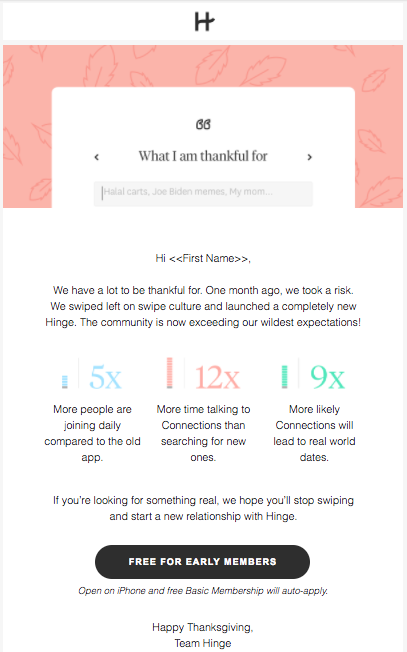
Hinge's holiday marketing campaign asks email subscribers what they're grateful for. [Click here to see the full email]

9. Lagavulin: Nick Offerman's Yule Log

This one is an oldie but a goodie. Actor, writer, and humorist Nick Offerman loves his whisky. He's sung about it before, and during a previous holiday season, he joined his favorite whisky brand, Lagavulin, to film a 45-minute video of — wait for it — Offerman sitting in a leather chair next to a crackling fire, drinking whisky and looking calmly at the camera. Where do we sign up for that gig?

"This is smart branding on Lagavulin's part," Kristina Monllos wrote for AdWeek. "Creating an extended ad that can serve as a conversation starter — should consumers swap the traditional Yule Log video for Offerman's at parties — will also get everyone talking about the brand."

Since the video was initially released, a new 10-hour version of it became available. Consider it our gift to you.

10. BarkPost: Yappy Thanksgiving Eve

Holidays are traditionally a time to be spent with family. For many of us, that includes our dogs.

BarkPost is no stranger to marketing campaigns that help "dog ruvers" include their furry friends into day-to-day life. In November, the pet-friendly brand showed how to do that at Thanksgiving, with a clever email that included holiday-themed cartoons and videos, feeding safety tips, and other holiday survival techniques — which, of course, involve your dog.

Plus, check out that adorable call to action at the bottom of the email: "Stop getting cute dogs in your email. Unsubscribe." I mean, who would want to unsubscribe from that?
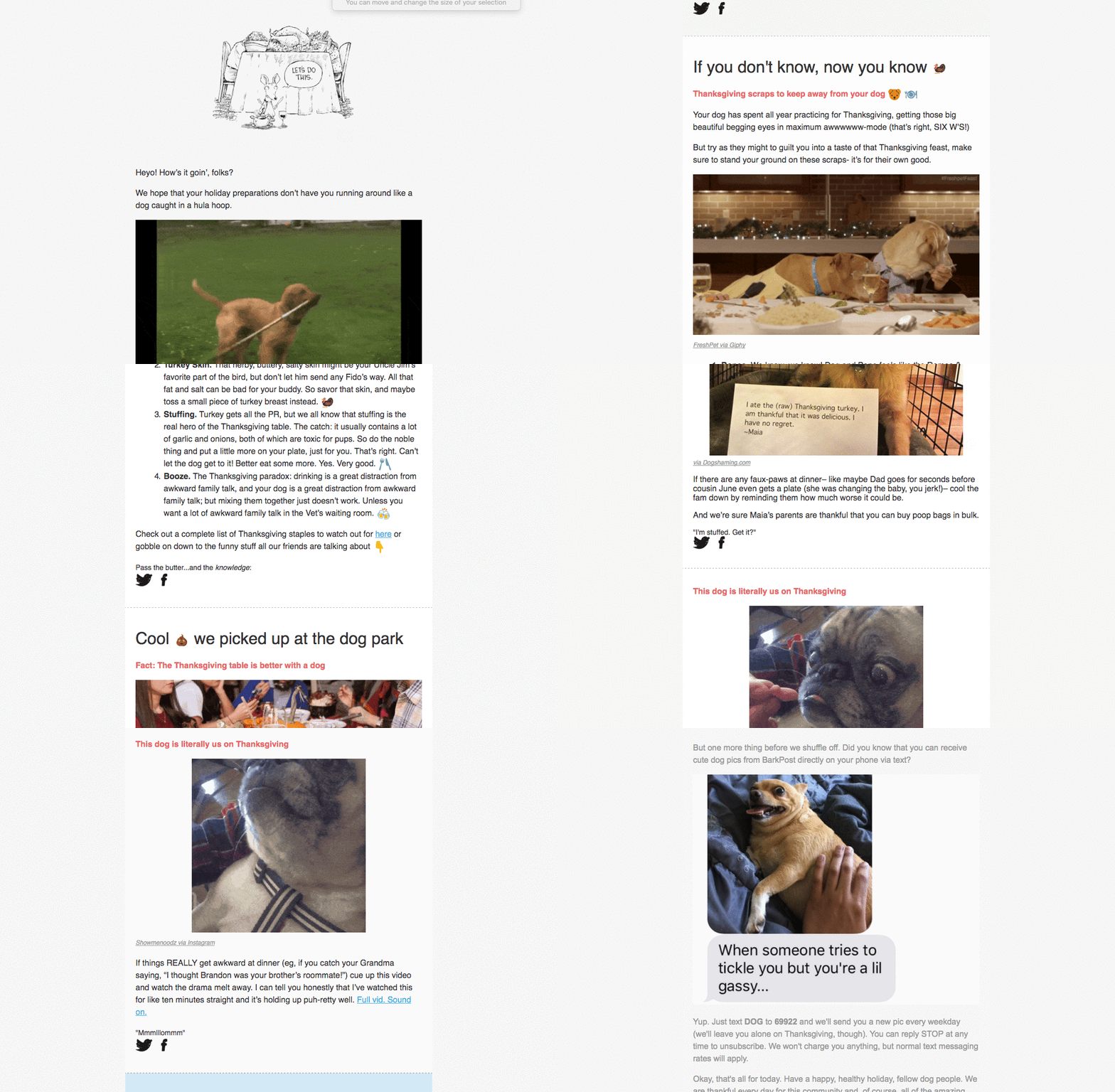
BarkPost's Thanksgiving holiday email campaign includes safety tips and adorable puppies.

11. reMarkable: Keep Your Goals for the New Year

You may not have heard of reMarkable, but no matter: this company is the definition of cool and simple. Their single offering is a tablet that acts as a “digital notebook.” When you jot anything down, the reMarkable tablet automatically turns your writing into typed notes. Pretty cool, huh? 

In its New Year email ad, reMarkable embodied the simplicity of its product by creating an equally simple campaign. In the email, they entice you to splurge with a $50 discount. Everyone knows that New Years is a time to make plans, set goals, and get your things in order. 

reMarkable presents its product as the way to do that. They want to help you save time, which will help you spend more time with your loved ones and pets in the upcoming year. And who likes transferring notes from a notebook to a tablet?

Image Source

12. Kool-Aid: All I Really Want for Christmas feat. Lil John

In a music-video styled ad, rapper Lil John quietly sits down to drink a glass of Kool-Aid as the Kool-Aid man smashes through his wall. At that moment, the bass drops as a festive musical video begins showing Lil John rapping in front of a family Christmas gathering. The video goes on to show Lil John, the Kool-Aid Man, and Santa dancing along with shots of holiday food, presents, and Lil John's Christmas list.

By launching a full-fledged music video with a prominent rapper, Kool-Aid both entertains prospects and demonstrates how "Kool" their brand is. Along with being humorous and entertaining, this ad also reminds you that you can still drink Kool-Aid during a time of the year where you're mostly thinking about hot beverages.

13. Resy: Where to Spend New Year’s Eve

Don’t want to cook for New Year’s Eve? We don’t want to, either—mostly because washing dishes is a chore. 

That’s what Resy bets on in a recent New Year email campaign. In a short but effective email, the company invites its subscribers to the best places to dine in the San Francisco Bay Area for the New Year. (If you’re not in San Francisco, you have the option to look for local eateries near you, also curated.) Like OpenTable, Resy allows you to make effortless reservations for you and your loved ones.  

We love that this simple email keeps the focus on what we can do to celebrate New Year’s Eve. And what better way to do that than through delicious, local food that we don’t have to cook ourselves?  

Image Source

14. Erste Group Bank: #EdgarsChristmas #believeinlove #believeinchristmas

You might not recognize this company, but you’d definitely recognize their holiday ad from 2018. Remember the cute porcupine who couldn’t get any friends because his spikes were, well, spiky? The short film has more than fifty million views on YouTube and touched millions of people’s hearts on other social media platforms. 

Erste Group Bank did it again during their 2020 holiday campaign. This time, they made it just a little bit more clear what they offer: loans that can help you purchase something that may feel out of reach, but that may help bring your family together. 

The ad begins with a granddaughter handing her grandfather his hearing aids. Throughout the video, the grandfather seems unhappy. We later find out that it’s because he’s been wanting to play music, but has no way to because he doesn’t own a piano. 

The granddaughter purchases a piano for him. In the end, the grandfather gets to play a song he’d written for his mother. The entire family joins in, and they play the song together.

15. Sonos + Spotify: #PlaylistPotluck

One great way to celebrate the holiday season is with an event. And with events typically come music. Spotify is aware of that tradition, which is why it created #PlaylistPotluck.

It started with a partnership with Sonos. The brands got together to turn playlists into something like a potluck in which everyone contributes something to bring the event together (the tagline of the campaign is "One home. One host. Everyone brings a dish.") Only, instead of contributing food or drink, everyone contributes a tune to a collaborative playlist.

Oh, look. That feature is available with Spotify!

The idea is delightfully interactive. Instead of using traditional invitations, guests RSVP to the potluck by adding songs to the collaborative playlist. And the cherry on top? Both brands also partnered with the PBS series "Mind of a Chef" for a televised holiday special, in which various celebrity chefs will be using the feature for their own meals.

What we love about this campaign is the fact that it incorporates several different elements and media formats to make it cohesive — a speaker system, a music-streaming app, and a televised special. Plus, if you participate, you're entered for a chance to win your very own dinner party, hosted by a world-renowned chef. Bon appetit — and rock on.

16. Google: Santa Tracker

While Google's Santa Tracker has been around for a few years now — and we recommend checking out the back story here — its features have evolved over time. Now there are interactive mini-games such as “Santa Selfie,” “Wrap Battle,” and “Build & Bolt.” Additionally, you can watch delightful short films such as “A Day at the Museum,” so you can see what Santa’s day-to-day looks like.

It's hard to narrow down what makes the Santa Tracker so delightful, but if we had to summarize it, we'd say this — it combines the holiday wonder of a belief in Santa with real-life technology. What a wonderful way to teach kids about the web, while also allowing them to be kids. (Although, we adults certainly appreciate it, too.)

Google even introduced a B2B element of the Santa Tracker by sharing the code with developers and releasing other elements of the tool as open source. Why make all of that information public? To inspire developers to create their "own magical experiences based on all the interesting and exciting components that came together to make Santa Tracker," writes Google's Developer Programs Engineer Sam Thorogood.

Up until Christmas Eve each year, visitors can have a peek at the "North Pole," to see what Santa's elves are up to as the holiday approaches.
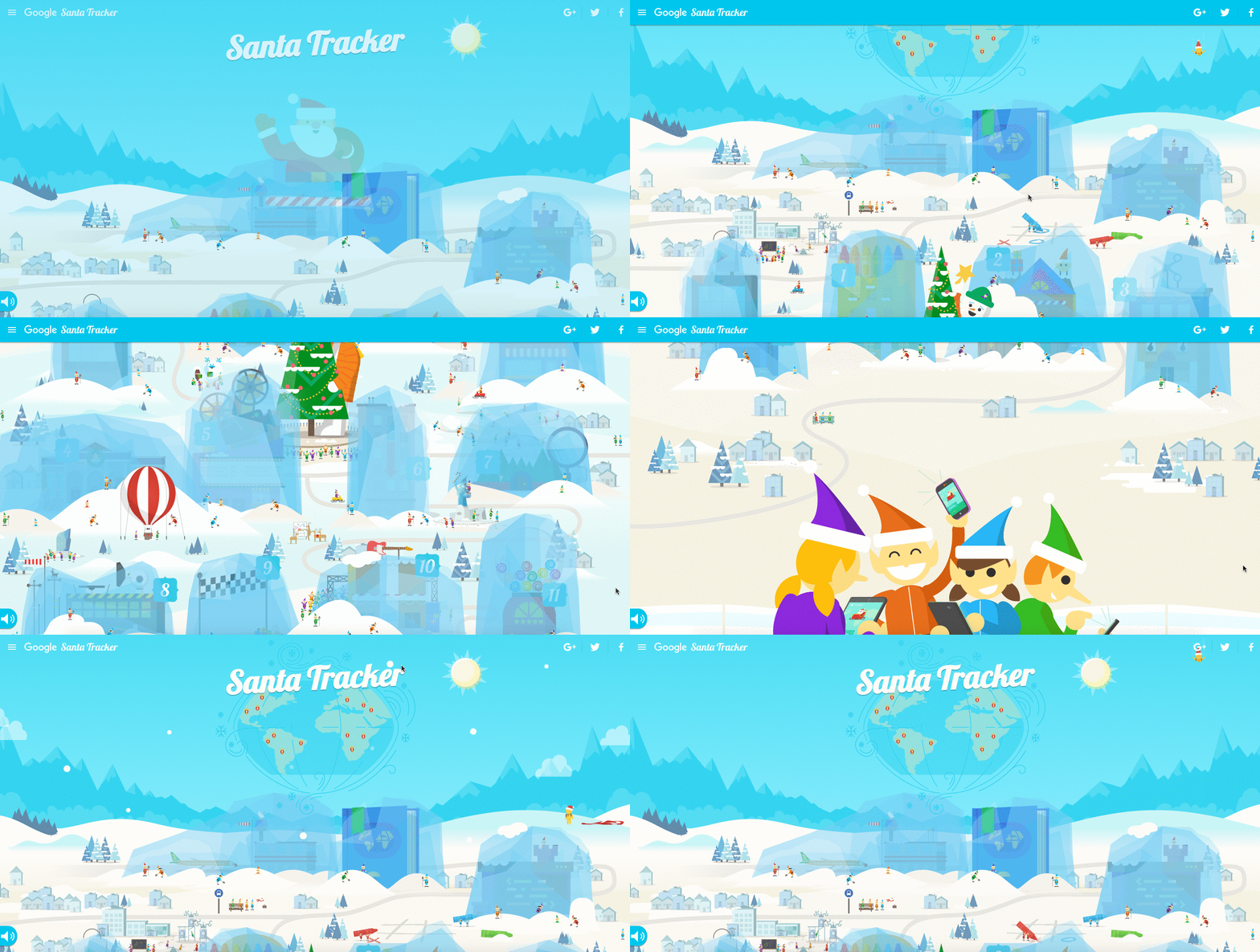
Google Santa Tracker

17. Disney: From Our Family to Yours

Culture, history, and holiday cheer come together in this holiday advertisement from Disney. The media giant takes advantage of their long-standing name to take us back to 1940, when a young girl gets her first Mickey Mouse plush toy.

As the video goes on, we see the little girl grow older until she becomes a grandma. She hands down the plush toy to her granddaughter, who doesn’t appreciate it as much as she becomes a young adult.

The granddaughter realizes how much it means to her grandma and restores the toy back to its former glory. We definitely did not cry when the grandma opened her holiday gift and saw her old toy fixed and restored. 

We expected something quite touching from Disney, and this one did not disappoint. We especially love how Filipino culture has been showcased to three million viewers and counting.

18. Black Owned Everything: Jingles and Things (with “Jingle Jangle: A Christmas Journey”)

Black Owned Everything, an Instagram curator of Black-owned businesses and brands, creates the perfect gift guide in Jingles and Things

Done in partnership with Netflix and the musical “Jingle Jangle: A Christmas Journey,” Jingles and Things curates the very best gifts for the holiday season, including items ranging from fragrance to dishware to dolls. There’s truly something for everyone here—and the best part is that we can support Black businesses while completing our holiday shopping.


Zerina Akers, the owner and head curator of Black Owned Everything, introduces us to the shop by explaining that it’s not just a marketplace but an inclusive platform. There’s nothing more that encapsulates the holiday spirit than inclusivity, community, and belonging, and we love that Jingles and Things uplifts that theme.

19. Heathrow Airport: The Heathrow Bears Return

This adorable holiday commercial from Heathrow Airport shows the journey of two grandparent teddy bears as they decide to pack up, leave their sunny home, and go visit their teddy-bear grandchildren for Christmas. At the end, you see the bears reunite with their family in London's Heathrow Airport.

For many, these bears are both nostalgic and relatable. They remind you of the bears you might have played with as a child and the average grandparents.  At the end, when you see the teddy bears join their family, you might also remember the happiness you felt when your grandparents came and brought you gifts or hugs during the holidays.

This commercial is a sequel to a similar commercial the Heathrow launched a year before, titled "Coming Home for Christmas". This ad follows the bears riding and exiting the plane to meet up with their family at a Heathrow Airport Gate:

This series of commercials has all the great aspects of an ad campaign because it’s relatable, nostalgic, and incredibly heartwarming.

Go Forth and Be Merry

Out of all the things that we appreciate about these campaigns, there might be one thing we like the most — the fact that they put the fun back in holidays. This season, don't let the stress get to you. Have a laugh or a cry with these examples, and please, be merry.

From our family to yours, happy holidays.

Editor's Note: This post was originally published in December 2015 and was updated in January 2021 for freshness, accuracy, and comprehensiveness.


19 Brilliant Examples of Holiday Marketing Campaigns was originally posted by Local Sign Company Irvine, Ca. https://goo.gl/4NmUQV https://goo.gl/bQ1zHR http://www.pearltrees.com/anaheimsigns

How to Get on Board With the Digital Transformation [+ Examples]

Ten years ago, I couldn't have cared less if the new burger place downtown had a website. Now, I don't trust one that doesn't. If your business is online, you're a part of the digital transformation. But it's not enough these days to just "be online." Businesses that will thrive in 2021 that are operating online — and the COVID-19 pandemic has proved this. 

Consumer buying behavior has drastically changed — today, most consumers are purchasing products online, including almost 70% of millennials. In 2019, nearly two-thirds of businesses ( 64% ) had a website. If you don't have one, you could be falling behind your online competition. 

So, while it’s a great step to have a website and a Facebook page, there’s more to the transformation than just having an online presence — technology should be ever-present in all of your business operations. This piece will explore the digital transformation, why businesses are getting on board, and outline the roadmap for enacting one for your business. We’ll also give some real-life success stories from companies that have bought into the digital transformation.


Essentially, a digital transformation fundamentally changes how businesses provide value to their customers and streamline their processes. It’s a reminder that materials and processes your company uses during day-to-day operations, no matter how big or small, might need a new medium — technology. Let’s take a look at why this transformation exists in the first place, with particular reference to the present pandemic. 

Why do businesses undergo a digital transformation?

Simply put, things are often easier when they’re online. New technology makes website building more accessible and creates more opportunities for businesses to connect with their audiences. A digital shift also saves time. You may already be using some methods of digital strategy, like Standard Operating Procedures (SOPs) , social media scheduling tools, and instant messaging apps; these are all examples of small digital transformations that replace paper instructions, outbound marketing, and an extra trip to your managers’ desk.  

A shift to digital processes also makes it easier to conduct overall large-scale business tasks. For instance, online databases that sort and catalog customer information, and automation tools that take over day-to-day activities and allow employees to focus their efforts on more pressing tasks. 

Customers have also begun to expect the businesses they interact with to have some sort of digital presence, whether it’s an optimized Google My Business profile for easy access to mapping instructions or an automated chatbot that can answer their questions over Facebook Messenger

In addition, the COVID-19 pandemic has further proven and accelerated the need for businesses to get on board with a digital transformation. As companies around the world were forced to pivot to providing service online or at a distance from their customers, having digital tools at their disposal was, and is, critical to survival. 

Many businesses have adopted different online practices during the pandemic, like providing digital customer service . It’s likely that, as a result of the pandemic and general trends, customers will expect that they’ll be able to conduct business online with their favorite brands.

70% of businesses today are finding that the digital shift is worth it, and these businesses either have a digital strategy in place, or are earnestly working towards one.

As a whole, 70% of businesses today are finding that the digital shift is worth it. These businesses either have a digital strategy in place or are earnestly working towards one. Whether you’re already one of these businesses or you’re hoping to begin your journey, let’s go over three critical questions that you can use as a roadmap for implementing your strategy. 


Digital Transformation Strategy

Business leaders are faced with a variety of options for enacting a digital transformation. As technology becomes more commonplace, there are a significant number of tools to choose from. While it may be exciting (and overwhelming) to imagine all of the possible upgrades you can make to your business, a digital transformation strategy will help you become more focused. 

This strategy is essentially a structured way to move through the process, how you get from point A (pre-transformation) to point B (post-transformation). Let’s go over some guiding questions and additional requirements to help you create a viable digital transformation strategy.

1. Why do we need a transformation?

Like all plans and strategies you’ve created for your business, designing your roadmap begins with identifying your purpose. You can start this process by uncovering the challenges your business faces that have significantly impacted success or processes that you feel may become easier with technology. This could be anything from day-to-day automation tasks like sending out email newsletters or more essential business needs like data collection and storage. 

You may also be hoping to address multiple challenges at once. For example, say your business has had trouble handling customer service requests because you’re using different platforms to store customer data and communicate with customers. Reps may have difficulty accessing a client's history with your company because they need to sift through other records and jump between platforms to find the information they need. This takes time, and clients may report being frustrated by how long it takes to resolve their issues. 

In this case, the answer to why do we need a transformation? is that your customer service team struggles to give customers the experiences they desire because of long wait times and a disorganized data storage system. Whatever your reasons are, identifying the challenges that expose the need for a digital transformation makes it easier to create further goals and metrics that will define your process’s success. 

2. What do I need to achieve to transform?

As mentioned above, the challenges and pain points you’ve identified answer why you need to transform. Once you have this why, it becomes easier to figure out what needs to be done and what steps you need to take to overcome the challenges you’ve outlined. 

Aim to come up with metrics or objectives you can use to guide yourself and your teams through this process, including workflows, identifying key stakeholders, and assigning critical tasks. If you have multiple pain points, come up with at least one objective or goal for each one of them. 

When you identify these objectives, come up with a time frame in which they should be met to succeed in your transformation. Continuing with the previous example, your challenge is that reps don’t have access to a summary of client history. Your objective can be that, over the course of the year, you want a streamlined process for inputting and cataloging customer information and a less than one minute wait time for accessing customer records during service interactions. With this goal in mind, you know what you need to achieve to say that you’ve transformed your process. With this, it becomes easier to identify the tools that will assist you along the way. 

3. What do I need to change to meet these goals?

The final question involves researching and identifying the technology you’ll need to successfully transform. Some of these may be middle-of-the-road tools that help you reach your end goal, while others may be the permanent solution you implement and use forever. 

Using the same example as before, you’ll want to know the tools you’ll need to use to begin the process of transferring the data you already have into the tool that your representatives will use to access customer data within the timeframe you laid out. This could mean that your initial tool is a simple data integration platform that you’ll use to merge existing data from your different sources. After this, maybe you’ll need a sorting tool that catalogs and organizes data into business-relevant categories, and this data will be further integrated into a Customer Relationship Platform (CRM) that all of your representatives have access to during customer interactions. 

4. Get company wide buy-in.

A digital transformation affects all areas of your business. Given this, it’s critical that you obtain company wide buy-in , from packing and fulfillment to C-Suite executives. You can’t just say “Okay we’re doing this!” and expect a seamless process, though. This is why this principle comes after the first three guiding questions — inspire buy-in using the understandings you’ve previously gathered. 

One of the first things you should do is present teams with a clear why statement that explains the reasons your business needs to undergo a digital transformation. Along with the why statement, present a value proposition to explain the benefits the business (and employees) will obtain from this transformation. Maybe you can share sample projections you’ve come up with or a case study you’ve created based on market research and competitive analysis (which we’ll cover below). 

Lastly, you should let them know that it’s an involved process. You’re not demanding that they get on board and deal with it — you want them to participate in the process. They can pose questions, offer suggestions, or simply ask about their new tasks.

5. Research industry and market competitors. 

As with most new projects, it’s important to understand what your competitors are doing. Conducting a competitive analysis can help you do this, as you’ll generate a well-rounded picture of how they’re performing. 

The results of your research will likely give you an understanding of how they do their business, if they’ve implemented and succeeded in a digital transformation, and uncover possible areas for your business to outperform them. It’s also important to conduct overall market research to understand what trends your industry is experiencing to understand how you compare, or as a means of inspiration to further guide your process. 

6. Create a budget. 

A digital transformation is a costly process, especially if it’s a complete overhaul of your current methods. Once you understand your purpose and outline how you’ll need to change, create a budget . This budget should address all possible expenses you’ll encounter throughout the process: software costs for transitional and permanent tools, any costs to hire new talent, employee training for new processes, and allocation of funds for any unexpected costs. 

The unexpected costs section of your budget may be the most important, as a digital transformation is based on change. These changes are likely new, so you’ll want to be prepared if any issues arise from adaptation difficulties along the way. 

7. Create a digital transformation roadmap.

Once you have all necessary information, the next step is to implement your strategy. Specifically, as mentioned above, how you’ll get from point A to point B. A digital transformation roadmap is the way to do this, and we’ll outline the steps below.


Digital Transformation Roadmap

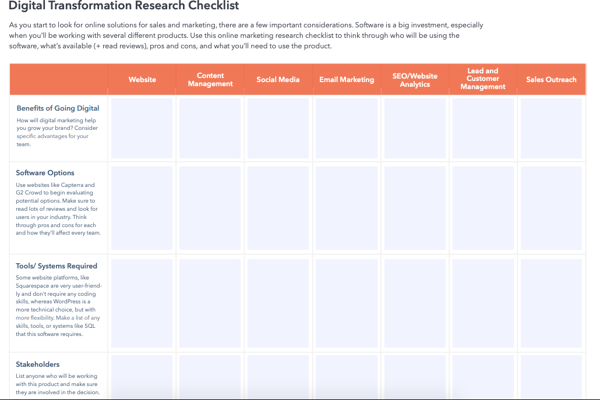
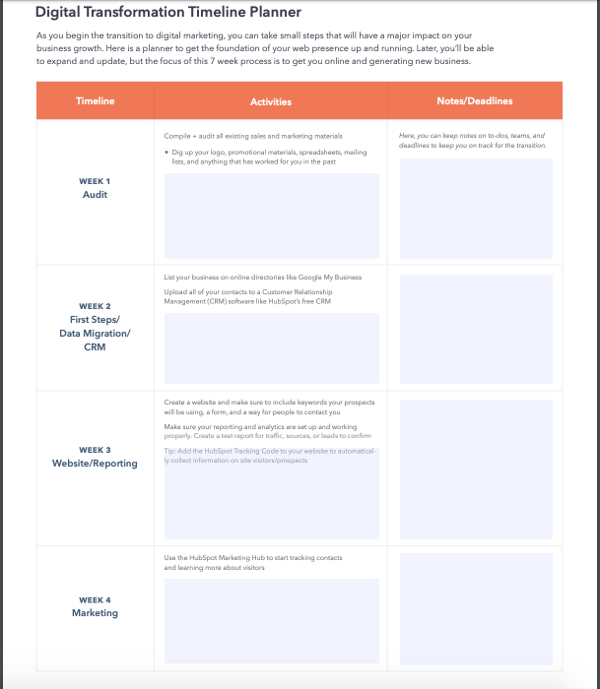
After you’ve created your strategy, a detailed plan will guide you through implementation. HubSpot offers a free template that will help you schedule and work through a digital transformation roadmap, broken down into seven weeks.

Firstly, this template comes with a checklist that you can fill in with the information you’ve gathered while creating your strategy. You can input benefits, what you need to achieve to transform, the tools you’ll need to transform, and key stakeholders for your business. Having all information in one place makes it easier to refer back to a common document as you navigate through your process.

digital transformation research checklist from hubspot

Week one is all about gathering existing sales and marketing materials on paper, while week two dives into transferring your business online, and so on. These small steps are designed to fit into your busy schedule and help you remain organized as you transition.

digital transformation checklist template

Week two is all about data migration. A free CRM, like HubSpot, can help you input business data, customer profiles, into an easy to access database. 

During weeks three and four, you should have a functioning website and marketing resources that will help you learn more about your visitors and their behavior. 

sample digital transformation checklist

The latter half of the weekly plan ramps up your online presence. Using this template can help you organize your new digital shift by area to avoid doing one huge push all at once and confusing employees.

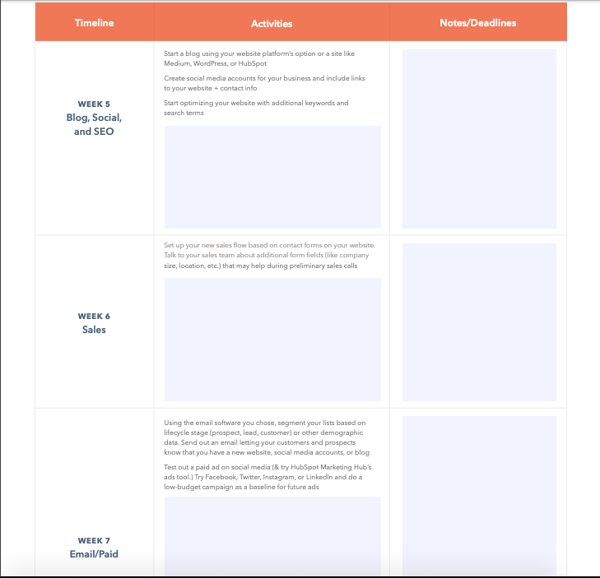
Creating a blog during week five will help you find your target audience online. Posts should be about your target market (if you're a tech marketing company, posts should center around the intersection between the two) to demonstrate your expertise. This will build your reputation as a thought leader in your industry.

By week six, you should set up a sales flow that will digitize your sales process. Online sales tools allow you to keep track of all your contacts, log your conversations, and keep tabs on-call schedules and upcoming meetings.

Email and paid ads should be rocking-and-rollin' by week seven. The email software you choose will help you through the process of sending automated emails to subscribers and let you test out paid ad software.

In a month and a half, most of your business processes will be digital.

Best of all, this template can be tailored to meet your business’ transformation individual needs and gives you the wiggle room to expand as your business continues to scale — but as a starting point, it gets you up and running. 

Once you’ve created your digital roadmap, it becomes easier to go more in-depth into your processes and create a finalized list of the technology you’ll need to succeed in your transformation. Below, we’ll go over some popular digital transformation tools to consider using.


Digital Transformation Tools

Depending on your overall transformation goals, there are multiple platforms available to help you succeed and meet your objectives. However, there are various multipurpose tools that can benefit all types of businesses, and we’ll go over a few of them below. 

1. Instant Messaging

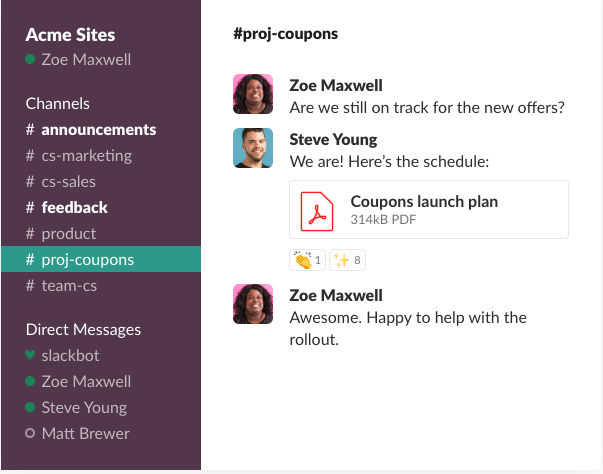
Instead of having a meeting or a long email thread for a quick message, consider using a company-wide instant messaging tool for quick and easy communications. Some instant messaging services are made for corporate settings, like Slack or Flock .

slack conversations dashboard example

Image Source

With these services, you can file share, direct message, and create channels where teams can collaborate and discuss projects. Think of it as the office water cooler — just online.

2. Application Tools

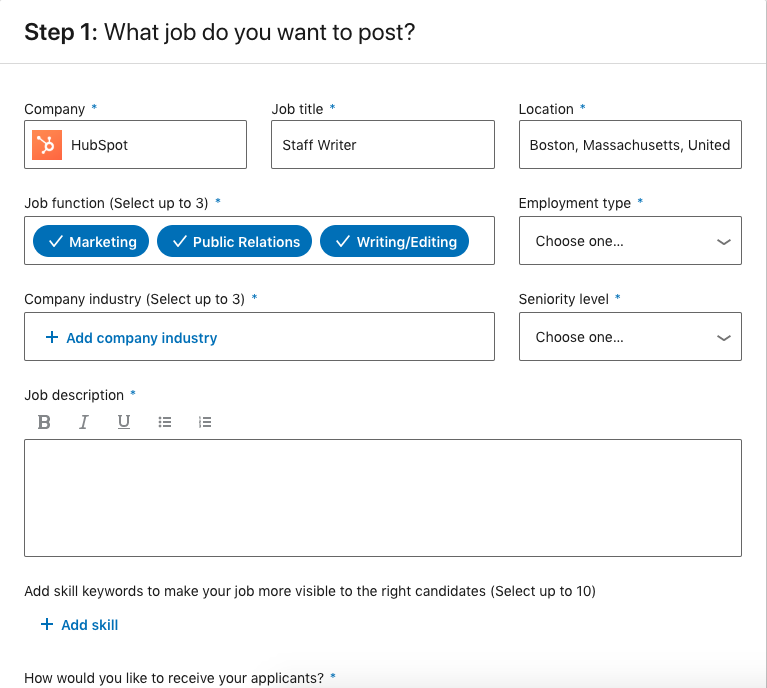
Are you looking for new talent? The best candidates (especially ones who prefer to work digitally) are online. For instance, LinkedIn, a site for professional networking, is an excellent source for recruiting candidates: 

how to make a job post on linkedin demo

Image Source

Using LinkedIn’s template will help you post a listing, and you can use LinkedIn’s industries function to ensure it’s shared with relevant candidates. LinkedIn will alert you of new entries and send you their applications, making the selection process an online breeze. This is an alternative to collecting application materials via email, where it might be difficult to structure, organize, and compile applications. 

3. Sales Management

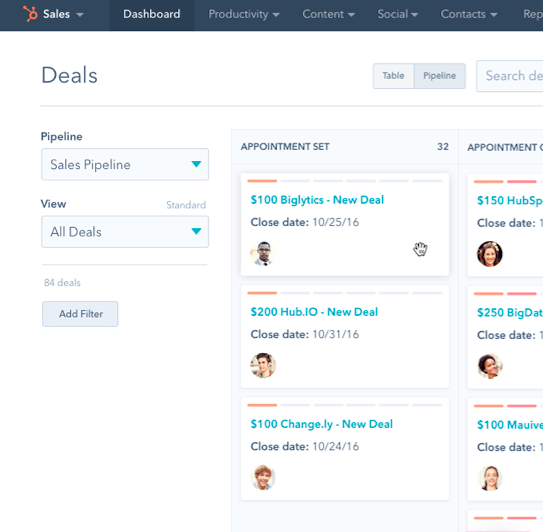
Software is available to help manage many facets of your business, including sales. This software enables you to manage calls, pipelines, reporting, and follow-up resources to help your process migrate smoothly online. 

hubspot crm sales pipeline manager demo

Image Source

For instance, as shown above, HubSpot’s Sales Hub can be used to organize all of your sales materials online. Within the platform, you can manage deals, filter contacts, and create different tasks using a dashboard to help you keep track of your sales processes. 

4. Standard Operating Procedures (SOPs)

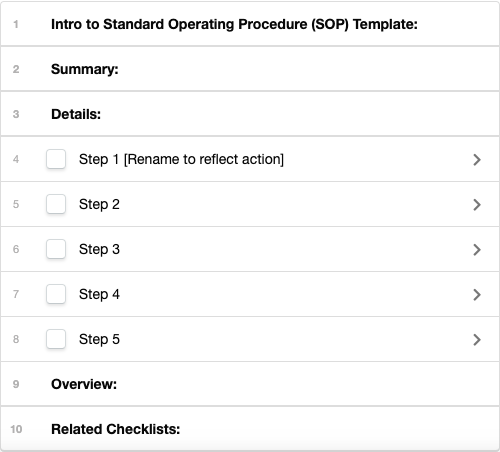
If you have certain aspects of your day-to-day that require multiple steps typically written down on paper, transfer it online. This will reduce paper trail and make the processes shareable and accessible to all employees. 

Online SOP software makes it easy to list procedures and job functions, which can be beneficial for onboarding and employee training. To make a smooth transition to your new digital tool, consider talking to employees and asking them to contribute and collaborate with you in the process. The image below is an example of a digital SOP workflow management tool by Process.st .

sop checklist demo

Image Source

5. Customer Relationship Management (CRM) Software

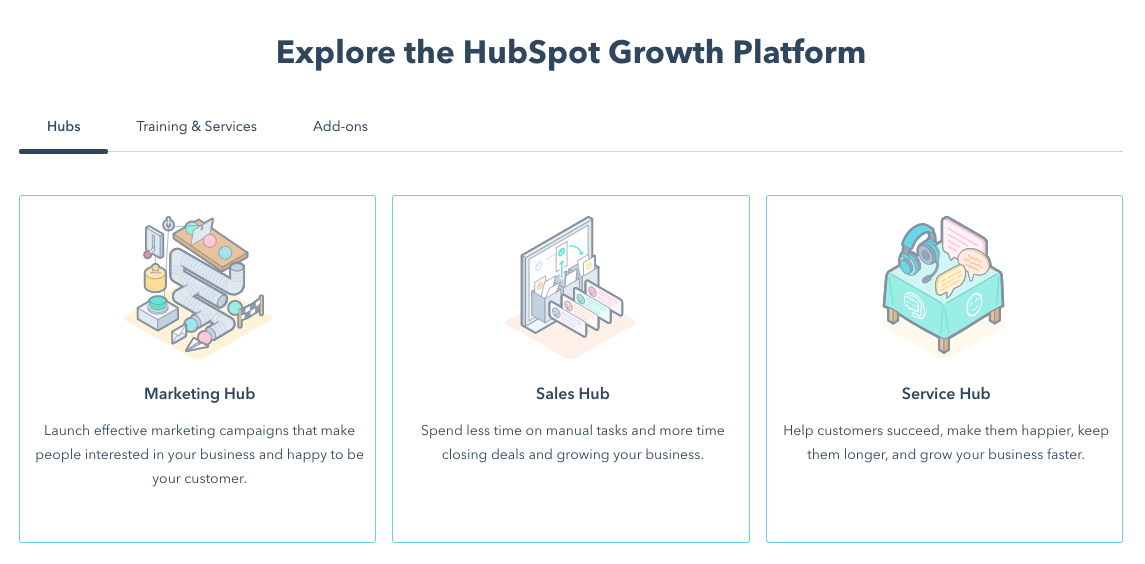
A CRM is going to be your best friend when shifting to an all-digital business. Whether your goals are to transform the customer experience, streamline sales, or digitize your marketing process, a CRM will make these processes more straightforward and even automate repetitive tasks. HubSpot’s free CRM offers three hubs that give you an all-in-one business platform designed for scalable growth. 

hubspot crm homepage demo

Image Source

HubSpot's free CRM offers three hubs that give you an all-in-one business platform experience. From customer service reps to sales leaders and business owners, this free CRM helps you fully transfer your business online and drive growth.

6. Video Chat Software

Is your team out of town but you need to schedule a meeting? Are your representatives transitioning to a remote, work-from-home model but you still want to maintain a collaborative environment? Use video chat software to meet virtually and maintain employee connections. 

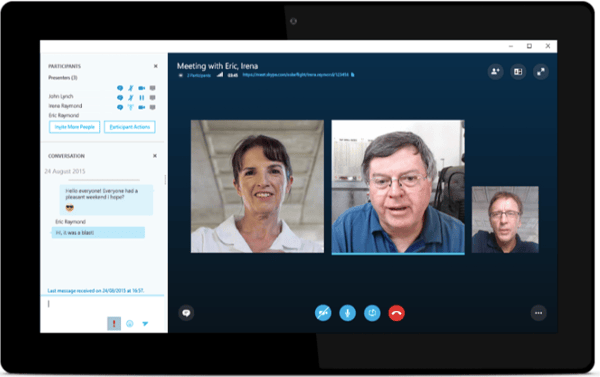
Software like Skype for Business and Zoom offer free web-chatting services for professional use.

skype video chat software demo

Image Source

Skype has automatic subtitle settings and 1:1 capabilities, and the option to host multiple people on calls at once. Most software also has mobile applications to make sure you’re accessible and able to meet at any point during the workday. 

Though these tools are designed to make your life easier, you may be confused about how they can apply to your business. Thankfully, many companies that are joining the digital revolution are doing so because they have similar needs. Below, we’ll go over digital transformation trends that you can use to further guide your process and understand how to apply the tools to meet your business needs.


Digital Transformation Trends

As the digital world grows, many businesses are jumping on the transformation trend. Whether you already have your own plan or you’re hoping to get inspiration for a future transformation, let’s go over digital transformation trends to look out for in 2021. 

Rapid Adoption of a Digital Operating Model

COVID-19 has required businesses to quickly adapt to online models. As the pandemic could not have been predicted, many businesses were left scrambling to scale their processes as in-person, and on-site business models became unsafe. Most industries needed to rise to the occasion unless they simply could not adapt to a work-from-home or work-from-online model. 

For example, customer service businesses found themselves needing to integrate online processes to successfully meet customer needs, like chatbots to answer routine and simple questions. Restaurants and grocery stores offering food services were forced to adapt to online food and grocery delivery options to continue to safely provide nourishment to customers. 

As COVID-19 related outbreaks become controlled, the need to adapt won’t die out but instead will become a requirement. Businesses will need to continue to utilize the new tools they’ve adapted or create detailed plans for future unpredictable circumstances that may force them to adapt quickly.  

AI and Machine Learning

Consumers are expecting personalized experiences now more than ever. Personalized experiences are also a driving factor of customer loyalty, as 41% of customers have reported switching companies because of poor personalization . This doesn’t just mean that customers want you to refer to them by their name when they call you on the phone; they want your business to know what they want before they know they want it. 

Because of this, a popular transformation trend is the adoption of AI and Machine Learning tools that contribute to personalized and customer-tailored experiences. A typical example of this is the algorithms on Netflix. It analyzes your previous watch history, likes and dislikes, and content ratings to figure out what you’re most likely to enjoy and recommends new content. This process works, as approximately 80% of the TV shows people watch on Netflix are discovered through recommendations. 

However, outside of providing different experiences for your customers, AI and Machine Learning can also involve streamlining rote processes that your employees do themselves, like cleaning up and organizing your data or using a social media scheduling tool to post and analyze your social profiles. McKinsey has predicted that, across the board, this kind of automation can increase productivity by 14% annually

Location-Adaptable Technology

Also influenced by COVID-19, businesses in 2020 have realized how important it is to have an arsenal of tools available that will allow their employees to work remotely whenever necessary. Some of these tools are familiar options, like Google Suite, Microsoft Office Teams, and Trello, but additional tools have gained popularity throughout 2020.

Ring Central is one of these tools, as it enables calls to your business line to be forwarded to mobile phones, or remote working employees. This is extremely beneficial for customer experience focused businesses. Zoom is another tool that has become a communication powerhouse over the last few months. It is an easy-to-use desktop platform for scheduling, hosting, and recording company meetings. 

All in all, COVID-19 has shown us that working from home is a valuable modell for businesses to consider, both during and after the pandemic. Some businesses have already committed to continuing this practice as time goes on. For example, Google has pushed back planned office returned dates to September 2021 and has said that the company will be testing a flexible workweek model where employees can split their workweek between working from home and participating in office collaboration days.

Application Programming Interface (API) Security

As processes become digital, it becomes even more important to protect the private, sensitive information you store within your company platforms. Given this, a recent digital transformation trend is an increased need for API security. 

In short, the APIs you’re using are the products you’ve implemented due to your digital transformation strategy, like Slack. Slack is a tool that can house business communications between internal teams and business employees. You’re likely using Slack to send out private information that is business-sensitive, but how are you going to ensure that this data isn’t taken advantage of?API security

API security involves using safety measures that ensure your sensitive information is secure and safe from hackers or external threats, like encryption services and two-factor authentication. While these measures are essential for your business information, API security is also important to consumers. 

For them, this means that the information you collect from them is stored securely and also safe from external threats. This means that if they enter banking information on your site to make a purchase, they want that information safe from malware. If you have an app that they’ve downloaded onto their phone, they want to know that the app is secure, and no third-party has access to this information. 84% of customers are more loyal to companies with robust security, so it’s worth adapting these processes. 


Given the trends mentioned above, it’s clear that digital transformation is something to focus on for 2021 if you haven’t already begun the process for your business. Or, if you have, maybe you’re hoping to address a different business challenge and start a new process entirely. Whatever your desires are, let’s go over four real-life examples of brands that have gone digital in a notable way. 

1. Nike

Nike, a sportswear company, has focused their digital transformation strategy on mobile devices. Rather than needing to visit a store and consult with an in-person employee, their mobile application uses machine learning and AI algorithms to study customer preferences and previous purchases to recommend products they may enjoy. 

The company also created a scanning tool where customers can scan their feet and the AI uses 13 data points to recommend the best pair of shoes. This automation eliminates the need to obtain recommendations from an in-store employee, so users can make decisions at home and spend less time in stores because they already know what they want. 

During the pandemic, this tool has become especially useful as customers can get shoe recommendations and make purchases online, ensuring the safety of in-house employees and other visitors. 

2. Wepow

Wepow is a Human Resources tech company. They have enacted a digital transformation to digitize the application and hiring process. Like Nike, the company has used AI and machine learning to analyze data to make it easier for employers and applications to connect digitally through online video interviewing and online applications. 

During the pandemic, businesses like this have become a beneficial resource as an alternative to in-person interviewing as remote work and safety requirements do not allow for in-house interviewing. 

3. Target

Target, a U.S. based department store, has spent the past eight years enacting a digital transformation that bridges the gap between in-person and Ecommerce shopping. 

Many of their stores have been remodeled and equipped with new technology like self-checkout kiosks and in-store scanners to obtain information about products they’re interested in rather than asking for help from a store attendant. As a result, employees spend less time on rote processes and focus on customer service needs that can’t be solved with a digital tool. 

A transformation that has become increasingly beneficial during COVID-19 is their online shopping and curbside pickup option. Even though customers may be shying away from visiting a store, they may not want to wait for a shipped item to arrive at their house. Curbside pickup allows them to order everything they need online and seamlessly pick up their items at a physical Target location without leaving their car and entering a store. 

4. Museo Nacional Thyssen-Borenmisza

Part of the allure of visiting a museum is the ability to aimlessly walk through exhibits and lose track of time. This desire hasn’t changed, but unfortunately, health and safety regulations have limited or gotten rid of the ability to safely browse your favorite galleries. 

Museo Nacional Thyssen-Borenmisza, an art museum in Madrid, has risen to the occasion and undergone a digital transformation that allows art enthusiasts to continue enjoying what the museum has to offer from the comfort of their own home. They’ve digitized some of their most popular galleries and created an online museum walkthrough for interested visitors to explore and immerse themselves in the art. 

Join In on the Digital Transformation

Digital transformation is digital because technology is used to solve traditional business problems and enhance the customer experience. For most businesses, some sort of digital presence has always been essential. However, recent health and safety requirements have shown that now, more than ever, businesses must have the ability to rise to the occasion and meet customers online. 

To make sure that you’re one of these businesses, take the time to create a digital transformation roadmap, research the necessary tools, and understand the trends that have inspired other businesses to change. Being prepared now sets you up for success, regardless of what the future holds. 


How to Get on Board With the Digital Transformation [+ Examples] was originally posted by Local Sign Company Irvine, Ca. https://goo.gl/4NmUQV https://goo.gl/bQ1zHR http://www.pearltrees.com/anaheimsigns
The State of Video Marketing in 2021 [New Data]

It's well established that video has been one of the breakout trends in the marketing world for the past decade.

But how is that assertion standing up to the twists and turns of a global pandemic? 

The challenges — and changes — brought about by this most surreal year have affected us all. 

At Wyzowl, we've released an annual State of Video Marketing survey every year since 2015, charting usage, spend, channels and opinions among video marketers and consumers. 

We recently released our seventh State of Video Marketing report and, in light of the chaos of the past year, it's perhaps our most fascinating set of findings yet.

Our research suggests:

  • Video remains a key priority for marketers with usage and spend both, overall, increasing slightly throughout 2020, and plans to increase again in the next 12 months.
  • The pandemic has impacted the video marketing landscape in contrasting ways - while video is generally seen as a more necessary tool by both marketers and consumers, many have seen budgets restricted and plans shelved.
  • The pandemic has overwhelmingly increased the amount of online video people watch.
  • Marketers feel more positive about the return on investment offered by video than ever, as it continues to strongly influence traffic, leads, sales, and audience understanding.
  • Consumers continue to use video as an integral part of their journey with brands, and are excited to see even more video content in the year ahead.

About the Survey

Wyzowl's State of Video Marketing Survey is an annual report, now in its seventh iteration. Every year, we ask a range of questions — many of them the same from year-to-year — to evaluate how the video marketing landscape is changing and growing. 

This time round, our survey was taken by a sample of 813 unique respondents (our highest ever sample) consisting of professional marketers and consumers.

The key findings …

86% of businesses use video as a marketing tool, up slightly from 85% in 2019.

This is the high point in a general story of video usage growing which can be traced back to 2016 (the first time we asked this particular question in this way.)

What's more, 93% of marketers who use video say that it's an important part of their marketing strategy — an increase from 92% in 2020, making this the highest percentage of any year since 2015.

Perhaps most strikingly, 87% of video marketers reported that video gives them a positive ROI — a world away from the lowly 33% who felt that way in 2015. This could well be attributed to greater understanding of how to use video, as well as how to track and quantify its impact

Pandemic Impact

So what about the impact of the global pandemic? 

Let's begin with the fact that 91% of marketers feel the pandemic has made video more important for brands.

A fairly considerable 40% of video marketers said their plans to create video were affected by the events of the last year — with around 74% of these saying they were more likely to use video, and 26% saying it was less likely. 

Around 60% of video marketers say they expect their budget to be affected for 2021, with around 70% of those people expecting a higher video marketing budget, and the other 30% expecting it to be lower.

68% of consumers say the pandemic has impacted the amount of video content they've watched online, with the overwhelming majority (96%) saying this has increased.

Looking forward …

All the signs suggest that usage and spend are on course to continue their growth in 2021.

More than 99% of current video marketers told us they'll continue using video in 2021, and 96% plan to increase or maintain their spend (again, up slightly from 95% last year.)

What's more, from the people who told us they don't currently use video, 69% told us they expect to start in 2020. (This is 10% higher than last year's figure of 59%.)


The net result of this is that we can all expect to see more noise and competition for audience attention in the coming 12 months.

Of course, while this is a challenge, it isn't an insurmountable one. It simply raises the bar in terms of content quality. Video needs to be well-planned, and very well-executed.

The big opportunities …

You'd be forgiven for looking at these numbers and feeling that video might be on the verge of reaching saturation point. Most of the data around usage, spend, and consumer opinion are in the 80s and 90s — where they've held, consistently, for a number of years.

But the good news is that there still seems to be underutilized opportunities for marketers to explore around video.

Unsurprisingly, YouTube and Facebook are the most widely used platforms among video marketers — used by 87% and 70%, respectively. 

But some of the lesser-used video tactics also seem to be reaping real results for video marketers.

Most notably, perhaps given global events and an increased desire for remote connection, 2020 seems to have been the year of the webinar. In 2019, just 46% used webinars — but in 2020, this rose significantly to 62%.


What's more, an overwhelming 91% of webinar marketers say they've been a success, making it the most effective video marketing channel of all those listed.

To Sum Up

The events of 2020 did, and are doing, little to slow the rise of video. 

In many ways, with people being isolated in their homes, and some teams working with less budgeting and resources than pre-pandemic, the demand (and consumption) of video has been accelerated.

Video looks set to continue its ten-year overnight success story into the coming decade. These stats paint a picture of a media type that's almost universally popular among both marketers and their audiences, helping achieve a number of incredibly important goals.

You can check out the full report — with plenty more data points — and get a downloadable version by visiting Wyzowl's State of Video Marketing 2021 page.


The State of Video Marketing in 2021 [New Data] was originally posted by Local Sign Company Irvine, Ca. https://goo.gl/4NmUQV https://goo.gl/bQ1zHR http://www.pearltrees.com/anaheimsigns
How to Use Schema Markup to Improve Your Website's Structure

Just like when I first watched The Matrix, when I initially heard the term "schema markup," I was intimidated by the technical know-how I felt I needed to understand it.

However, just like the movie, understanding schema markup isn't as difficult as you might think.

As a marketer, schema markup is important because you want to make it as easy as possible for search engines to crawl your website.

The easier it is for Google to understand your site, the higher in search engines your website can appear.

Below, let's review what schema markup is, where to add it, and how it can improve your website's structure.

What Is Schema Markup?

Schema markup is code you can add to your website that helps search engines return better results for users. Essentially, it gives vital information to search engines to include in your listing that can improve visibility online, as well as click-through rates.

In 2011, top search engines including Google, Yahoo, Bing, and Yandex collaborated to create schema.org, which is a "collaborative, community activity with a mission to create, maintain, and promote schemas for structured data on the Internet, on web pages, in email messages, and beyond."

Ultimately, schema markup is a form of microdata. According to Wikipedia, "microdata is an HTML specification used to nest metadata within existing content on web pages. Search engines, web crawlers, and browsers can extract and process microdata from a web page and use it to provide a richer browsing experience for users."

For instance, schema markup will create an enhanced description -- sometimes referred to as a rich snippet -- which will appear in search results.

As a result of using microdata, your website's structure will be simple and easy for search engines to crawl, making it easier to appear higher in search results.

1. iPhone 11 Example

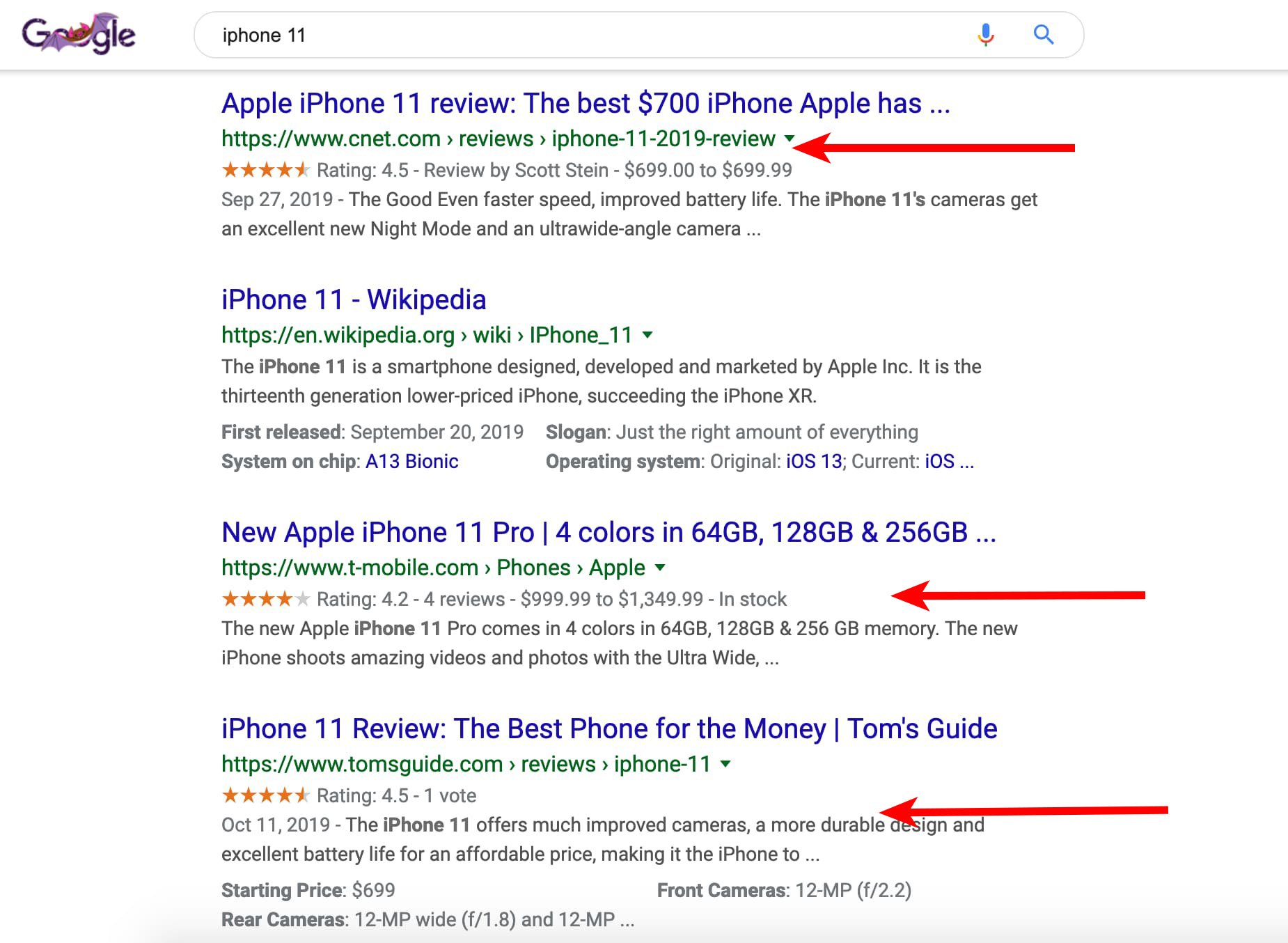
Below is an example of a search engine results page featuring listings with and without schema markup data. As you can see, three of the top four results for the iPhone 11 have schema markup data including ratings, reviews, and price.

Although T-Mobile and Tom's Guide are the third and fourth listing down, using schema markup microdata can improve its click-through-rate. Plus, it helps the listing stand out from the rest.

iphone-schema-markup-example

2. Betabrand Example

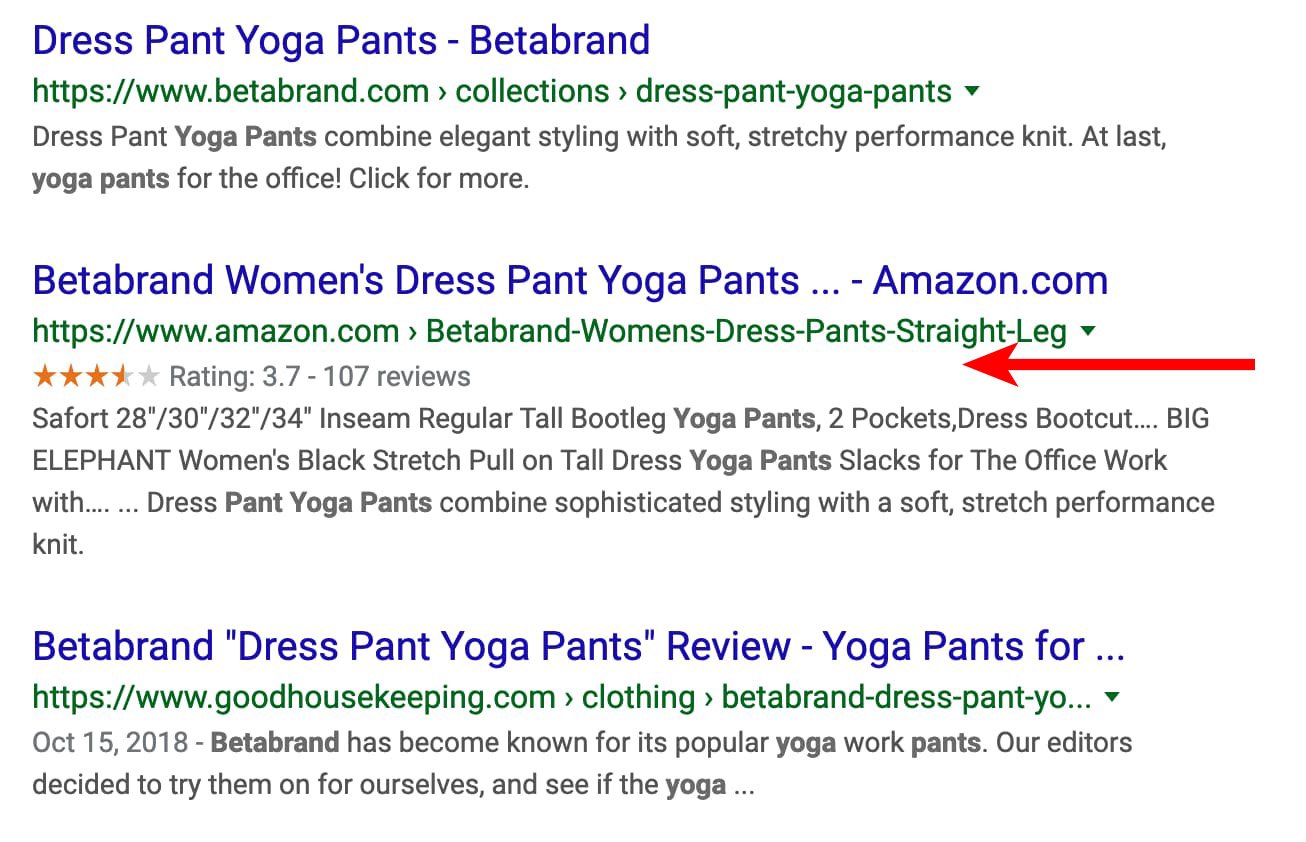
In the example below, there are three listings for Betabrand yoga pants on Google. The ones from Betabrand and Good Housekeeping don't include additional information.

However, the one from Amazon includes ratings and reviews.

Again, including this type of information helps search engines provide more information that can persuade users to click on your listing.

betabrand-schema-markup-example

3. Booking.com Example

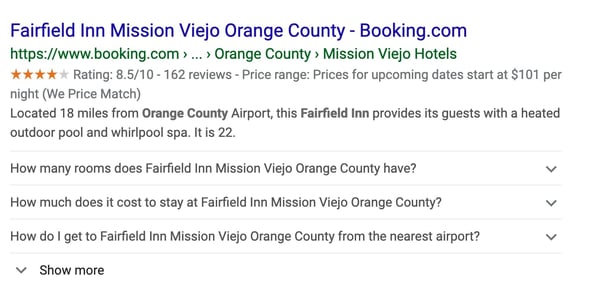
In the example below, you can see Booking.com used schema markup to include ratings, reviews, price, and Frequently Asked Questions for an Orange County hotel. In their listing, they include a drop-down, answering questions a user might have.

If someone is searching for and might be staying in that hotel they can learn how close it is to the airport, the average cost, and the ratings.

Fairfield Inn schema markup data on Google.

Where to Add Schema Markup

You can add a variety of microdata depending on your service or product.

For example, you can include:

  • Reviews
  • Star ratings
  • Pricing
  • Availability
  • Events
  • Location
  • Price range
  • Payment options
  • Store hours

The options are endless. No matter what service or product you sell, you can use schema markup to enhance your search engine listings.

So, how do you add schema markup to your site?

Schema Markup Generator

The process is actually pretty simple. All you need to do is use a schema markup generator.

Step 1: Go to Google's Structured Data Markup Helper

Step 2: Select the type of listing you want to add schema markup to. Then, copy and paste the URL in the form field.

Step 3: Add schema markup data on the right pane by filling in the information you want to show up.

Step 4: Hit "Create HTML" button.

Step 5: Copy and paste the yellow, highlighted code. This is your schema markup code. Alternatively, you can hit the "Download" button to grab the code.

Step 6: Paste the code into your content management system.

Once you've gone through this process, you'll want to then test your schema markup to make sure it shows up correctly in search engines.

If you use HubSpot, you can actually use a Schema Helper integration to add schema markup to your posts.

Below, let's review how to test your listing.

Schema Markup Tester

Now that you've added the schema markup code to your site, it's time to test it out. You can do this by using the Google Structured Data Testing Tool.

You can test your schema markup two ways: by URL or code.

To test the URL, all you need to do is copy and paste the URL of the webpage you want to see. Then, the tool will showcase a preview of your listing.

To test the code, you can copy and paste the code the structured data markup tool generated for you. Again, a preview of your listing will appear.

While schema markup may seem technically intimidating, it's actually a simple process. By using schema markup code, you can increase the visibility of your search engine listings and improve click-through-rates.


How to Use Schema Markup to Improve Your Website's Structure was originally posted by Local Sign Company Irvine, Ca. https://goo.gl/4NmUQV https://goo.gl/bQ1zHR http://www.pearltrees.com/anaheimsigns
How to Do a SWOT Analysis [With Template & Examples]

As your business grows, you face more obstacles, challenges, opportunities, and projects in general. It's a good and natural part of scaling an organization, but how do you determine your priorities? Which initiatives should you execute on first, and which challenges should you address right away?

Enter the SWOT analysis, a framework that can help you develop a roadmap for moving forward with your business, maximizing opportunities and minimizing roadblocks along the way. 

While it may seems simple on the surface, a SWOT analysis allows you to make unbiased evaluations on: 

  • Your business or brand
  • Market positioning
  • A new project or initiative
  • A specific campaign or channel

Practically anything that requires strategic planning, internal or external, can have the SWOT framework applied to it, helping you avoid unnecessary errors down the road from lack of insight. 

Importance of SWOT Analysis

You've noticed by now that SWOT stands for Strengths, Weaknesses, Opportunities, and Threads. The framework seems simple enough that you'd be tempted to forego doing using it at all, relying instead on your intuition to take these things into account. 

But you shouldn't. Doing a SWOT analysis is important because: 

  • It gives you the chance to worry and to dream. Adding the SWOT analysis as an important step in your strategic process, you're giving yourself the space to dream, evaluate, and worry before taking action. Your insights in this regard then turn into assets as you create the roadmap for your project or initiative.
  • It forces you to define your variables. Instead of diving head first into the planning and execution, you're taking inventory of all your assets and roadblocks. These can help you create a more specific and effective roadmap.
  • It allows you to think more critically and account for mitigating factors. As you identify weaknesses and threats, you're better enabled to account for them in your roadmap, improving your chances for success.
  • It helps you keep a written account. As your organization grows and changes, you'll be able to strike things off your old SWOTs and add new things as the industry changes. It can be illuminating to look back to where you started as you look ahead at what's to come.

Here, we’ll tackle how to best do a SWOT analysis, provide you with a SWOT analysis template, and conduct SWOT analyses on major brands Apple and Starbucks. When you’re done reading, you’ll have all the inspiration and tactical advice you need to tackle a SWOT analysis for yourself.

How Do You Write a Good SWOT Analysis?

There are several steps you’ll want to take when evaluating your business and conducting a strategic SWOT analysis.

1. Download HubSpot's SWOT Analysis Template.

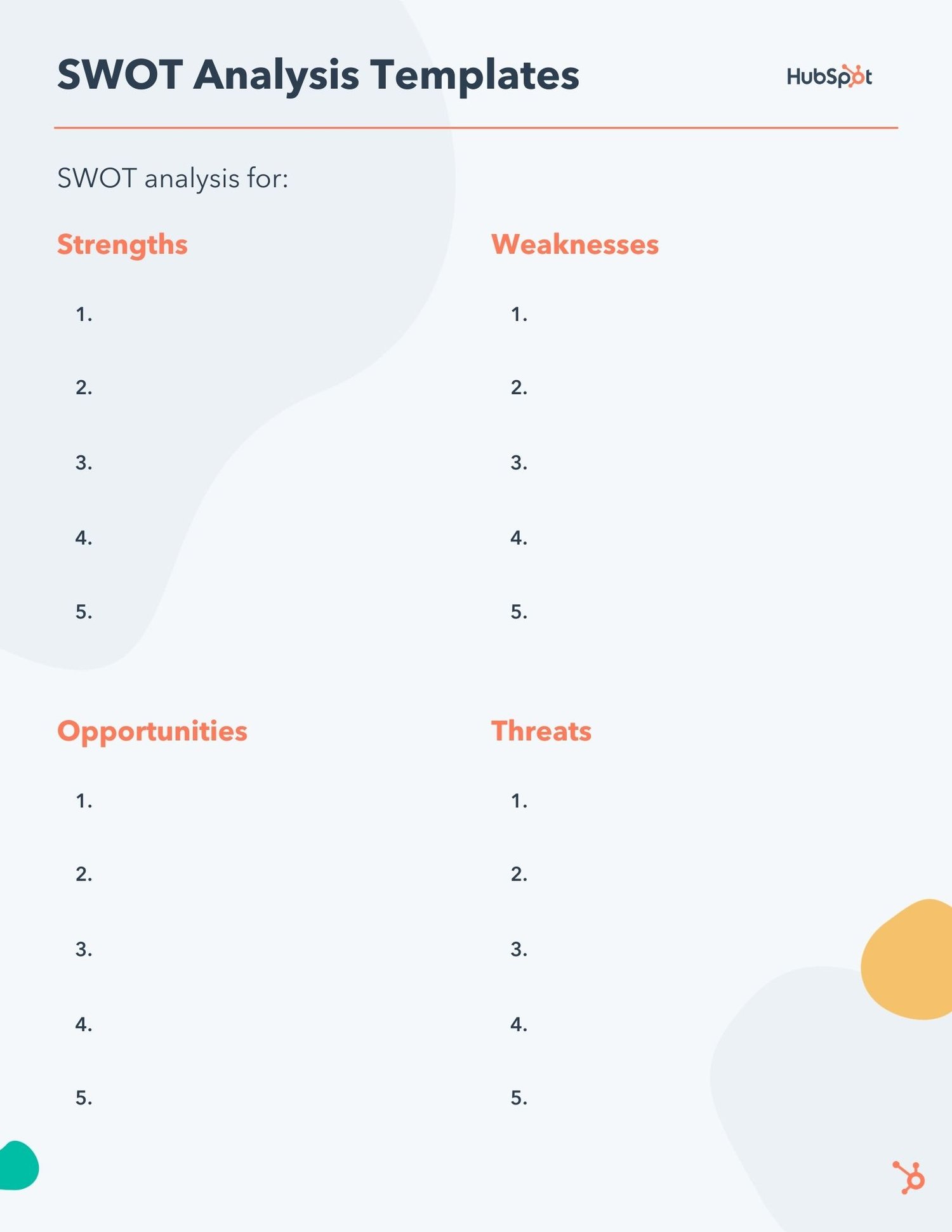
There's no need to start from scratch for your analysis. Here, I’ve created a sample using a free, editable template -- feel free to use the model yourself, or create your own as it suits your needs.

free editable SWOT Analysis pdf template

Download a free, editable SWOT analysis template.

2. Arrange each section into a table with four quadrants.

Whether you use the template above as a model or create your own to suit your needs, it can be helpful to start in table format to visualize your SWOT analysis. This can be done by arranging each of the four sections into separate quadrants.

3. Identify your objective.

Before you start writing things down, you’ll need to figure out what you’re evaluating with your SWOT analysis. Be specific with what you want to analyze. Otherwise, your SWOT analysis may end up being too broad, and you'll get analysis paralysis as you are making your evaluations.

If you're creating a social media program, you'll want to conduct an analysis to inform your content creation strategy. If you're launching a new product, you'll want to understand its potential positioning in the space. If you're considering a brand re-design, you'll want to consider existing and future brand conceptions. 

All of these are examples of good reasons to conduct a SWOT analysis. By identifying your objective, you'll be able tailor your evaluation to get more actionable insights.

3. Identify your strengths.

"Strengths" refers to what you are currently doing well. Think about the factors that are going in your favor as well as the things you offer that your competitors just can't beat.

For example, let’s say you want to use a SWOT analysis to evaluate your new social media strategy.

If you’re looking at a new social media program, perhaps you want to evaluate how your brand is perceived by the public -- is it easily recognizable and well-known? Even if it’s not popular with a widespread group, is it well-received by a specific audience in particular?

Next, think about your process: is it effective or innovative? Is there good communication between your marketing and sales to ensure both departments use similar vocabulary when discussing your product?

Finally, evaluate your social media message, and in particular, how it differs from the rest of the industry. I’m willing to bet you can make a lengthy list of some major strengths of your social media strategy over your competitors, so try to dive into your strengths from there.

4. Identify your weaknesses.

Similarly to your strengths, what are the roadblocks hindering you from reaching your goals? What do your competitors offer that continue to be a thorn in your side. This section isn't about being a Negative Nancy. Rather, it's critical to foresee any potential obstacles that could mitigate your success.

When identifying weaknesses, consider what areas of your business are the least profitable, where you lack certain resources, or what costs you the most time and money. Take input from employees in different departments, as they’ll likely see weaknesses you hadn’t considered.

If you’re examining a new social media strategy, you might start by asking yourself these questions: First, if I were a consumer, what would prevent me from buying this product, or engaging with this business? What would make me click away from the screen?

Second, what do I foresee as the biggest hinderance to my employees’ productivity, or their ability to get the job done efficiently? What derails their social media efforts?

5. Consider your opportunities.

This is your chance to dream big. What are some opportunities for your social media strategy you hope, but don’t necessarily expect, to reach?

For instance, maybe you’re hoping your Facebook ads will attract a new, larger demographic. Maybe you’re hoping your YouTube video gets 10,000 views, and increases sales by 10%.

Whatever the case, it’s important to include potential opportunities in your SWOT analysis. Ask yourself these questions: What technologies do I want my business to use to make it more effective? What new target audience do I want to reach? How can the business stand out more in the current industry? Is there something our customers complain about that we could fix with our social media strategy?

The opportunities category goes hand-in-hand with the weaknesses category. Once you’ve made a list of weaknesses, it should be easy to create a list of potential opportunities that could arise if you eliminate your weaknesses.

6. Contemplate your threats.

It’s likely, especially if you’re prone to worrying, you already have a good list of threats in your head.

If not, gather your employees and brainstorm: What obstacles might prevent us from reaching our social media goals? What’s going on in the industry, or with our competitors, that might mitigate our success? Is there new technology out there that could conflict with our product?

Writing down your threats helps you evaluate them objectively. For instance, maybe you list your threats in terms of least and most likely to occur, and divide and conquer each. If one of your biggest threats is your competitor’s popular Instagram account, you could work with your marketing department to create content that showcases your product’s unique features.

SWOT Analysis Examples

The template above helps get you started on your own SWOT analysis.

But, if you’re anything like me, it’s not enough to see a template. To fully understand a concept, you need to see how it plays out in the real world.

These SWOT examples are not exhaustive, and I’m sure you could add some yourself, but hopefully, it’s enough to inspire you as you do your own SWOT analysis.

Apple’s SWOT analysis

Here’s how we’d conduct a SWOT analysis on Apple.

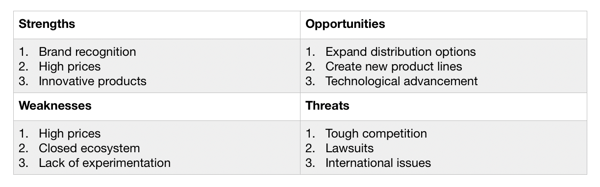
SWOT analysis showing Apple's Strengths, Weaknesses, Opportunities, and Threats

Strengths

First off, strengths. While Apple has many strengths, let’s identify the top three:

  1. Brand recognition
  2. High prices
  3. Innovative products

Apple’s brand is undeniably valuable, and their business is considered the most valuable in the world. Since it’s easily recognized, Apple can produce new products and almost ensure a certain degree of success by virtue of the brand name itself.

This degree of recognition lends itself to Apple’s ability to sell products. For instance, in 2019, Apple sold 72.9 million iPhones compared to 70 million Galaxy phones by Samsung. This is despite the price disparity between the two (the flagship Galaxy phone is $100 cheaper). Often, people don’t care about price as much as they care about brand recognition.

Lastly, their innovative products: Apple didn’t earn its reputation for nothing. They create highly innovative products, which are often at the forefront of the industry.

Weaknesses

Next, let’s look at three of Apple’s weaknesses.

  1. High prices
  2. Closed ecosystem
  3. Lack of experimentation

While the high prices don’t deter Apple’s middle and high class customer-base, they do hinder Apple’s ability to reach a lower-class demographic.

Apple also suffers from its own exclusivity. Apple controls all its services and products in-house, and while many customers become loyal brand advocates for this reason, it means all burdens fall on Apple employees.

Ultimately, Apple’s tight control over who distributes their products limit their market reach.

Lastly, Apple is held to a high standard when it comes to creating and distributing products. Apple’s brand carries a high level of prestige, but that level of recognition inhibits Apple from taking risks and experimenting freely with new products that could fail.

Opportunities

Now, let’s take a look at opportunities for Apple.

It’s easy to recognize opportunities for improvement, once you consider Apple’s weaknesses. Here’s a list of three we came up with:

  1. Expand distribution options
  2. Create new product lines
  3. Technological advancement

One of Apple’s biggest weaknesses is its distribution network, which, in the name of exclusivity, remains relatively small. If Apple expanded its network and enabled third-party businesses to sell its products, it could reach more people globally, while alleviating some of the stress currently put on in-house employees.

There are also plenty of opportunities for Apple to create new products. Apple could consider creating more affordable products to reach a larger demographic, or spreading out into new industries -- Apple self-driving cars, perhaps?

Finally, Apple could continue advancing its products’ technology. Apple can take existing products and refine them, ensuring each product offers as many unique features as possible.

Threats

Finally, let’s look at threats to Apple.

Believe it or not, they do exist.

Here are three of Apple’s biggest threats:

  1. Tough competition
  2. Lawsuits
  3. International issues

Apple isn’t the only innovative tech company out there, and it continues to face tough competition from Samsung, Google, and other major forces. Many of Apple’s weaknesses hinder Apple’s ability to compete with the tech corporations that have more freedom to experiment, or that don’t operate in a closed ecosystem.

A second threat to Apple is lawsuits. Apple has faced a bunch of lawsuits, particularly between Apple and Samsung, and so far it has only won one case. These lawsuits interfere with Apple’s reputable image, and could steer some customers to purchasing elsewhere.

Finally, Apple needs to improve its reach internationally. It isn’t number one in China, and doesn’t have a very positive relationship with the Chinese government. Then, in India, which has one of the largest consumer markets in the world, Apple’s market share is low, and the company has trouble bringing stores to India’s market.

If Apple can’t compete globally the way Samsung or Google can, it risks falling behind in the industry.

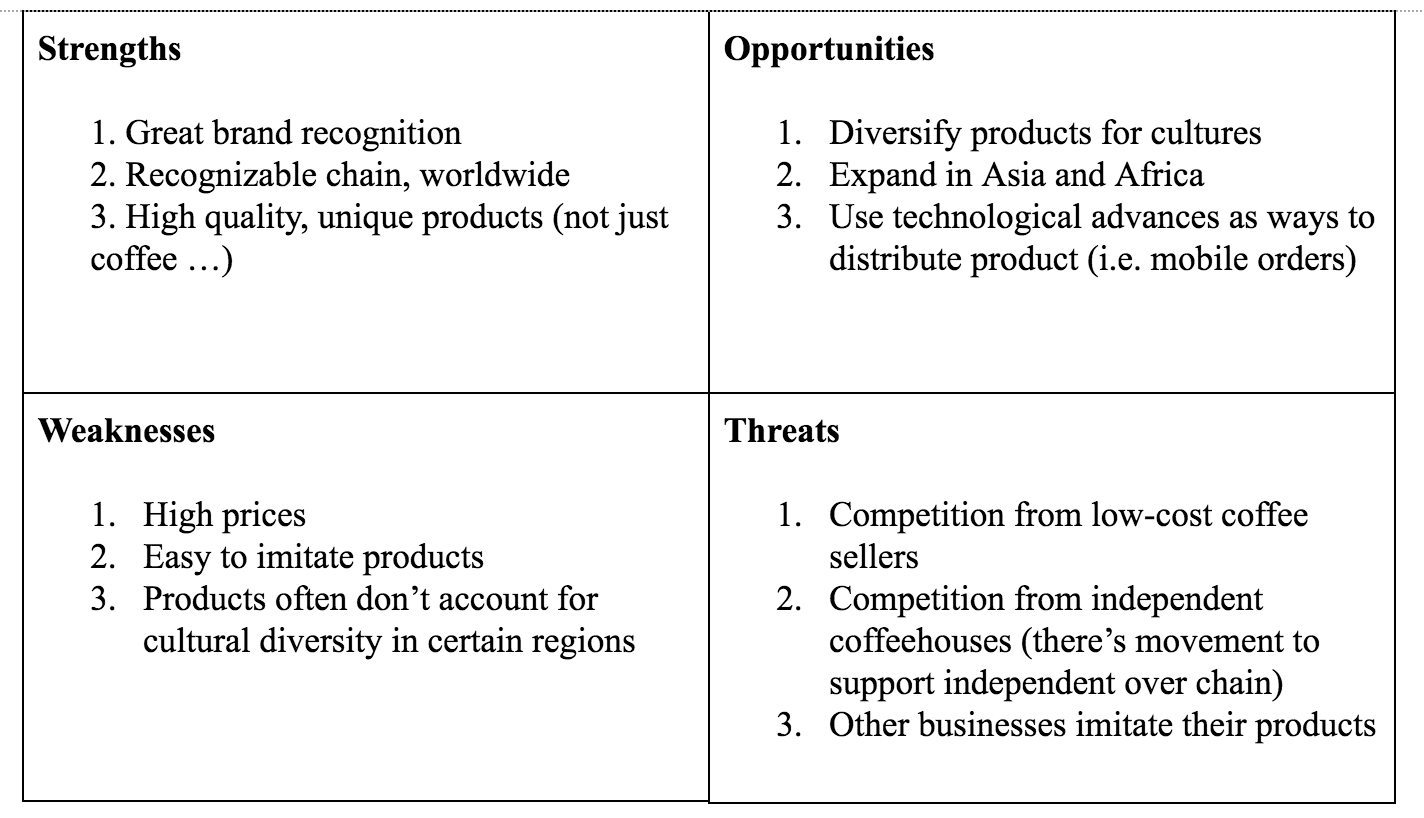
Starbucks SWOT Analysis

Now that we’ve explored the nuances involved with a SWOT analysis, let’s fill out a SWOT template using Starbucks as an example.

Here’s how we’d fill out a SWOT template, if we were Starbucks:

Starbucks SWOT Analysis example

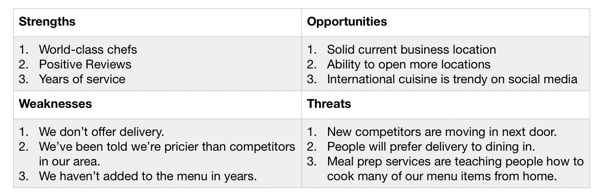
Dine-In Thai Restaurant SWOT Analysis

Some small-business marketers may have difficulty relating to the SWOT's of big brands like Apple and Starbucks, so here's an example of how a restaurant might visualize each element:

Dine-in Thai Restaurant SWOT analysis example

While a Thai or any other restaurant might not be as worried about high-level lawsuits like Apple, the small business might be more worried about competitors or disruptors that might enter the playing field. 

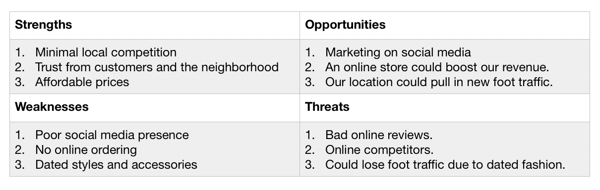
Local Boutique SWOT Analysis

In another small-business example, a local boutique might be well known in its neighborhood, but it also might take time to build an online presence or get its products in an online store. Because of this, some of its strengths and opportunities might relate to physical factors while weaknesses and threats might relate to online situations.

Local boutique SWOT analysis example

When to Use a SWOT Analysis

Ultimately, a SWOT analysis can measure and tackle both big and small challenges, and opportunities, and both big and little strengths and weaknesses.

While the examples above focus on businesses in general, you can also use a SWOT analysis to evaluate and predict how a singular product will play out in the market.

Hopefully, our SWOT template will supplement your market research and business analysis, and provide fair insights into how to optimize your products for bigger payoffs, and less hurdles.

Editor's note: This post was originally published in May, 2018 and has been updated for comprehensiveness.


How to Do a SWOT Analysis [With Template & Examples] was originally posted by Local Sign Company Irvine, Ca. https://goo.gl/4NmUQV https://goo.gl/bQ1zHR http://www.pearltrees.com/anaheimsigns
Why You Might Want to Be More Negative in Your Marketing

Ever wake up on the wrong side of the bed?

Of course you have. We all have.

Ever wake up on the wrong side of the bed, and then have to be cheery? Like, interact in social media? Write an engaging blog post? Put together a lovable email marketing campaign?

Ugh. Those are the times you wish you could shut out the world, or at least channel a little of your inner snark. Well, the good news is you can do that once in a while, and your marketing results may even thank you for it! Sometimes, it's good to embrace a little bit of the negative. (Trust me -- this will all make sense in a second.)

So, here we go ... if you ever wake up wanting to shut out the world, here's how you can take it out (positively!) in your marketing.

Keep in mind, however, that negative marketing shouldn't be deployed simply because you want to be cranky. Instead, it should be implemented strategically with one (or more) of these goals in mind: 

  • Empathizing with customer struggles 
  • Differentiating your brand with that of competitors, especially those who may not be willing to take a stand or acknowledge certain truths in the industry
  • Cutting through the noise of "neutral" messaging that might not be resonating

If you're successful, the end result causes you to stick in your audience's mind, which gives you the bandwidth to prove your brand as a superior alternative.

How to Be Negative in Your Marketing

So how do you implement this tactic successfully? Here are some opportunities to be "more negative" in your marketing.

1. Create negative, or exclusionary, personas.

Let's start with something a little bit easier to swallow than just being a total grumpy pants: exclusionary personas. Exclusionary personas, sometimes also referred to as negative personas, are kind of like the opposite of buyer personas -- they're the personas of the people you do not want to target in your marketing.

This is about more than just recognizing that not everyone in the world is a potential future customer -- it's about recognizing that your marketing attracts certain types of people who totally clog up your funnel, waste your sales team's time, and will never become customers.

Why won't they ever become a customer? Could be a lot of things -- they don't have the budget, or they're just fans of your content or social media presence. Or maybe they do become customers, but they cost you a ton of money; for instance, they could have a high acquisition cost or a high propensity to churn.

In this case, it behooves you to identify who these folks are so you can ensure you either 1) stop creating content that draws in the wrong people, or 2) let them keep reading and engaging with your content to help you spread your reach, but keep them from getting rotated to sales reps using methods like assigning them a low lead score.

2. Leverage a little exclusivity.

This is the VIP, red-carpet tactic we all know and love (or love to hate). When you tell someone they can't have something or what they want is scarce, it often makes them want it more. You know, the whole "playing hard to get" thing.

This just so happens to be a common sales tactic, but marketers can use it, too. Tell prospects they can have an offer ... but only for a limited time. Or only for the first 10 that respond in social media. Heck, you don't even always have to tell them what it is.

This tactic is particularly popular with savvy ecommerce shops, too -- ModCloth, for instance, frequently sends me emails letting me know that an item I like is so popular, it's almost out of stock. "Oh no! Everyone else is snagging it! I have to get it before I'm left out!"

The moral of the story? Leave people out once in a while. If everyone gets something, it's not as special. And when you go VIP, the ones who do get it feel uber-special. (There... we just turned a negative into a positive. See?)

3. Craft "negative" headlines and titles.

I don't know what this says about human nature, but there's an undeniable correlation between page views and negativity. Consider some of these titles you might find on a news site like CNN:

  • What you get wrong about BBQ
  • Could our favorite flavorings be damaging our DNA?
  • Beware the parental overshare

These are about clicks. No question about it. We all know the news has gone the negative route for years, and -- for better or worse -- they do it because it is effective at grabbing attention.

Now, you absolutely shouldn't throw out some inflammatory headline just to get clicks -- if you're going to get negative with your titles, you have to back it up with some solid content that actually merits that title of yours. Here are a few examples that worked out extremely well for us:

4. Create a bond over a shared negative experience -- but don't dwell.

Alright, now we're getting warmed up! So you're throwing out some negative titles, but have you considered drawing that negativity into your content? When you draw on a negative situation in your content -- particularly right in the beginning -- it can actually help reader retention and engagement. Some marketers are afraid to stir up negative feelings in their reader, but it can actually create a shared experience and tap into a level of emotion that some may not expect to get while reading marketing content, particularly if you're a B2B marketer.

I mean, that's why I started this post the way I did -- getting up on the wrong side of the bed is an experience everyone I know can relate to. And sometimes, it's easier to form a bond with someone over a shared negative experience than something warm and fuzzy.

But be forewarned -- once you have a bond with the reader based on a shared negative experience, it's crucial to shift the mood to something more positive and solution-oriented. People like to know they're not alone (misery loves company), but most don't like to dwell on the negativity.

5. Cast some villains.

Just like we can all bond over a shared negative experience, so too can we bond over a common enemy. Casting a villain has been a common marketing tactic for years, and I'm not just talking about the Hamburglar. Villains can take more subtle forms, playing on common tropes -- the jerk boss, the slob roommate, bureaucratic drone.

These take common experiences and personify them in order to elicit a feeling in the consumer, and help tell the story you're trying to tell. A great example of this is Genesis's "Going Away Party" commercial where they use the "stuffy" party trope and the "villains" within it to demonstrate that luxury doesn't have to be stuffy.


6. Take a stand for something you believe in, even if it's controversial.

If you feel confident about your brand, your PR team, and your position on an issue, you can take a controversial stance on a popular topic. Controversial marketing is a risky play because, in many cases, your brand could be seen as capitalizing on an issue just to peddle your products. However, when done well, your brand could be seen as socially responsible. 

Controversial marketing can also do a few other things for your marketing:

  • Position you as a thought leader (only if your thought was a good one -- so try to make sure it is)
  • Help you define your brand in the eyes of consumers and what it stands for
  • Drive natural publicity
  • Elicit strong emotions from audiences, both positive and negative

That last one is what I want you to pay the most attention to. When you take a staunch position on a polarizing issue, you will have people who like you less for it. You will also generate some seriously ardent supporters. If you're going to play the controversy game, be prepared to deal with both, because while some results could be really exciting for your brand, some backlash will inevitably come with it.

7. Use data to build a case study around why something stinks.

Let's start off with an example: [New Research] It’s Official — Lots of Salespeople Hate Their CRM. It gets props off the bat for its grabby negative headline, but it's also full of interesting statistics like this one:

50% of sales leaders say that their CRM is difficult to use, and 18% say this has caused them to lose opportunities or revenue.

You build a case around why one thing stinks (traditional CRMs) so you can show why something else is awesome (the new HubSpot Sales Hub Enterprise).

This can be made even more compelling if you have two data points that demonstrate a stark contrast; the juxtaposition of positive and negative paints a pretty dramatic picture in readers' minds, and the succinct data points make it easy to quickly demonstrate the bad versus the good.

8. Poke some fun at your competitors.

This is perhaps what most people think of when negative marketing is discussed, but it's rarely executed because of how delicate the situation can be. On one hand, a little healthy competition can be a good thing, especially if you want to position yourself as a better option. However, if done poorly, your audience may actually think less of your brand for "playing dirty" or being too low-brow. In addition, if you leverage false claims, you could be asking for legal trouble.

There are two types of negative marketing with regard to your competitors: 

  1. Attack: Focuses on the negative sides of your competition's offerings. 
  2. Contrast: Focuses on the positive sides of your offerings and establishes the gap. This is more subtle but still highlights what your competition may lack.

Typically, it's easier for larger brands to engage in negative marketing with their competition because they're already well-known, so the reward can be greater than the risk to highlight value propositions.

Pepsi has a famous "attack" ad in which a child dispenses two Coca-Cola cans from a vending machine and stands on them in order to reach the Pepsi button. 

Bud Light uses the more subtle "contrast" approach in their "Special Delivery Corn Syrup" ad: 

This ad works because it's a light narrative and doesn't engage in serious mud-slinging (it merely highlights a differentiator).

Nonetheless, controversy brewed even in this case as the company was sued for potentially misleading consumers by not acknowledging the difference between corn syrup and high-fructose corn syrup, which demonstrates exactly why this tactic is risky.

If your brand isn't a household name, it may be better to highlight value propositions and differentiators in less risky ways.

For example, some brands engage in competitor criticism without mentioning any names. Doing this ensures you're not giving your competition free airtime while you capitalize on ideas your consumers know to be true. For example, Domino's does this in their "Designed to Be Delivered" ad, which doesn't mention a single competitor (but does imply them):


9. Make fun of yourself.

Another less risky way would be to turn that negativity inward. A little self-deprecation can be fun for others, makes you seem more human, and actually might make you feel better about your slip-ups. After all, we all have them, and it's important to learn how to make light of your mistakes. Speaking of Domino's, one of the best examples of recent self-deprecating advertising is when Domino's admitted their pizza tasted like cardboard and what they're doing about it:


When Negativity Backfires

All this being said, it's important to always consider whether your negativity is going to backfire. Are you being an unadulterated jerkface? Is this negativity going to be lost on your audience? Does your buyer persona really hate this kind of stuff?

For instance, something that almost always comes off as totally petty and unnecessarily negative is bickering with competitors. I mean, think about how annoying political ads are; you certainly don't want to come off like that. I think one piece of advice from my childhood can sum up how you should approach bickering with competitors:

"If you don't have anything nice to say, don't say anything at all."

Yes, even if they started it.

It's also important to remember that any negativity you draw on needs to be tempered with some positivity. 

Finally, I think striving to be inspirational should always be an aspiration for marketers. There's no question that marketers capable of inspiring people see unbelievable success from their efforts. In fact, I think if you're able to inspire people in your marketing, the effects last much longer and are much stronger than any of these negative tactics.

Editor's note: This post was originally published in April 2013 and has been updated for comprehensiveness.


Why You Might Want to Be More Negative in Your Marketing was originally posted by Local Sign Company Irvine, Ca. https://goo.gl/4NmUQV https://goo.gl/bQ1zHR http://www.pearltrees.com/anaheimsigns