Tuesday, December 15, 2020

Should Your Brand Use Controversial Advertising? 10 Examples to Help You Decide

In the beginning of 2019, people were tweeting pictures of razors submerged at the bottom of their toilet bowls. No, this wasn’t a wacky teen challenge to make dads late for work. It was a protest against Gillette’s latest advertisement, one that confronts toxic masculinity.

Brands that craft controversial advertisements like Gillette’s, however, expect this type of response, at least from some people. Taking any kind of stance on potentially sensitive social issues tends to lead to some form of disagreement.

But authentically advocating for the causes you truly believe in usually has more pros than cons.

“Even if publicizing your beliefs may ostracize some potential customers, it also builds deep loyalty for those who share your values -- particularly values like celebrating equality and inclusion, which many people support, regardless of political affiliation,” Joe Lazauskas, the Head of Content Strategy at Contently, wrote in an article after the divisive 2016 presidential election. “The same goes for expressing concern and support for the diverse people who work for you. Loyalty isn’t just a marketing metric; it’s also critical for measuring the internal health of your company.”

Executed properly and from a place of genuine support, controversial ads can be an unexpected, emotional delight that can not only deepen your connection with your core audience, but can also help you reach new audiences. For instance, after Gillette released their ad challenging toxic masculinity, Adweek discovered the campaign actually resonated with women the most.

What Is Controversial Advertising?

Controversial advertising doesn’t aim to polarize an audience. It’s an attention-grabbing technique for stating an opinion, and brands use it to spark productive conversations about certain moral values. In recent years, any stance taken on potentially sensitive social issues can be considered controversial advertising.

The Psychology Behind Controversial Advertising

People usually read and share opinionated content because it aligns with their own values. And by letting the world know about their beliefs, they can solidify an ideal image of themselves within their social circle and their own minds.

Opinionated content also has a knack for making people think and consider other points of view, which builds more loyal audiences because it can teach people something new and help shape their perspective on life.

But while controversial ads can generate more buzz than other types of ads, if executed poorly or in a merely performative manner, they can be detrimental to your brand. For instance, consider SNL’s hilarious skit of ad executives pitching commercial ideas to the snack brand Cheetos.

Although SNL isn’t specifically giving controversial advertising a ribbing, they’re poking fun at the way brands exploit sensitive social issues to peddle their products instead of what they should be doing when covering these types of topics -- encouraging productive conversations.

Creating a controversial ad with a merely commercial motive is a one way ticket to receiving Kendall Jenner & Pepsi type of feedback (we’ll cover this later). In other words, it can spark harsh backlash and bad publicity instead of meaningful dialogue.

So how do you avoid this type of negative response if you want to create a controversial advertising campaign? Below, we’ll analyze three controversial advertising examples that work and two that don’t to help you support the causes you genuinely believe in and better connect with audiences.

Controversial Advertising Examples That Work

1. Anheuser-Busch | Born The Hard Way

Anheuser-Busch’s ad about their founder’s origin story makes people realize that something so fundamentally American, like Budweiser beer, can have immigrant roots.

Budweiser is commonly associated with themes of American patriotism, so taking a stance on immigration, which is a controversial issue in the United States, conflicted with some of the brand’s most loyal customers’ political beliefs. But taking this social stance also led to a meaningful dialogue about how immigrants have founded some of America’s most iconic brands.

By telling a gripping and emotional story about the founding of their company, Anheuser-Busch could take a stance on an important issue that’s essential to their brand and connect with the people who understand that the United States is country of immigrants, helping the ad garner more than 21.7 million views in only three days.

2. Nike | Dream Crazy

“Believe in something, even if it means sacrificing everything” is an accurate life motto for Colin Kaepernick, a professional American football player. In the 2016 NFL season, he stoked controversy by kneeling during the National Anthem before the start of every game as a protest against racial inequality.

Unfortunately, all the controversy associated with him has basically barred him from the NFL -- no team hasn’t signed him since his controversial 2016 season. Yet, admirably, he still advocates for the causes he supported during his protests.

Along with Kaepernick’s story, Nike’s "Dream Crazy" weaves in other narratives of athletes who followed ambitious dreams to eventual success. And Nike made it clear that they want to help Colin Kaepernick achieve his dream of a righteous world, no matter how crazy it seems right now.

"Dream Crazy", while highly controversial, resonated with millions of people. Just days after they released the ad, Nike’s sales soared by 31%, despite videos of their gear engulfed in flames circulating throughout social media.

3. Heineken | Worlds Apart

In Heineken’s “Worlds Apart”, people were paired together and asked to build stools and a bar together. After they completed the activity and developed some rapport with each other, pre-recorded videos starting playing and revealed that their political views were actually the polar opposite of each others. They were then asked if they would discuss their differences over a beer. All of them said a resounding “yes”.

Making an ad where people with such differing political views actually engage in meaningful dialogue and don’t just belittle each other is a risky move. A lot of people have a fiery passion for their political beliefs and won’t associate with people who don’t agree with them. But that’s ultimately why Worlds Apart was met with rave reviews and called “The Antidote to Pepsi’s Kendall Jenner Ad” -- it focuses on putting our differences aside to work for a greater cause together, not Heineken’s product.

4. Burger King | Whopper Neutrality

Net neutrality regulation was repealed in the United States in 2018. Leading up to this decision, many Americans debated whether this would be a good or bad thing, but many more didn't understand what the fuss was about.

Burger King aimed to explain and persuade with their "Whopper neutrality" analogy where customers pay a premium to get their food delivered fast.

Despite net neutrality being irrelevant to burgers, the campaign resulted in $67 million in earned media and 3.8% sales growth — while igniting conversations about the issue among everyday people and celebrities alike.

5. Poo~Pourri | Girls Don't Poop

It's not every day you see a post where the protagonist is sitting on the toilet. Culturally, going to the bathroom is an "inappropriate" or "crass" topic. Despite this, Poo~Pourri brings it front and center for their odor removal product.

Needless to say, this could've gone down poorly. However, the comical dialogue, impeccable production, and endearing relatability earned positive reactions from audiences. In fact, it was viewed 17 million times in just a month.

6. Lane Bryant | #ThisBody

In 2016, Lane Bryant launched their #ThisBody campaign, promoting their plus-sized clothing line in conjunction with radical body positivity. The ad features several plus-sized models declaring how they feel about their bodies and what they can do in an effort to change cultural perception and make a stand against body shaming. However, the ad was pulled by ABC and NBC for showing "too much skin.'' Critics claimed the ad was no more risque than other underwear ads.

The networks proposed to re-air the ad once Lane Bryant made some minor edits, but the retailer refused, launching it on social media instead where it received viral levels of positive engagement.

Controversial Advertising Examples That Don’t Work

1. Pepsi | Live for Now

If you think long and hard about it, could a can of Pepsi really mend the complex rifts that divide the entire world right now? Nope. Not at all. Even worse, is Kendall Jenner really an integral part of any social justice movement, or was she just there because she’s a famous celebrity who can grab almost anyone’s attention? You probably know the answer to this question by now.

After receiving five times as many downvotes as upvotes on YouTube and a glut of bad publicity and negative reactions on social media, Pepsi removed the ad from their channel only a few hours after posting it.

If you want to avoid this type of response when creating controversial content, don’t emphasize your product more than the issue at hand. All advertisements are technically self-serving, but people can spot overly promotional fluff masquerading as social justice faster than they’ll click exit on a pop-up ad. So if you don’t truly feel convicted to support a specific social cause when creating controversial content, it’s best to not even put pen to paper.

2. Miracle Mattress | Twin Towers

Labor Day, Veterans Day, and even Memorial Day are prime holidays for furniture sales. However, San Antonia mattress company Miracle Mattress created a controversial video to promote a September 11th sale.

In the video meant to be an edgy parody, two stacks of twin mattresses are toppled over, and the Miracle Mattress employee says, "We will never forget."

The ad was seen as insensitive rather than provocative, making light of the lives lost on September 11th. The company faced severe media backlash and closed its doors as a result.

3. Hyundai | Pipe Job

Speaking of, the whole goal of provocative narrative and imagery is to prompt an emotional response and, in effect, stand out.

Hyundai set out to do this when promoting their lowered emissions with an ad featuring an attempted suicide. The man featured in the ad was unable to take his own life due to the exhaust being made up primarily of harmless water vapor.

The ad was pulled after airing for only a day, criticized as being disturbing at best and, at worst, mocking toward suicide attempt survivors and suicide loss survivors.

4. Nationwide | Boy

It starts out as an adorable story about a boy who seems to lack self-confidence, but Nationwide’s “Boy” turns shockingly dark when it’s revealed that the main character can’t live a normal childhood because he’s actually dead.

Child accidents are a serious problem that should be addressed, but this ad was criticized for being too fear-mongering and manipulative -- it literally uses the death of children to sell insurance.

So even if your ad highlights a prevalent problem, make sure it doesn’t exploit a potentially sensitive issue just to peddle more product. Otherwise, it might get crowned as the worst ad of the year.

Editor's note: This post was originally published in January 2019 and has been updated for comprehensiveness.


Should Your Brand Use Controversial Advertising? 10 Examples to Help You Decide was originally posted by Local Sign Company Irvine, Ca. https://goo.gl/4NmUQV https://goo.gl/bQ1zHR http://www.pearltrees.com/anaheimsigns

Best Display Advertising Campaign: Supla+

Today we celebrate the final winner of our seasonal best display campaign competition for 2020.

At the end of every quarter, we highlight the very best display campaigns out there, focusing on the use of technology, design, and overall impact of the display ad. The winner is then put forward to compete for display campaign of the year.

This quarter’s offering is a great example of a timely Black Friday campaign that engages through HTML5 animation and makes a visual impact though a premium design. And the winner of the best display advertising campaign of Autumn 2020 is audio subscription service, Supla+.


Supla is an app and website for radio and podcasts, plus it has an audio subscription service for audio books called Supla+. It is part of Finnish media conglomerate Sanoma. Supla produces digital advertising across social, display and email channels, with regular and special campaigns, like Autumn’s winning one for Black Friday.

We spoke to Art Director, Sanna-Maria Pihl about her winning Black Friday campaign.

Display Campaign Autumn body image Supla+ Art Director

What was the purpose of this campaign and how did this translate into design challenges?

Sanna-Maria Pihl, Art Director at Sanoma B2C: We made this display campaign specifically for Supla+’s Black Friday and it was live for 24 hours. Hence why we choose to use the countdown timer widget.

The concept is a little different from what we would normally do for our campaigns, as it’s a one-off campaign. So within the ad, we tried to differentiate the design and make it look a little bit separate; doing this we hoped that the ad would be more eye catching.

The idea for the ad visual comes from me – I’m a fan of the 80s. So that’s how I started to build up the idea for the Black Friday, adding neon and other recognisable stylistic flourishes.

What were some of the technical things you did in the Supla+ ad set?

Sanna-Maria: I used a GIF animation on the bottom of the ad. And then I used the lightning effect widget, and then another for the countdown timer.

The design came together pretty much how I wanted it to. First, adding the lightning, and then adding new elements. Unfortunately, I couldn’t use the lightning to our email design, so that’s a little bit extra for the display and the social media ads. Hopefully it injects a little bit more impact and helps make sure the customer’s eye catches onto the ad.

Are the assets part of a wider campaign or custom built?

Sanna-Maria: We used our stock library, plus the phone and book cover assets were provided from our service. From there I created the master ad, putting together all of those key elements.

We have to produce for email, and social media – such as Instagram stories – plus display. And all those act a little bit different when considering which graphical elements to use across all of them.

In general, how do you tackle the design process of building display campaigns?

Sanna-Maria: Usually we have a kickoff meeting with the sales team. This is when we set the target and decide who, or what, it is we want to reach with the campaign. We then touch upon the idea of what the campaign might look like – for example, if we have any ideas already.

After that I normally work on the visuals of the project by myself. During coronavirus times that has been the case for most projects! I take the notes from our kick-off meetings and then I go to work on a visual concept for the campaign.

I collect and create all the resources, then I use Bannerflow, After Effects and image manipulations to get all the assets I need. Sometimes I even come up with some of the copy too! After the campaign assets are designed and approved by the brand, we put the campaign together and the rest of the team pushes it live.

When working on the design process which other tools, beyond Bannerflow, do you use?

Sanna-Maria: I normally create designs for digital channels using Photoshop. Then I use After Effects for most campaigns on social media. Bannerflow I use mainly for display but sometimes I use it for social too. I try to utilise the fact that you can download ads as MP4s, meaning I can use Bannerflow to create the social videos.

Do you still use pen and paper, or is that long gone?

Sanna-Maria: Pen and paper is still there! I start with pen and paper. I use it to think and test initial ideas out, like layouts and other stuff. From there, I usually start building it in Adobe and let the concept develop to its final look.

Since you started using Bannerflow have you seen any shifts in how you work?

Sanna-Maria: Definitely! We used to create all our ads individually; now Bannerflow has cut the time it takes to build-up a whole ad set. I love the Creative Studio side of it too – it’s a really agile tool. When you can copy and paste designs to new projects or within the banner set to a new size, it makes a big difference. It’s definitely an improvement in our job.

How did COVID-19 affect your work? Did Bannerflow enable you to carry on just working remotely?

Sanna-Maria: Yes. That’s the best part of it – we carried on working as a team. Of course COVID has made you work a lot more by yourself, and you can’t reach out to everyone all the time, like you would normally. However, using Bannerflow we can share all the designs in the cloud. It’s really handy to get feedback too, as it’s not all in my local drive.

What is it about the Bannerflow platform that makes designing ads easier?

Sanna-Maria: Bannerflow has definitely made my life easier, especially as you can make dynamic ads so easily. Plus, the platform itself is quite simple to use as well.

We produce so many banners, so it’s definitely helped improve our process. One year – not this particular year – we produced something like 3000 banners. Making variations, not different campaigns, but it was a lot.

As a designer, how do you continue to find inspiration for your work?

Sanna-Maria: I like to build mood boards for myself to kick-off creative thinking. I keep an eye on social media and websites to see what the trends are too. Although I work under brand rules, having a mood board is a quick way to come up with new ideas and inspiration for different visuals for campaigns or digital layouts. Sometimes it’s just an image with certain colour and emotion that sets off my thought process for something new. Mood boards are definitely what I like to utilise.

Take the next steps

If you would like to find out more information about you too can create winning Black Friday display campaigns, then please get in touch with us. Or if you would like to see how Creative Studio works for yourself apply for a demo now!

The post Best Display Advertising Campaign: Supla+ appeared first on Bannerflow.


Best Display Advertising Campaign: Supla+ was originally posted by Local Sign Company Irvine, Ca. https://goo.gl/4NmUQV https://goo.gl/bQ1zHR http://www.pearltrees.com/anaheimsigns

Monday, December 14, 2020

10 Logo Design Trends to Watch for in 2021 [Infographic]

We demand a lot from logos.

They have to be simple, yet still convey the ethos of the brand in a way that resonates with consumers. They have to be timeless and distinct, but still modern and consistent with contemporary graphic design trends.

It's a lot to ask of a single symbol. As any designer will surely tell you, designing a logo that meets these varied expectations is no easy task.

To help you prepare for the new year, Logaster created the infographic below detailing their predictions for the most influential logo design trends of 2021. Keep an eye out for these design approaches in the coming year.

Logo Trends 2021-1


10 Logo Design Trends to Watch for in 2021 [Infographic] was originally posted by Local Sign Company Irvine, Ca. https://goo.gl/4NmUQV https://goo.gl/bQ1zHR http://www.pearltrees.com/anaheimsigns

How to Design a Pitch Deck that Doesn't Suck

The pitch deck is a staple of modern entrepreneurship — folded into the startup survival process. As a growing business, how compelling and intriguing yours is can be the difference between getting the capital you need to get off the ground and getting buried before you have the chance to make something of your company.

An exceptional pitch desk is a solid asset for any business looking to secure funding and take that next step. But a mediocre one is easy to pass over and can undermine how cutting-edge or viable your company actually is.

Every entrepreneur needs to have a solid grasp on the concept, so here, we'll get a more definitive picture of what a pitch deck is, review some of the information you need to include in yours, go over some programs you can use to construct one of your own, see some examples to use as reference points, and pin down how to make yours as engaging as possible.

Pitch decks aren't keynote presentations. You're not trying to blow people away with deep dives and fancy language. The best ones are succinct, straightforward, and easy to digest. Yours needs to be lean — fleshed out with your most impressive, relevant information and organized with some degree of flow and cohesion.

There are certain boxes you need to check — information you need to convey concisely and engagingly. And you need to get those points across without bloating the presentation with too much fluff. 

Here are the bases that your pitch deck should cover.

1. Basic Company Information

Start with the fundamentals. It might go without saying, but you need to let your audience know exactly who you are. Include your logo, company name, and contact information — specifically, your phone number and email.

You have to make yourself readily accessible to investors. That's tough to do if you don't include the necessary, baseline details to help them identify and reach you.

2. The Problem

Why does your company exist? What are you trying to remedy? Who does it impact? And why does it matter? You need to communicate some degree of urgency with your pitch deck.

Be able to present a pressing, relevant problem that a significant base of prospects goes through. If you can't show that you're solving a real, meaningful issue, your potential investors will likely tune out or ditch your deck at this point.

3. The Solution

Okay, so you've established there's a real problem that impacts a lucrative niche. Now, you have to show how your product or service, specifically, can be used to solve it.

Give a fundamental picture of your value proposition here. What does your solution do? Don't get too caught up in describing specs and features — you're better off providing a higher-level overview in this section.

4. Your Business Model

Investors need to have a picture of how you plan on acquiring customers and making money — that's kind of the whole point of investing in a startup. That said, the nature of this section is pretty fluid. As you scale and new challenges arise, your business model will probably change.

The key here is to present a cogent roadmap that demonstrates your critical thinking and strategic planning skills. Show your investors that you're thoughtful and business savvy — the model itself probably isn't set in stone.

5. Information About the Competitive Landscape

Who are your competitors? How do you stack up against them? How do they serve your target audience? How big is your market in general? Give your potential investors a picture of what you're up against.

Then, explain your competitive advantages. Show them what you have that the other side doesn't. Investors want to know that you'll be able to set yourself apart, so prove that you're not going to be just another face in the crowd.

6. Product or Service Specs and Benefits

Here's where you get into your features a bit. See if you can show what your product or service looks like in practical use. Images are an excellent way to support this. Use mediums like screenshots, diagrams, blueprints, or even real pictures — depending on the nature of your product or service.

7. A Financial Forecast

This is one of the most crucial components of an effective pitch deck. Investors are investing because they want to make money — that's the literal purpose of investing. You need to show them that your operation is financially viable.

Include relevant metrics that can show what it will take for you to break even and ultimately make a profit. At the end of the day, investors are looking at your pitch deck for a reason, and that's to gauge the potential return you can offer. Here's where you give them a clear picture of what that could be.

8. Information About the Team

Investors aren't just investing in your product or service — they're investing in you. You need to show that you're trustworthy and competent. Include some information about you, your staff, both your and their experience, and any relevant accolades your team members might have accrued.

Put investors at ease by demonstrating that their investments are going to wind up in capable, sensible hands.

9. Information About Other Stakeholders

One of the better ways to inspire confidence from investors is to let them know they'll be in good company should they invest. Being able to tout sizable contributions from other investors can mitigate the perception of risk among the VCs looking at your deck.

By referencing success in previous funding rounds or demonstrating that reputable sources have faith in your company, you can put investors at ease and make them more inclined to hear you out — at the very least.

The points above need to be addressed, but they won't do too much for you if they're not conveyed with some style, cohesion, and grace. Let's check out some ways to make yours as engaging and thoughtful as possible.

How to Design a Pitch Deck that Doesn't Suck

1. Make your text extremely legible.

That guy who forgot to wear his contacts today and somehow ended up in the back row of the conference room? Yeah, he needs to be able to see your slides just as well as everyone else.

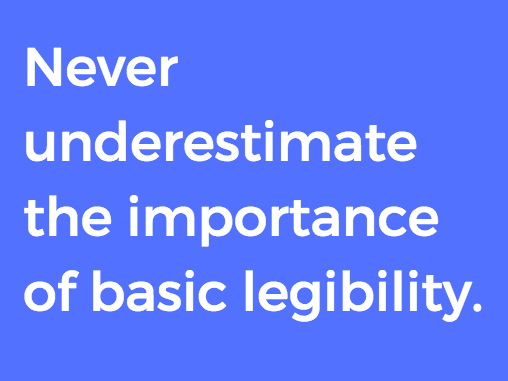
The significance of creating extremely legible, easy-to-read slides should not be underestimated. It's more than a matter of aesthetics: If your slides are at all difficult to read, even people with 20/20 vision are going to quickly lose interest and zone out.

They didn't come here to expend effort — they came here to be spoon-fed. And it's your job to make your information as digestable as possible. To keep the focus on your content, stick to big, bold fonts on highly-contrasting backgrounds.

Don't do this:

This font color doesn't contrast enough with the background, and the text size isn't large or clear enough to be read comfortably from a distance. Don't make your poor audience stare at this for too long.

Do this:

This font is big and bold enough to be seen from the back of the room, and it contrasts well with the background. When all else fails, a bold sans-serif font is the way to go.

2. Tell a story.

When we process information in list format, the basic language-processing areas of our brains get activated. Scientists call these sectionsBroca's area and Wernicke's area, and they're responsible for translating words we see or hear into coherent meanings — but they don't help us stay interested or retain information.

In other words, bullet points don't usually produce a very exciting reaction in our brains, leaving the rest of our minds to wander.

When our brains are given a story instead of a list, things change — big time. Stories engage more parts of our brains, including our sensory cortex, which is responsible for processing visual, auditory, and tactile stimuli. If you want to keep people engaged during a presentation, tell them a story.

Centering you presentation around a story, instead of a list of facts or figures, is essential for keeping people interested and leaving a lasting impression.

Don't do this:

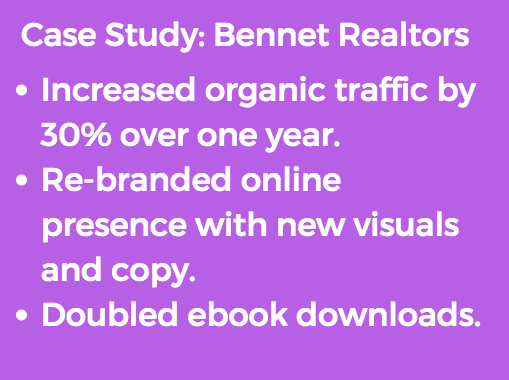
This information might be impressive, but it isn't likely to stick with your audience when presented in list form.

Do this:

Weaving your impressive case study into a story is much more likely to have an impact on the audience. 

3. Break everything down into extremely simple parts.

When it comes to pitch decks, it's time to wean yourself off of bullet points. Although they're still better than slapping a dense paragraph of text onto a slide and calling it a day, they can be overwhelming, and prevent your audience from really absorbing your main points.

You might think you're already simplifying your content, but take it a step further. Each slide should convey a single, simple idea — not a multiple ideas, not a multi-faceted idea, and not an idea that requires a degree in rhetoric to meticulously decode.

If it seems like you're making things way too simple, then you're on the right track. Remember — not all your talking points need to occupy real estate on your slide deck. Save the slide space for the big ideas, and talk your way through the rest.

Don't do this:

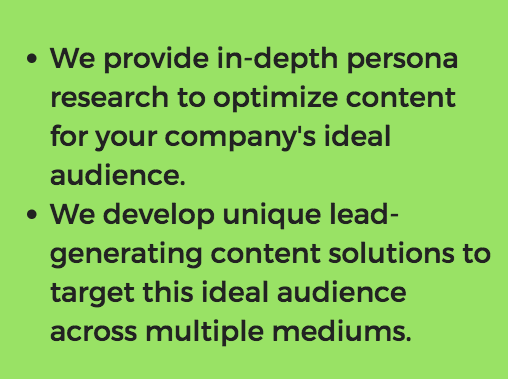
These points might seem simple, but they could be broken down even further and separated onto different slides.

Do this:

There's nothing difficult to understand about this simple, straightforward slide.

4. Make the points obvious.

The point of each slide should be obvious. Your audience shouldn't have to work to understand what's going on, especially when graphs or charts are involved.

Any information you include on a slide should be immediately translated for the audience, even if you think it speaks for itself. Ask yourself:

  • What point are you trying to make by including this piece of information?
  • How does this fact or figure connect back to your main premise?
  • What do you want the audience to get out of this slide?

Don't do this:

While this graph clearly shows growth, the point doesn't obviously tie back to your premise.

Do this:

The title on this slide tells the audience exactly what they should take away from the graph, directing them immediately to the conclusion that benefits your cause.

5. Focus on the prospect's challenges, not yourself.

It's safe to assume that your prospect has spent some time researching your agency, so there's no need to waste valuable presentation time talking about your accomplishments or accolades.

You aren't just convincing the audience you're amazing at your job — you're convincing them that you understand them, and that you're the best person to help them overcome their unique challenges.

The business pitch consultants at Blue Lobster recommend asking yourself a few questions to focus your presentation around your audience:

  • "Who is the audience?"
  • "What is their problem?"
  • "How can you help?"

Don't do this:

While this is all very impressive, it doesn't express an understanding of your client's problems or delve into how you can help them. Plus, your prospect probably already found this information from a quick scan of your agency's website.

Do this:

This slide shows that you've done your research, and expresses a clear value proposition to the prospect. 

6. Supplement your deck with additional materials.

Even when it makes sense to use a pitch deck, you don't need to spend the whole presentation talking at your audience. Instead, consider supplementing classic pitch decks with additional materials, such as "handouts, prototypes or posters to encourage discussion so the presentation and the presentation deck are not seen as one and the same."

Now that you have a picture of what your pitch deck needs to contain and how it can best be conveyed, let's take a look at some of the pitch deck-creation resources you have at your disposal. 

1. Canva

Canva is an attractive option for any startup looking to easily create visually compelling pitch deck slides without design experience or a substantial budget. It's a simple, straightforward program that has a variety of pitch deck slide templates available.

Pitch deck canvaImage Source: Canva

2. HaikuDeck

HaikuDeck is another straightforward design software that reconciles accessibility with powerful functionality. It features a simple interface and boasts a wide range of different presentation templates — including ones for compelling pitch decks.

pitch deck HaikuDesk

Image Source: HaikuDeck

3. Slidebean

Slidebean separates itself from similar programs with its available library of pitch deck templates. It actually provides presentation formats pulled directly from various companies' successful startup pitches — offering a series of unique, provenly effective avenues for emerging businesses to take.

Pitch Deck slidebean

Image Source: Slidebean

4. Google Slides

Google Slides is a staple of the GSuite — and for good reason. It's an accessible, no-nonsense, free solution that virtually any startup can figure out. With hundreds of pitch deck template integrations available online, Google Slides is one of the better options businesses have when constructing their pitch decks.

pitch deck google slides

Image Source: PoweredTemplate

Let's see what these concepts, structures, and points look like in practice.

Pitch Deck Examples

Here's a look at some pitch decks that delivered results. 

Uber

MatterMark

AppVirality

Castle

Pitch decks aren't going to go away anytime soon — no matter how many pitches start to come in the form of crazy stunts. Sometimes, a pitch just demands a straightforward, no-frills presentation. And in those cases, you've got to bite the bullet, swallow your creative pride, and open your presentation software of choice.

So, given how fundamentally ingrained in startup culture they've become, it's in your best interest to have a grasp on the nature of pitch decks and a picture of how to do them right.

Editor's note: This post was originally published February 16, 2017 and has been updated for comprehensiveness.


How to Design a Pitch Deck that Doesn't Suck was originally posted by Local Sign Company Irvine, Ca. https://goo.gl/4NmUQV https://goo.gl/bQ1zHR http://www.pearltrees.com/anaheimsigns
How We Octupled Image Search Traffic to the HubSpot Blog in 1 Year

This post is a part of Made @ HubSpot, an internal thought leadership series through which we extract lessons from experiments conducted by our very own HubSpotters.

Cliché: A picture is worth a thousand words.

Fact: HubSpot's pictures are worth 120 thousand clicks.

Last year, my colleague Karla Cook gave our readers a 3,000-word peek behind the curtain into a new SEO strategy we implemented at the beginning of 2018. That strategy, which was designed to fix a traffic plateau across the blog, increased our organic traffic by 25% year over year -- to eight million organic pageviews per month. This is about three million new organic views we didn't have at the beginning of 2018.

Where that traffic is coming from is equally exciting.

As I said, our new SEO strategy launched our organic blog traffic to heights it had never been to before. But that strategy had another, somewhat unintended consequence for us.

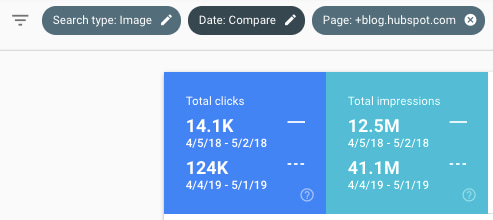
While we increased our total organic traffic by 25% from last year, we increased our image search traffic by … wait for it … 779%. This refers to traffic that comes from people who conduct a search in Google, or a similar search engine, and click on an image result that leads to the HubSpot Blog.

"Pics or it didn't happen, Braden.” As you wish:

image search results hubspot blog

Source: Google Search Console

Take a look at the royal blue tile in the chart above. Between April 2018 and April 2019, HubSpot literally increased its organic traffic from 14,100 organic views per month to 124,000 organic views per month — a nearly 8X lift.

Our image traffic accounts for just under 2% of our blog's total monthly organic traffic, which, in the scheme of things, is not all that significant. But even though the vast majority of our organic traffic still comes from web search (the written blogs themselves), our image traffic's rate of increase (779%) is vastly disproportionate to that of our total blog traffic (25%).

And let's be honest, 2% of 8 million is nothing to sneeze at.

But what made the difference, if not just our new blog-aligned SEO strategy?

Image SEO Best Practices That We Learned

As it turns out, we had a few other tricks up our sleeve along the way that gave our images some extra juice on the search engine results pages (SERPs), all of which are just good best practices in commercial content creation.

1. Optimized Alt Text

In the HubSpot COS, we’ve almost always filled in image alt text fields with text that (tries to) describe the image it's associated with. Last year, though, we started taking alt text way more seriously.

Rather than automatically fill image alt text with the image file name — something the HubSpot COS conveniently does for you so this field isn't left blank — we now optimize each image we embed with the keyword the blog post is targeting. Then, we add language that puts this keyword into context that reflects the image it's describing.

For example, if we're embedding the image below into a blog post about "college courses about SEO," our alt text might look something like this:

"Marketing professor showing college student SEO on her computer screen"

marketing professor showing college student SEO on her computer screen

Now, let's modestly estimate that one in three HubSpot blog posts (33%) have at least one image embedded on them, not including the article's featured image. HubSpot publishes (or republishes) approximately 260 blog posts every three months. If we were to extrapolate this alt text process for 33% of these blog posts, that's at least 87 images that can potentially capture new organic traffic for us every quarter.

And if the average blog post targets a keyword that receives 3,500 searches per month — a rough estimate based on the HubSpot Marketing Blog's editorial calendar — that's a landscape of 304,500 searches per month to which we're adding more HubSpot content (87 images x 3,500 searches per month). In other words, we’re putting ourselves inside hundreds of thousands of Google Image galleries we weren’t ranking in before.

Read more about our team’s approach to alt text in this blog post.

2. Branded Images & Templates

At HubSpot, we create a ton of valuable resources for our readers to download, ultimately making them a qualifiable lead for the business. However, there are still a ton more resources our readers want for which we necessarily don't have a lead generation strategy but still garner valuable organic traffic. And these resources appear in image form on many SERPs that are important to us.

These resources include inspiring business quotes, resume templates, sample emails, and even image thumbnails that appear in Google's featured snippets.

To identify these images, the SEO team analyzed where HubSpot was getting most of its image traffic already, and categorized these sources into image types. Then, we worked with HubSpot UX designer Amanda Chong and the rest of our creative team to develop original HubSpot image templates for each image type.

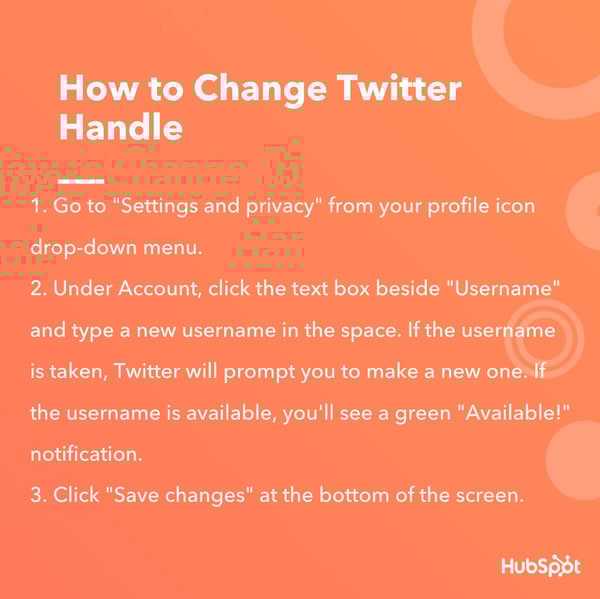
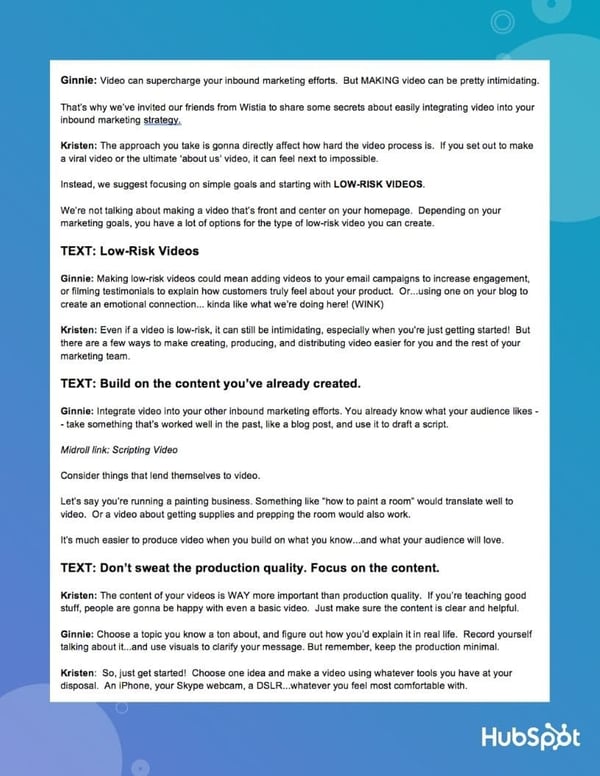
These new image templates allowed the blog team to effectively "brand" various images they might not otherwise embed into a blog post and add alt text for each image using the style described above to expose it on the right SERPs. Here are a couple examples of these branded images now live on HubSpot content:

how to change twitter handle


how to write a video script


3. The Search Insights Report

HubSpot's “Search Insights Report” is a quarterly manifestation of our SEO strategy, delivered directly to the blog team every three months. These reports consist of more than 200 blog post topics, all rooted in searches for which we want to appear on a SERP, that our writers take up and publish over the course of 90 days.

And although we have obviously made deliberate moves to capture more image traffic over the last year, the radiative effect these reports have on our website traffic can't be overstated.

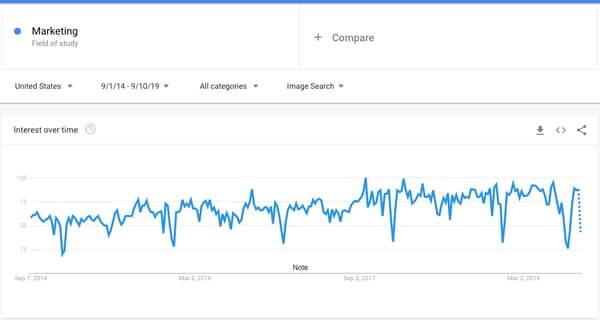
For one, as we create these search insights reports every quarter, we’re tapping into topics that are increasingly being found in image form. There’s even data to support this -- here’s a five-year trend line showing an increase in Google Image search for all queries related to “marketing”:

google trends marketing

Source: Google Trends

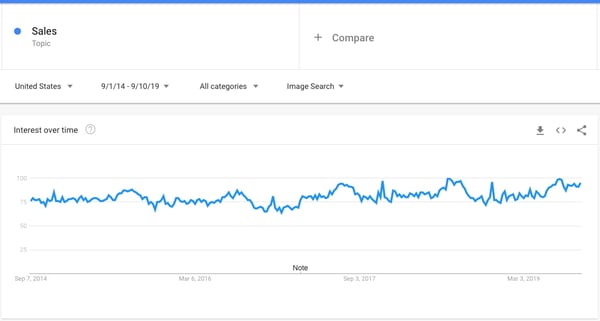
Here’s one for all searches related to “sales”:

google trends sales

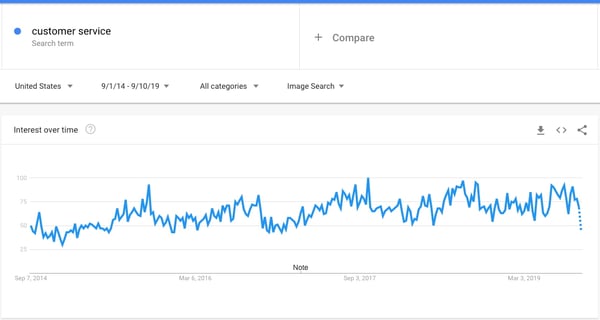
And, finally, for “customer service”:

google trends customer service

Conveniently, these three topics reflect the target markets of three of our blog properties: the Marketing Blog, the Sales Blog, and the Service Blog. But image traffic has gone up across the board, which means more traffic from image searches has become a byproduct of our new SEO strategy — one that has continued to grow as we capture more space on SERPs we didn’t have before.

Plus, having a document that distills all of our potential content topics, and aligning the content team with this document, has earned us ranking on some of the most competitive search engine real estate we've ever seen. It stands to reason we'd see a little (alright, a lot) more image traffic as a result.

It’s easy for marketers to attribute website traffic increases to good SEO, but these results ultimately aren’t possible without the time, creativity, and good judgment put into the content itself.


How We Octupled Image Search Traffic to the HubSpot Blog in 1 Year was originally posted by Local Sign Company Irvine, Ca. https://goo.gl/4NmUQV https://goo.gl/bQ1zHR http://www.pearltrees.com/anaheimsigns
How to Grow Brand Awareness on Snapchat, According to Snapchat's Product Marketing Manager

Snapchat has undoubtedly become a powerful advertising tool for marketers aiming to reach millennials and Gen Z — and for good reason.

For one, Snapchat reaches 75% of millennials and Gen Z.

Additionally, Snapchatters are highly engaged on the platform. In fact, most users open the app 30 times per day.

All of which is to say: If you're looking to reach millennials or Gen Z'ers and you're not using Snapchat for Business, you could be missing out.

But that might sound easier said than done. How can you truly leverage the platform — typically used to send funny photos and videos to friends — to grow brand awareness and impact your company's bottom line?

Fortunately, there are plenty of ways to grow brand awareness and drive sales on Snapchat — with the help of engaging ad formats, intricate targeting, and plenty of access to creative tools and resources.

Here, I sat down with Evan Orenstein, Group Product Marketing Manager at Snapchat, to explore how you can expand your business' reach on one of the world's most popular social platforms.

Let's dive in.

*Click here for a $150 credit in ad credit from Snapchat & HubSpot — simply spend $50 in Snapchat's Ads Manager and receive $150 in ad credit to use towards your next campaign!

(Note: The italicized questions are mine. The rest of the text is Evan’s direct quotes.)

1. How have you seen brands evolve over the years with how they use Snapchat? Do you think Snapchat serves a different purpose for businesses now than it did 2-3 years ago?

It's truly been amazing to watch the evolution of advertisers on Snapchat. When I initially came to Snap our business was entirely bought through insertion order and our ad products were mostly one day takeover type experiences designed for the Fortune 500.

As the business grew, it became clear that we can drive success for businesses of all sizes. For example, products like Dynamic Ads allow ecommerce businesses of all sizes to leverage their existing product catalogs to build ads and automatically show the right product to the right Snapchatter at the right time.

Even Lenses AR Experiences, which were originally only available as a one day takeover with a high price tag, are now supported in our auction, with many targeting and optimization capabilities, for as little as $5 a day.

Beyond our advertising solutions, we are working on products and services like Brand Profilesto give brands a permanent home on Snapchat, SnapKit, which gives developers access to Snapchats best features, and the Yellow Accelerator program which supports entrepreneurs.

2. If a company is looking to grow brand awareness via Snapchat, what are 2-3 methods you'd suggest they test out? (Those methods could be Snapchat features, tools, third-party extensions, or types of content itself)

If brand awareness is the goal, I think it's important to really take advantage of all our ad formats to ensure your brand is present in all areas of Snapchat to maximize reach. That means advertising across Single Image or Video Ads, Story Ads, Lenses AR experiences and Filters.

Also, focus on broad audiences that align with your product by testing our first party targeting segments called Snapchat Lifestyle Categories.

From a creative perspective, make sure your ads are eye catching and get your brand's key message or offer across in the first 2-3 seconds, and make sure to include your brand logo early in your ad.

If you don't have creative readily available, you can try out Snap Publisher, our easy-to-use video and image ad creation tool, or Lens Web Builder, the easiest way to create engaging AR ads right in your browser. Both of these tools are super easy to use and available within Ads Manager.

3. Do you have an example of one brand that really impresses you with how they use Snapchat for brand awareness?

There are so many brands that impress me by how they use Snapchat to market their business.

In general, the brands that impress me most tend to have a few things in common — first, they leverage creative that is designed for our unique Snapchatter community. They also use more than one of our immersive ad formats because our ad products work better together.

A specific brand that impressed me was Truff, a luxury hot sauce brand. They used Snap Publisher to develop creative that showcased their product being used in everyday situations and leveraged video ads and Story Ads to reach new potential customers on Snapchat.

TRUFFTo see other success stories, I highly recommend checking out the Inspiration section of the Snapchat For Business site. There are so many great examples of brands that leverage the versatility of our ads platform to drive mass reach amongst our diverse audience, while also driving efficiency that contributes to their bottom line.

4. What do you think is unique to Snapchat's platform for growing brand awareness, that a business might not see with other social platforms?

There are a number of reasons why Snapchat's ads platform is perfect for growing brand awareness, but if I had to choose one I'd have to say our Snapchatter community.

On any given week, many Snapchatters can be found exclusively on our platform, as opposed to competitors.

For example, per App Annie's analysis commissioned by Snap Inc. for figures calculated for Q1 2020, 43% of Snapchatters 16 and older in the U.S. aren't on Instagram on a weekly basis, and 86% aren't on Twitter.

Daily exclusive reach is based on the daily overlap of active users on Snapchat and competitor apps. App Annie weights iOS and Android data in their sample to reflect the general population of the market.

If you want to reach millennials and Gen Z where they are everyday, you need to be on Snapchat.

This is proof that if Snapchat is not part of your media mix, you are missing out on reaching all of your audience. Snapchat captures an important audience that is hard to reach on other platforms — in fact, they are unduplicated and incremental to your efforts.

It's a recipe for success when you combine our engaged and unique audience with an expansive set of immersive ad formats that were made for mobile. Whether brands want to use their existing assets or build their own from scratch, we offer a ton of flexibility within our tools to let a brand's creativity fully come to life.


How to Grow Brand Awareness on Snapchat, According to Snapchat's Product Marketing Manager was originally posted by Local Sign Company Irvine, Ca. https://goo.gl/4NmUQV https://goo.gl/bQ1zHR http://www.pearltrees.com/anaheimsigns
5 key programmatic advertising trends you need to know | 2021

Programmatic advertising trends for 2021 promise an exciting time for online marketing. Indeed, if there was ever a method of advertising keeping the industry on its toes, it’s programmatic.

As we highlighted this time last year, it was predicted that $81 billion would be spent programmatically by 2021 with Zenith also suggesting advertisers would spend $98 billion on programmatic advertising.

The nature of programmatic meant it was able to be flexible during the global pandemic. Indeed, MediaRadar reported back in September that after the initial impact of COVID-19 on the advertising sector, programmatic was once again experiencing a marked resurgence.

This was described as getting back to a ‘pre-pandemic normal’ with a 36% uplift of programmatic ads in July, since January. Fascinatingly, the total spend on programmatic between April and July was up 11% year-on-year.

Businesses of all sizes, but especially SMBs, are displaying an increasing appetite for targeting and data-driven strategies. And programmatic advertising is set to thrive!

Understanding where to focus your ad spend is important and the capability of programmatic to withstand even the harshest of industry conditions might appeal to your brand.

In this guide, we detail the predicted programmatic advertising trends for 2021 to help you take advantage of this exciting, agile component of advertising.

What 2021 programmatic advertising trends will we be discussing?

  1. Worldwide growth of in-house programmatic
  2. The importance of asset optimisation
  3. Planning for P3PC
  4. Continued rise in investment
  5. Adoption of emerging formats

1. Worldwide growth of in-house programmatic

When planning out strategies, the ability to have control is becoming increasingly crucial for many brands. This is why one of the key trends for 2021 is a worldwide movement to bring programmatic efforts in-house. This trend is shaking up the industry and could change the relationship between brands and agencies moving forwards.

In-house programmatic advertising in numbers

The 2020 IAB report focusing on programmatic in-housing shows a clear international shift towards many brands moving an element of this buying in-house.

Worldwide figures show:

  • 21% of surveyed brands have shifted programmatic buying in-house
  • 48% have partly brought this work in-house

European figures show:

  • 74% of brands surveyed in Europe have totally or partly moved programmatic buying in-house
  • Why is programmatic moving towards in-house?

The study also notes that bringing programmatic buying in-house means brands have increased transparency across the whole process. This helps businesses to heighten the effectiveness of campaigns by improving reach, lowering ad spend and increasing efficiency.

Programmatic advertising has established itself as a key digital marketing tool across the industry. How effective programmatic can be in terms of efficient targeting at scale helps brands to quickly identify where ad spend needs to be weighted. This can help to explain why many businesses across the world are choosing to create capacity to handle this efforts internally.

2. The importance of asset optimisation

Creating relevant, targeted, high-quality ads has increased in importance in recent years, but the continued optimisation of assets will be a real focus of programmatic managers in 2021.

Back in August, Google rolled out an advanced feature on Chrome to block ‘heavy ads’ to heighten user experience and discourage practices that use bad UX. What this means in practice is that any ad that is deemed ‘heavy’ is ‘unloaded’ and replaced with a grey square labelled ‘ad removed’.

The criteria for a heavy ad includes the following:

  • More than 4MB of network data usage
  • Over 15 seconds of CPU usage for 30 seconds
  • 60 seconds of CPU usage all told

This means video-based ads will most likely be impacted by this Chrome feature. This feature will ultimately impact brands using unsophisticated methods without utilising any optimisation.

Harry Kargman, CEO of Kargo, an ad-tech firm, told Digiday that this update is most likely to “hurt all the less sophisticated more invasive players who have large ad payloads and haven’t done a lot of optimization — mostly the in-ad gaming providers.”

Therefore, ensuring your strategy for asset optimisation is up to scratch during 2021 and beyond is a must.

How can a Creative Management Platform (CMP) help?

Any worries you have as a brand relating to asset optimisation can be removed by employing the assistance of a CMP. But how?

CMPs enable you to create programmatic advertising efforts of the best quality possible. Meaning it is possible to produce impactful, personal ads at scale, quickly and simply. Using a CMP such as Bannerflow, brands can produce incredible ad campaigns – from the initial idea to publishing and beyond with continuous optimisation.

A premium CMP such as Bannerflow uses a scaling tool to ensure every single ad asset is network-ready as standard. This eliminates the need for file size reduction and additional code writing, when publishing ads.

Meaning every single campaign created via your CMP is ready to go live in rapid time! And best of all, this includes ads for creative, dynamic and personalised campaigns.

3. Planning for P3PC

Programmatic advertising trends third part cookies

The advertising industry is undoubtedly being shaken by Google announcing that the company is phasing out the use of third-party cookies on Chrome by 2022. Reacting to this development is a key programmatic advertising trend.

However, while this situation brings major changes for programmatic advertising efforts, 2021 is the year to focus on planning for 2022, when third-party cookies are no longer available.

Approaching a post-third-party cookies (P3PC) world will require different strategies. The fact that the online advertising space is built on the foundations of third-party cookie will mean a many-layered approach may need to be taken.

Can a P3PC world be good for my brand?

Even though it’s a shakeup, Google is removing third-party cookies from Chrome for good reasons, the main ones being:

  • Customers expect more from brands
  • Legal and privacy issues – including GDPR
  • Browsers blocking cookies

This signals a further shift towards more consumer control, with an increased focus on transparency. Therefore, it could be the ideal opportunity for your brand to seek alternative, effective and efficient solutions for how to interpret online consumer behaviour.

Whether you look into Google’s Privacy Sandbox, encourage your customers to create personal accounts with you, or use contextual targeting – 2021 is the year to plan for these changes in 2022.

4. Continued rise in investment

Programmatic advertising continues to experience a rise in investment, year on year. Today, it is a smart move for your brand to allocate ad spend to programmatic.

According to the 2020 IAB Europe Attitudes to Programmatic Advertising report, budgets for digital advertising remain on an upward trajectory and programmatic is experiencing the largest investment.

Investment in numbers

The IAB report shows many encouraging statistics for the world of programmatic advertising, including:

  • Advertisers that invest more than 41% of their display budget into programmatic leapt from 55% in 2019 to 70% in 2020
  • 54% of agencies now purchase over 41% of their video programmatically. Up from 50% in 2019
  • The purchase of ads.txt inventory also looks to be growing. 52% of publishers reported that they were selling over 81% of their inventory.

As 2021 progresses expect these numbers to increase further.

5. Adoption of emerging formats

Programmatic advertising trends 2021 emerging formats

Exciting, emerging formats such as audio, Connected TV (CTV) and Digital out-of-home media (DOOH) are readily available. However, these formats are yet to truly takeoff! Expect this to change on quite a considerable scale during 2021 and beyond.

Emerging formats is another area the 2020 IAB Europe Attitudes to Programmatic Advertising report covers in interesting detail.

A closer look at CTV

Advertisers were questioned about their take up of CTV in relation to their overall programmatic advertising budget. Fascinatingly, 60% of these agencies and advertisers responded that they were investing less than 20% of their budget on CTV. Another 73% responding by saying they weren’t investing anything.

Despite this, consumers of over-the-top media (OTT) content is rising and CTV is quickly becoming the top option for customers to view it.

The report also states that CTV is going to rise in popularity when it comes to programmatic advertising. Why? It’s the only way to reach two types of audience group:

  • People wanting to watch TV according to their own timeframe (known as cord-cutters)
  • People that reject linear TV altogether (known as cord nevers)

Ad spend for CTV, according to eMarketer, is predicted to reach $8 billion this year and climb to more than $17 billion by 2024.

Expect this upward curve for CTV to look similar across several emerging formats too. Programmatic is an agile arm of advertising so this is an exciting one to watch!

Apply these programmatic advertising trends now

Programmatic advertising is a digital marketing heavyweight that’s gaining serious ground. Therefore it will pay for your brand to be on the pulse of latest developments and programmatic advertising trends.

While the pandemic inflicted damage on many industries this year, the robust recovery and subsequent growth of programmatic has created optimism for 2021 and beyond.

If you’re looking to attribute a portion of your ad spend to programmatic and want to learn a little more, head to our ultimate guide.

At Bannerflow, we can help you with creating, circulating, optimising and measuring all your digital advertising assets. Apply for a demo today to experience this seamless process for yourself from start to finish.

The post 5 key programmatic advertising trends you need to know | 2021 appeared first on Bannerflow.


5 key programmatic advertising trends you need to know | 2021 was originally posted by Local Sign Company Irvine, Ca. https://goo.gl/4NmUQV https://goo.gl/bQ1zHR http://www.pearltrees.com/anaheimsigns

How Three New Instagram Shopping Tools Could Help Marketers Boost Sales

For years, millions of brands have flocked to Instagram to spread awareness to millennials, Gen Z, and members of other generations on the app.

And, at this point, Instagram marketing has proven to be a smart tactic. Currently, 90% of Instagram's 1 billion-plus user base follows a Business page on the platform.

But, while Instagram has been a great place for brands to engage target audiences, it hasn't always been easy for those companies to turn their followers into customers.

When the app launched, Instagram only allowed links in profile bios. Shortly after, the platform allowed users to place links in Stories -- but only if they had a verified account or more than 10,000 followers. This meant that smaller or less-followed brands had to think strategically to get their Instagram audience to view product information, research the brand, and ultimately leave the Instagram app to buy products.

Things got easier for brands with the global launch of Instagram Shopping's Shoppable posts in 2017. This was the first time standard feed-based posts or Story images could be linked to a brand's Facebook product catalog. However, the feature still required Instagram users to leave the app to make a purchase.

But this summer, with the launch of Facebook Shops, Instagram Checkout, and Instagram Live Shopping, many of the friction points between discovering products on Instagram and buying them have been eliminated.

In this blog post, I'll highlight the three free, new tools that brands can use to make sales directly from Instagram's platform, as well as any brand requirements for using them.

3 New Instagram Shopping Tools to Know About

1. Facebook Shops

Technically, this tool was launched by Facebook, which owns Instagram. However, your Instagram followers won't need a Facebook account to make purchases with this feature.

Facebook Shops, launched in May, enables brands to create online stores that link directly to a brand's Instagram, WhatsApp, Messenger, or Facebook Business Page.

When creating a free Shop, brands can upload bulk or individual product listings with photos, prices, and descriptions; change the store's button colors and text to make it consistent with their brand; and choose to have visitors buy products directly from the shop or through an integration with an ecommerce website they already use.

Facebook Shops can be created on Facebook Commerce Manager. To get started, you'll need admin privileges to the Instagram Business or Facebook Business account you'll be linking the Shop to -- as well as admin privileges for your brand's Facebook catalog.

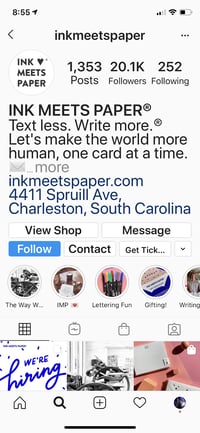
Once a Shop is created, it can be linked directly to your Instagram Business profile. When this is done, an icon that says "View shop" will appear on your mobile profile under your bio. At this point, you can access Facebook Shops on desktop from Facebook Business profiles, but not from Instagram or WhatsApp desktop sites.

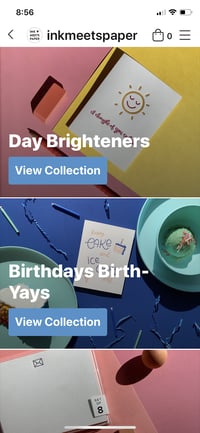
Here's what the Shop experience looks like when an Instagram app user visits the account of Ink Meets Paper, a printing company which offers a Facebook Shop:

Ink meets paper facebook shop link on instagrqam bioink meets paper facebook and instagram shop

Facebook Shops, which is free to all businesses that fulfill the business page requirements noted above, could be a great option for small or medium-sized businesses that are interested in ecommerce but don't have the time or bandwidth to create and promote a full ecommerce site around their brand.

To learn more about how Facebook Shops works and the background of why Facebook launched it, check out this post.

2. Instagram Checkout

For brands that want to sell a few select products on Instagram, or don't have time to create a Facebook Business Page or catalog to open a Shop, Instagram also now offers an in-app Checkout experience that links to Instagram Shoppable posts.

Before 2020, several brands were already using Shoppable posts. These posts, which often highlighted an image of a product or experience, allowed users to tap the content to view it in an online catalog outside of the platform.

Instagram shoppable post

But, in March, Instagram launched a Checkout feature that allowed Shoppable purchases to happen directly in the app.

In an announcement, Instagram explained that it launched in-app Checkout to keep users on the platform when they were inspired to make a purchase.

Instagram also adds, "Businesses can truly leverage the full ecosystem of Instagram Shopping features to build experiences that drive awareness and transactions all in one place.

Currently, Checkout is free to brands through until at least 2021. However, there might be selling fees for businesses after that.

"We also want to help reduce the cost of doing business during this tough economic time, so we’re waiving selling fees for businesses that use Checkout on Instagram through the end of the year," Instagram's post said.

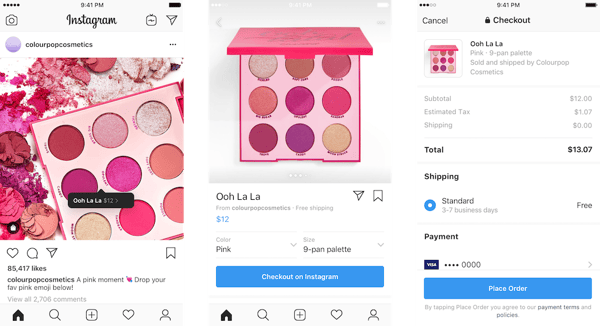
Now, when users click on a Shoppable post that links to the Checkout feature for the first time, they'll be asked to give their name, billing information, and shipping address and can then click "Place Order" directly on Instagram. To further eliminate friction, users can set the app to remember purchasing information so they don't need to submit it each time they place orders.

Instagram shopping post and store

Image Source

At this point, you might be wondering, "How is this different from Facebook Shops?"

Both tools similarly allow consumers to make purchases directly on Instagram. However, a Shop is a mini-online store where you can purchase one of many products listed by one brand. Meanwhile, Checkout allows consumers to buy a product they happen to see on an Instagram Shoppable post within their feed or a brand's profile page.

Additionally, to use the Checkout feature, you'll need to fulfill the same requirements as Facebook Shops, plus approval for Instagram Shopping.

Checkout might be a good option for your brand if you want to dabble in internet sales but don't want to monitor how multiple products are selling in a wider shop. With Checkout, you can choose to sell one or two products within a few posts, and monitor your content for engagements and sales metrics.

3. Instagram Live Shopping

Aside from adding Checkout to posts within a feed, Instagram Live Shopping brings a similar purchasing experience to live content streamed on the app.

Essentially, Instagram Live Shopping lets brands or Instagram influencers present a small CTA for a product at the bottom of an Instagram Live stream. Below is an example where an influencer discusses a product live as its Checkout CTA is highlighted at the bottom of the screen:

Instagram live shopping content

Image Source

When an Instagram Live viewer sees the Checkout CTA and clicks "Add to Bag," they can either save the order for later if they want to continue watching the stream, or they can purchase the product immediately via Checkout.

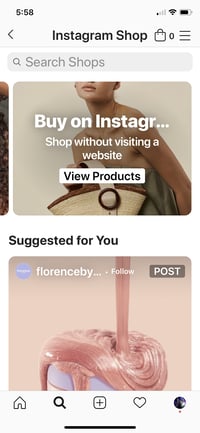
If a user places a product in their Instagram Bag, they can find it by going to the app's Explore tab and tapping "Shop" in the top navigation. Fram the  Shop page, they can then tap the bag icon in the upper right corner to see carted products:

Instagram shopping tab of app

Because users who purchase items via Instagram Live Shopping will be directed to Instagram Checkout to finalize the purchase, brands will need to gain access to Instagram Checkout before using Live Shopping.

What to Keep in Mind When Selling Products on Instagram

At this point, you might be ready to sell your brand's products using Instagram's in-app shopping features. However, as you would with any new marketing or selling technique, you'll want to keep a few key things in mind:

Your content strategy is still key.

While it might sound tempting to blast your followers with posts filled with product shots or basic promotional messaging, and hope that users click the Checkout button immediately, some audiences might not respond well to content that feels like a basic advertisement.

Remember, social media users see ads with product shots and bland descriptions daily. If your content doesn't stand out above all the other promotional posts out there, your audiences might disengage from you, even if they like your brand.

Rather than posting basic images or videos of products linked to Checkout, consider going a step further. For example, you could air a live stream tutorial where an influencer discusses your product, or publish user-generated content such as customer testimonials. These types of content will show audiences more valuable details than a basic product shot, while also presenting how real people benefit your product. This could persuade them to click and buy your items much faster.

You'll want to pick the right feature for your company.

While Shops will allow customers to buy a bunch of different products from you all at once, Checkout and Instagram Live Shopping allow you to zone in on specific items or services through your content. While Facebook Shops might be great for brands that can deliver multiple products at once and handle potential high demand, Checkout and Live Shopping could be beneficial for smaller businesses that are more comfortable highlighting one standalone product at a time.

Additionally, if you have a killer supply chain, tons of products to sell, and no time to make content, a Facebook Shop could help you move your inventory. Meanwhile, if you have a great content team, but only have a few key products to sell, you might want to create solid product marketing content paired with Instagram Checkout.

You'll want to monitor your metrics, including revenue.

Although brands don't need to pay for Facebook Shops, Checkout, or Live Shopping, time and effort will still go into creating and maintaining a Shop or content that highlights items sold in Checkout. Because of this, you'll want to monitor the money and engagement-related metrics of each strategy you take on. While these metrics can help you learn what to do, and what not to do, they can also help you determine if these features are worth your team's time.

If you're considering an ecommerce strategy on Instagram or another online platform and don't know where to start in your planning, bookmark our Ultimate Guide to Ecommerce. If you're interested in learning how other brands shifted to ecommerce in 2020, check out this piece.


How Three New Instagram Shopping Tools Could Help Marketers Boost Sales was originally posted by Local Sign Company Irvine, Ca. https://goo.gl/4NmUQV https://goo.gl/bQ1zHR http://www.pearltrees.com/anaheimsigns
8 e-commerce advertising trends to boost results in 2021

E-commerce advertising trends for 2021 could be the saviour for many for brands. Especially as 2020 swept the rug out from under many brands’ feet! Making them realise just how important a good e-commerce offering is.

Indeed, those who were not prepared suffered when it came to sales. Consider Primark, for example, with no online shopping offering it lost an eye-watering £800m over the first Covid-19 lockdown.

The trend and preference for online shopping has been growing in recent years but the pandemic has proven the need for it.

But it’s not just those ‘treat yourself on payday’ purchases that consumers are shopping online for. Today, everything from food shops to prescriptions are now available via e-commerce platforms. You could get everything you need and never leave the house again – but we definitely don’t recommend that.

Instead, this poses a question for marketers: how do we improve our e-commerce offering to keep consumers coming back?

In this article, we consider the e-commerce trends we expect to witness in 2021.

What 2021 e-commerce advertising trends will we be considering?

  1. Bigger focus on dynamic display ads
  2. Adapting your e-commerce advertising post Covid-19
  3. Mobile display advertising
  4. Personalisation across platforms
  5. Reusing content
  6. Focus on key shopping days
  7. Niche e-commerce marketplaces will rise
  8. Shoppable TV is coming

1. Bigger focus on dynamic display ads

Today, every brand understands the need for an all-singing, all-dancing e-commerce platform. Yet, it’s also important that you stand out amongst the crowd when it comes to your display advertising.

Online shopping allows users the opportunity to research what they’re looking for and compare prices. Personalised and dynamic display advertising enables you to draw them back in if they’ve strayed. Marketers who put this to use should see customers return and hopefully make those all-important transactions.

What are dynamic ads?

Dynamic ads reduce the number of cart abandonments and in most cases, offer a consumer something that they’re actively looking for. You can also factor in A/B testing so you can determine which approach works best for the consumers you want to target.

Perhaps a potential customer is shopping for a new pair of winter boots? A dynamic ad featuring a data feed link to those very same boots will pop up on other websites and social media they visit, enticing them back.

It’s a tactic many will still be employing in 2021 – as long as it is done in such as way to continue to comply with GDPR laws.

2. Adapting your e-commerce advertising post Covid-19

Many of us came to rely upon online shopping to get what we needed during the pandemic. Supermarkets saw an incredible surge in online shopping orders – so much so that they struggled to keep up with demand. In fact, online supermarkets witnessed a 102.7% increase year on year in consumer spending and online clothing stores also enjoyed a 24.3% increase.

In 2020, it’s predicted that shoppers in the UK will spend £88.54 billion with retailers. And while this number is the lowest since 2015, these sales will be predominantly online. E-commerce sales are expected to increase by 16.7% and this trend is sure to continue into 2021 if the pandemic doesn’t ease off.

As we navigate this tricky Covid focused world with ever-shifting goalposts and guidelines, it’s important that your e-commerce advertising adapts and that you embrace this new trend.

Producing ads that point people towards your e-commerce offering is essential. Therefore, ensure your platform is up to scratch for those who land. And have a plan in place to remind people you’re still there for their online shopping needs if they navigate off the page.

3. Mobile display e-commerce advertising

E-commerce advertising trends mobile display advertising

Smartphones are where many of us do everything from communicating with friends and family to completing our Christmas shopping. Not only should your brand’s e-commerce offering be mobile-friendly but your advertising needs to be too. It’s predicted that by the end of 2021, 73% of e-commerce sales will be made on a mobile device.

Optimise your e-commerce advertising with a mobile-first approach

Here are a few ways to do this in 2021:

  • Focus on video. Video banner ads will become commonplace across industries, as brands look to capture the attention of those desired audiences. In 2019, the use of video in display advertising grew by 82% and people are twice as likely to take notice and share video content than any other type of content. In 2020, however, we witnessed a sharp decline in video display advertising. However, as businesses start to recover there should be a resurgence in the year ahead.
  • Ensure everything is mobile friendly. Did you know that 30% of people will abandon an online cart if they discover the website isn’t friendly? This means that any content you create needs to adapt for every shape and size of mobile. Loading time is important too. Keep ads simple to ensure your consumer sees them before they get bored and click away.
  • Go after voice search. Voice search optimisation is a rising star in the world of e-commerce advertising. We use voice assistants every day, from Alexa to Siri, and when we ask them questions they search Google for the most voice friendly answer to a query. If you’re targeting those between the ages of 25 and 49, it’s worth noting that 65% in this bracket use a voice-enabled device once a day.
  • Don’t forget about text message marketing. Ditch the email (okay, not entirely) and consider marketing to your consumers via text. (Of course, only if they’ve consented to this form of communication). Texts are personal, unavoidable and won’t get hidden amongst the other promotions in their email inbox.

4. Personalisation across platforms

Omnichannel advertising is a dream for any advertisers and is often named as an e-commerce advertising trend. This seamless approach ensures customers enjoy the same level of care and quality of interaction however they engage with a brand.

Whether they’re shopping in the bricks and mortar store or browsing the website for inspiration, everything they need adapts and works together. Only 26% of companies currently report having channel-specific personalisation solutions in place, this is set to change in 2021. It’s a personalised approach that customers love and brands can also track purchase journeys easily, allowing them to adapt and offer customers something they need again in future to encourage more engagement and sales.

H&M is an example of a brand doing omnichannel advertising and e-commerce well. Its app is easy to navigate on mobile and when a customer signs up they join the brand’s loyalty programme.

This links all their receipts – both in-store and online – allows them to track where orders are and see what rewards they’re owed for their loyalty. It also offers consumers early access to sales and discounts on trending items.

More and more brands will be looking into how they can adopt such an approach in 2021, as consumers who perhaps hadn’t considered online shopping before feeling the need to during the current circumstances.

5. Reusing content is a key e-commerce advertising trend

In 2021, rehashing and recycling content will be the norm as brands are still navigating an advertising world where they need to spend less and get more back.

In-house marketing departments took a hit in 2020, with an estimated 40,000 creatives being made redundant or put on furlough. However, there’s no shame in adapting and reusing e-commerce advertising content and assets to make something new.

The Swedish supermarket City Gross did just this in 2020, reusing assets to create an effective video display ad that offered up recipes and ingredients around Easter time to inspire its customers. GHD is another example, sharing a Christmas advertisement created last year on its social channels.

Reusing content gives brands a breather, especially when perhaps dealing with reduced staffing and lower capacities in-house. It also relieves the issue of having to produce ad after ad in short time frames, adapting and repurposing what’s already there – and with the average person seeing 1,700 digital ads every month, it’s no wonder teams are busy. There’s also the issue of being quick to supply assets for limited time slots. Reusing assets enables brands to capitalise on opportunities. And it’s a trend we’ll likely see more of in 2021, as more users head to online stores.

6. Focus on key shopping days

In 2020, the run-up to Black Friday and Cyber Monday saw brands advertising their deals earlier than usual to tempt buyers shopping online before the days arrived.

Amazon’s Prime Day and week-long Black Friday event saw shoppers doing most of their Christmas shopping in app. While, clothing retailers such as ASOS jumped on the bandwagon early, releasing their sale the day before Black Friday.

In 2021, brands will continue to target online shoppers with earlier advertising campaigns and exclusive offers for those who engage.

While every brand’s key shopping days are different – an online flower delivery service will prep for Valentine’s and Mother’s Day over Black Friday, for example – it does suggest that the earlier you get started the better.

Display campaigns that are ready for these dates will be essential.

7. Niche e-commerce marketplaces will rise

E-commerce display advertising trends niche e-commerce

Think Amazon is king? Well, as the need for digital e-commerce platforms and selling rises, single-brand marketplaces could become more competitive and less profitable.

Therefore, smaller more niche markets will arise selling items from a range of sellers that work better in terms of ROI and that can target consumers searching for the related products. It’s already happening in the world of handmade products. Although Amazon’s Handmade store has tried to wade into this niche too. Thus we may start to see marketplaces arising in 2021 that offer customers focused shopping experiences.

8. Shoppable TV is coming

Ever watched a TV programme and thought ‘wow, I really love that jacket’. Well, get ready the rise of shoppable TV advertising! Advertising that allows the purchasing of items we see on our screens.

For many we are talking about a futuristic e-commerce advertising trend. Yet, shoppable TV has already been rolled and tested over in the States on the NBCU channel!

Users watching a show are greeted with an ad featuring a QR code, they hold their phone up to this and it takes them through to a product that’s been shown on screen so that they can buy it! Brands such as Lacoste have already got involved, featuring advertisements offering the clothing that tennis players are wearing in the French Open.

It’s a new way of reaching more eyeballs than ever before and while it relies on tech-savvy customers to get involved. And it could become more than a gimmick if it takes off! In fact, NBCU has noted that during the testing stage conversion rates have been on average 30% higher than the traditional e-commerce benchmark and social media followings have grown by 10%.

Conclusion

Next year will be a test again as we continue to navigate the world of e-commerce. More and more consumers are moving online – even those who had not yet dipped their toes in the world of online shopping. Considering these e-commerce advertising trends and implement them into your strategy for 2021 to give your brand the best chance of standing out in the digital world.

The post 8 e-commerce advertising trends to boost results in 2021 appeared first on Bannerflow.


8 e-commerce advertising trends to boost results in 2021 was originally posted by Local Sign Company Irvine, Ca. https://goo.gl/4NmUQV https://goo.gl/bQ1zHR http://www.pearltrees.com/anaheimsigns