Friday, October 2, 2020

How to Use Instagram: A Beginner's Guide

Over the past few years, Instagram has seen exponential growth -- from one million users in December 2010 to over one billion in 2020.

If you're interested in getting an Instagram account, or just created one but aren't sure how to use it, you're in luck. Here, we're going to cover all the basics, so you can see why Instagram is the top social media platform for engagement today.

It's hard to remember a time before Instagram. "Do it for the 'gram" has become a common saying, which means, essentially, "Do something so we can take a picture and post it to Instagram."

If you're not part of the one billion on Instagram, you might want to reconsider. The app is a great chance to stay apart of friends' lives -- when I want to see how my college friends are doing, I don't check Facebook, I check Instagram. Plus, you can follow your favorite celebrities or political figures to see candid photos of their everyday lives.

Additionally, it's a phenomenal platform for investigating what other brands are doing -- for instance, Nike uses the Instagram Stories' feature to promote inspirational athlete stories you won't find anywhere else.

If you're ready to sign up for Instagram, follow these steps below:
  • Go to the Instagram site on your desktop, or download the Instagram app from the App Store (iPhone) or Google Play Store (Android).
  • If you're on desktop, click "Log in with Facebook", or fill in the form with mobile number or email, name, username, and password. Then click "Sign up".
  • On Android, click "Sign Up With Email or Phone Number".
  • On iPhone, select "Create New Account".
  • Enter your email address and phone number, then click "Next". Alternatively, you can also sign up with your Facebook account on the app.
  • Once you've filled out your username and password, you will be instructed to fill out your profile info. Then, tap "Done".
  • If you register with Facebook, you'll need to log into your Facebook account if you're currently logged out.

How Do Instagram Notifications Work?

When your account is created, you'll want to adjust your notifications so you only receive the information you want. For instance, you can choose to receive notifications when you get likes from everyone -- but, alternatively, you might decide to only receive notifications when you get a like from someone you follow. Or, you might turn off notifications for likes altogether.

You can adjust notifications to "Off", "From People I Follow", or "From Everyone", for the following categories -- Comments, Comment Likes, Likes and Comments on Photos of You, Follower Requests, Accepted Follow Requests, Friends on Instagram, Instagram Direct, Photos of You, Reminders, First Posts and Stories, Product Announcements, View Counts, Support Requests, Live Videos, Mentions in Bio, IGTV Video Updates, and Video Chats.

If you're overwhelmed by that list, I get it -- I am, too. If you're unsure what notifications you want to receive, you might start with your notifications on "From Everyone", and if certain notifications begin to annoy you, you can turn them off later.

To customize which notifications you receive, follow these steps:

1. Go to your personal account (which you'll find by pressing the person icon at the bottom right of your screen). Then, click the "Settings" icon (the circle icon beside "Edit Profile").
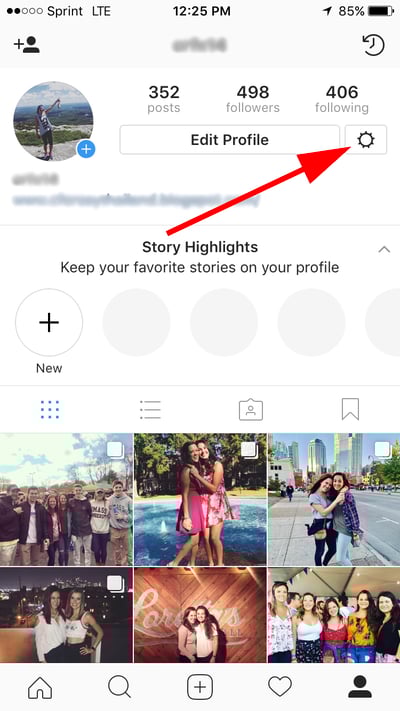
cog icon for settings next to the edit profile button in instagram

2. Scroll down to "Push Notification Settings".
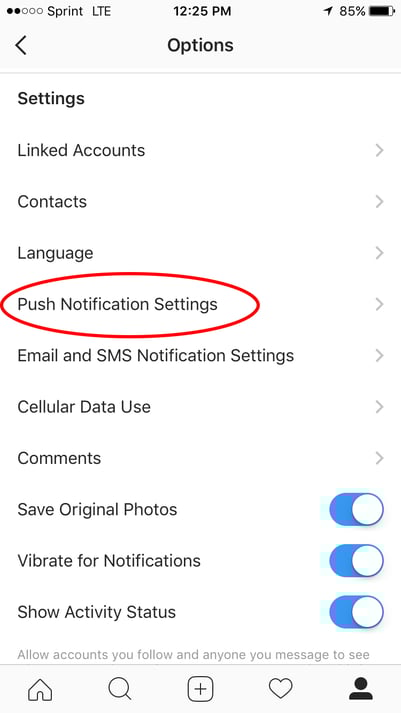
push notification settings option in instagram

3. Check off the notifications you want to receive.
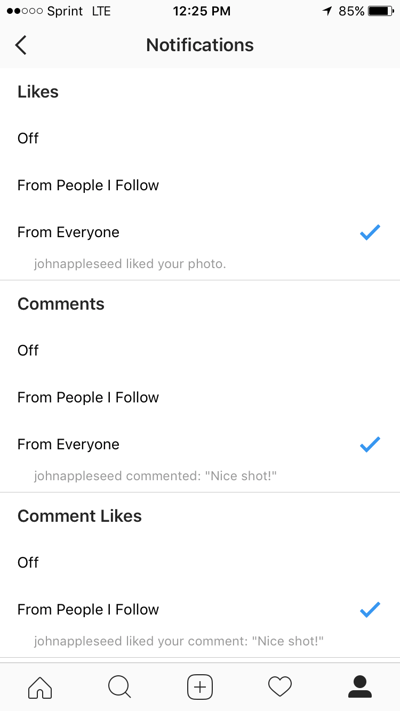
notifications option within instagram settings with sections for likes, comments, and comment likes

And that's it! Next, let's explore how to connect your other social media accounts to your Instagram, so when you post an image to Instagram, you can share it with your other online audiences, as well.

Connect to Other Social Accounts

When you post an image to Instagram, you have the option to share it on other social media accounts, like your Facebook or Twitter.

To link your other social media accounts to your Instagram, follow these steps:

1. Go to "Settings" and click "Linked Accounts".
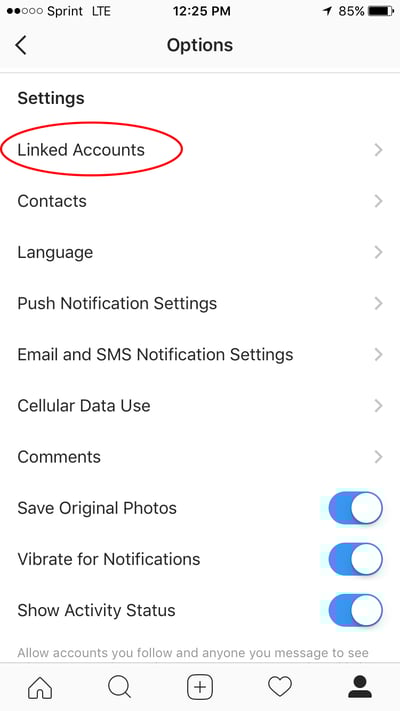
linked accounts option in instagram settings

2. Select whichever social media channels you'd like to link to, and input the necessary information to incorporate the channel with your Instagram.
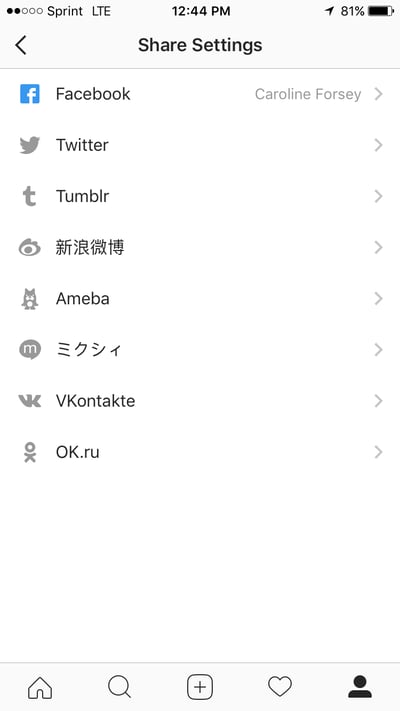
share settings menu in instagram

In the next section, "Upload, Edit, and Post an Image", I'll show you when a linked account comes in handy.

Upload, Edit, and Post an Image

Now, for the most important part of Instagram -- how to upload and post an image.

Instagram is an entirely visual platform. Unlike Facebook, which relies on both text and pictures, or Twitter, which relies on text alone, Instagram's sole purpose is to enable users to share images or videos with their audience.

On Facebook, you might choose to post 100 photos in an album. On Instagram, you need to be choosier about which photos you post. There are a few reasons for this -- first, you don't want to post more than once a day (typically). For the purpose of scarcity alone, you don't want to post too many similar photos. For instance, it would be odd for you to post ten photos from the same beach vacation on your Instagram. Instead, you might choose one or two.

Additionally, you want your overall profile aesthetic to look diverse.

To learn more about Instagram account themes and get inspiration, take a look at "12 Stunning Instagram Themes (& How to Borrow Them for Your Own Feed)".

Additionally, if you want to embark on a deep-dive, you can take HubSpot's Instagram Marketing Course.

Now that we've covered that, let's explore how to upload, edit, and post an image.

1. Click the "+" icon in the bottom center of your screen.

instagram homepage with + icon at the bottom in the center

2. Here, you have three options. You can look through your Photos library on your phone, you can take a new picture from right within Instagram, or you can take a new video. For our purposes, I looked through my Photos library and found a picture of Boston I wanted to use. Then, I clicked "Next" in the top right.
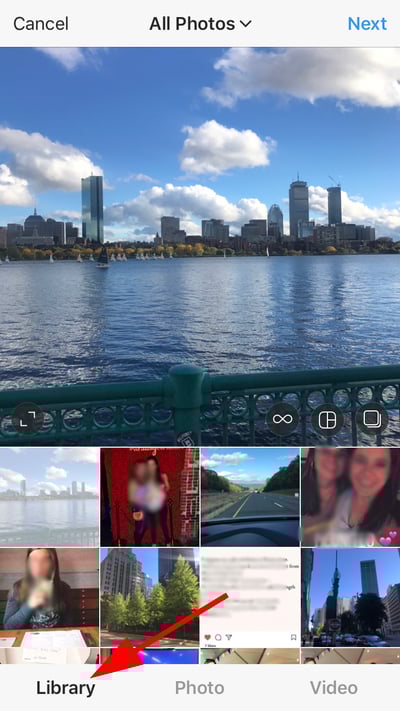
instagram library option

3. There are two categories you can use to edit your image -- "Filter" and "Edit". Instagram automatically shows you filters first. You can scroll through the carousel and click any of the filters to apply it to your image. Additionally, if you want to use a filter but you want to tone it down, double tap the filter and move the cursor to the left to lessen the intensity of the filter.
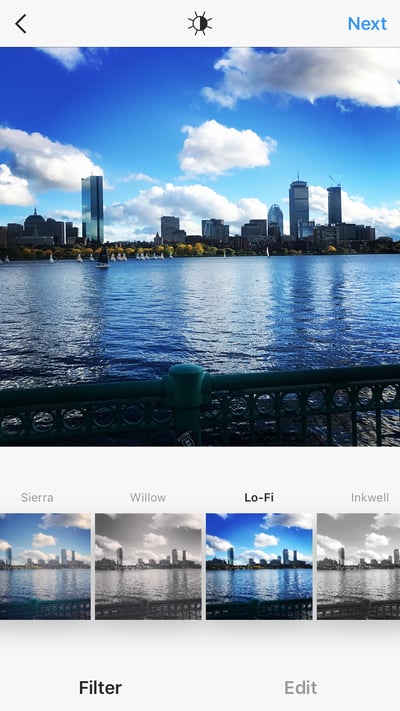
instagram filter option

4. Next, click "Edit". Here, you can adjust contrast, brightness, structure, warmth, and more. When you're happy with your edited image, or if you don't want to edit it at all, click "Next" in the top right.
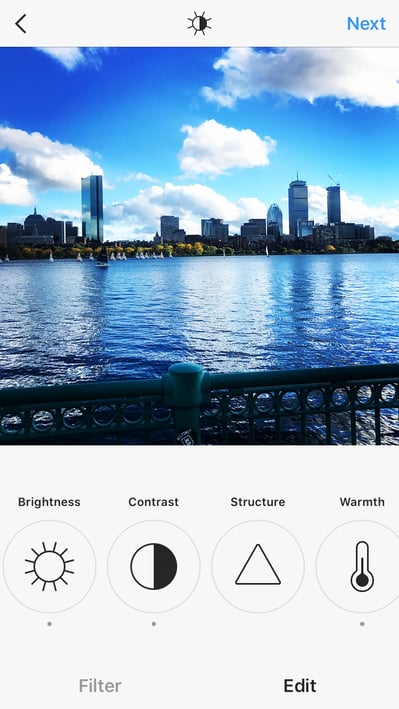
instagram edit option

5. Now, you can add a caption, tag people (you can only tag someone if they also have an Instagram account), and add a location. Additionally, click the button beside Facebook or another linked social media account to share your image on that platform, as well. When you're ready to publish, click "Share" in the top right.
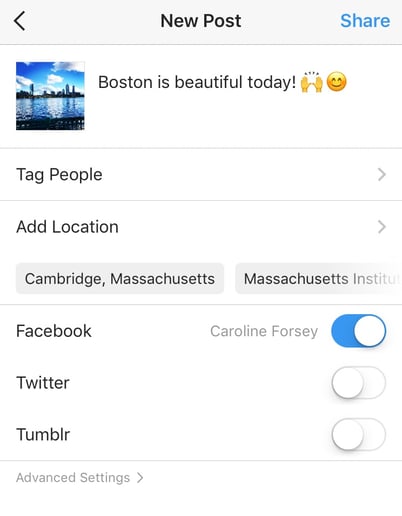
new post in instagram with add caption option

Upload a Image or Video to Your Stories

In 2016, Instagram launched "Stories", a feature that allows you to post videos or images that disappear after 24-hours. Instagram's Stories feature is similar to Snapchat in terms of content -- users often post more casual and candid videos and images, offering glimpses into their every day lives.

For instance, you might post a heavily-edited picture of yourself and friends at a baseball game. But you might post a more candid video to your Story of the stadium singing "Sweet Caroline".

To learn how to upload an image or video to your Stories, follow these steps:

1. Click the camera icon in the top left.

camera icon in the top left of instagram homepage

2. Once you're within the Stories feature, you can take a picture or video right from within the app. Alternatively, if you have an image saved to your phone that you'd like to use, click the small square in the bottom left corner.
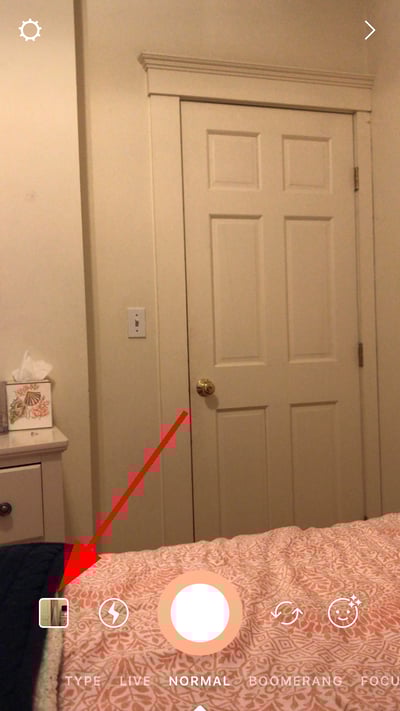
instagram stories box at the bottom left of camera feature

3. Click on a photo you'd like to use in your Stories.
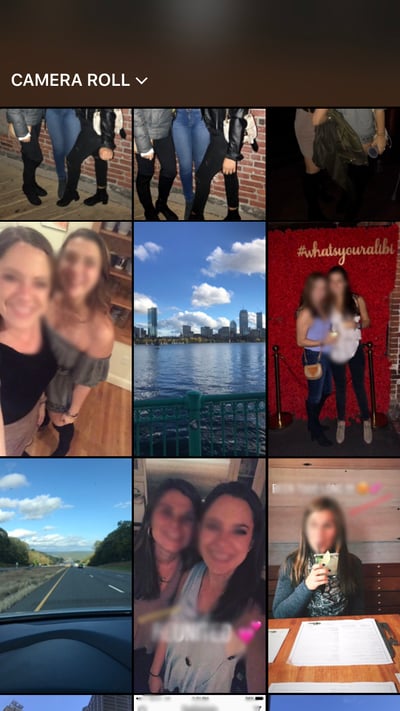
camera roll in instagram

4. In the top right, you have a few different editing features. The smiley face lets you add a location, hashtag, time, date, and other fun images or emojis to your picture. The pencil lets you handwrite or draw on your image. And the "Aa" icon is your text button. Once you click "Aa", you have the option to change your font by clicking "Classic" at the top.

stories in instagram

5. If you click the smiley face icon, you'll see the following screen. Simply click on one of the icons to add them to your image. If you don't like it, drag it to the bottom, and a trash can will appear so you can delete it.
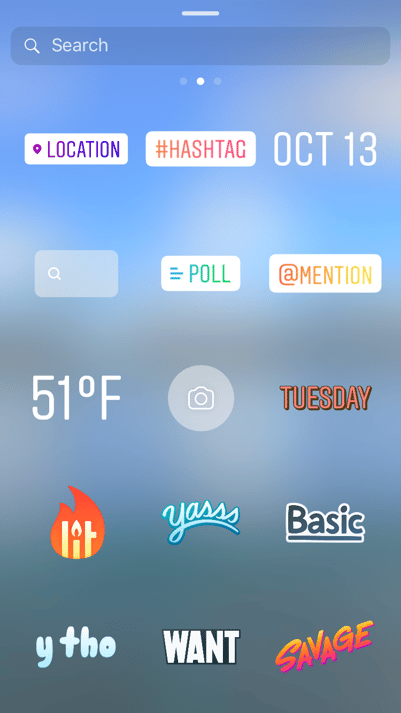
icons in instagram

6. For instance, I clicked the smiley face icon to add a location and hashtag to my image. You can also swipe to the left or right to add filters to your photo or video. Once you're happy with your content, you can either click the "+ Your Story" icon in the bottom left, which allows you to share your Story with everyone who follows you, or select "Send To" to send the post to someone specific.
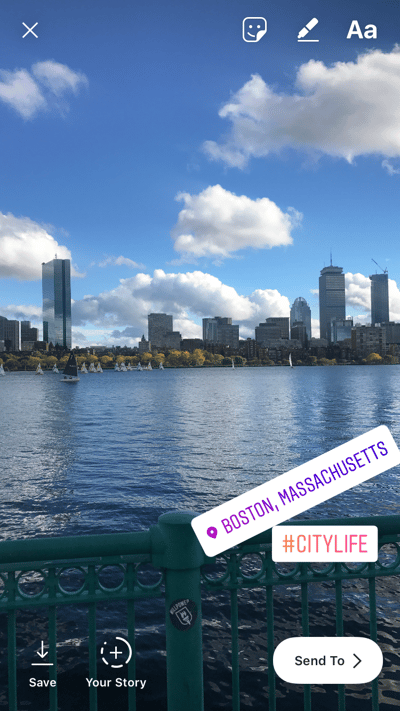
new photo post in instagram with icons and send to button at the bottom right

How to Follow on Instagram

It's incredibly easy to find and follow users. Using Instagram's search feature, you can find celebrities, brands, and friends. Additionally, you can search "Tags" or "Places". "Tags" is particularly useful if you know what type of content you want to find, but you're not sure who posts about it.

For instance, you might search "#familyrecipes" under tags -- your results will include any images with that hashtag. As you peruse, you might find someone who posts content you really like, and you can choose to follow them so their content appears on your feed.

To follow someone, follow these three easy steps.

1. Click on the search icon on the bottom of your screen (it looks like a magnifying glass).
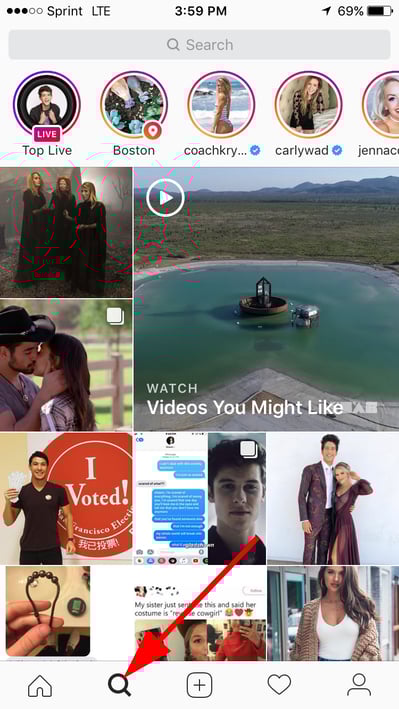
search feature in instagram with magnifier icon

2. Next, type in a person or brand. For this example, I began searching "mandym" (Mandy Moore) and found her as #1 in the search results. Alternatively, I could've clicked "Tags" or "Places" to search those categories.
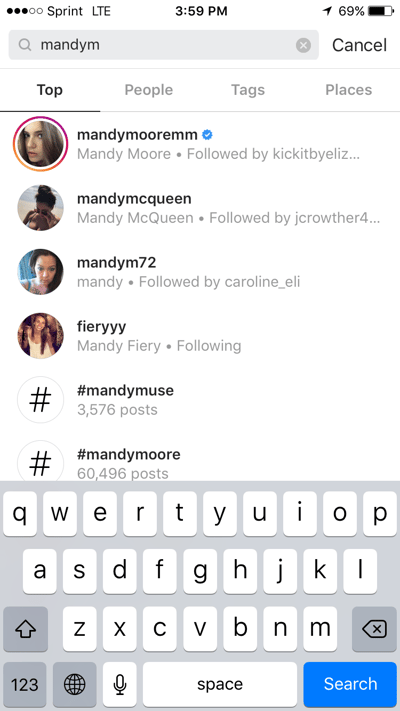
search feature for "mandym" in instagram

3. Once you're on someone else's account, you'll see a blue "Follow" button at the top. For public profiles, you can click and immediately begin following that account. However, if the profile is private, you may need to wait for them to accept you first.
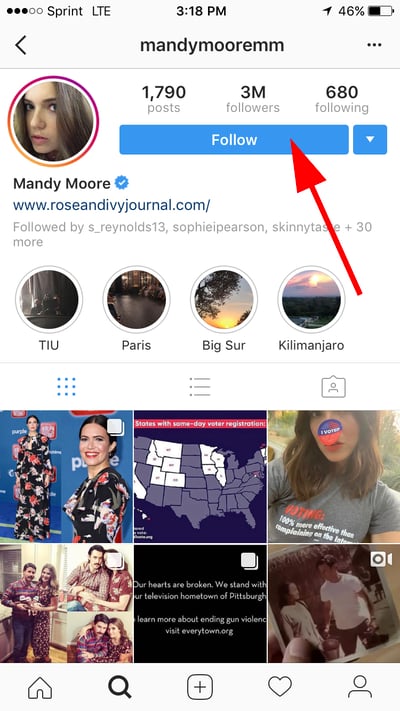
follow button on mandy moore's profile on instagram

And that's it! You're on your way to becoming a pro. To take your account to the next level, plan out your next posts using an array of content ideas and templates.

Editor's note: This post was originally published in November 2018 and has been updated for comprehensiveness.


How to Use Instagram: A Beginner's Guide was originally posted by Local Sign Company Irvine, Ca. https://goo.gl/4NmUQV https://goo.gl/bQ1zHR http://www.pearltrees.com/anaheimsigns

The Beginner’s Guide to Usability Testing [+ Sample Questions]

My favorite part of the writing process is when my editor reviews my work. By the time I’ve submitted the first draft of most of my blog posts, I’ve invested so much time and effort into my piece that I’m too emotionally attached to it. I need to distance myself from it.

My editor also has fresh editing eyes, so she can discover any overlooked errors and new creative opportunities to sharpen my piece. After I address her edits, my piece always looks more polished.

Asking other people to evaluate your work applies to almost every discipline, especially user experience and design. It's not smart to rely on yourself when evaluating your own product or website design. You're partial towards it, and that can skew your perception of reality. Learning directly from the people that your work is actually for -- your users -- is what enables you to craft the best user experience possible.

UX and design professionals leverage usability testing to get user feedback on their product or website’s user experience all the time. So we interviewed some of HubSpot’s Senior UX Researchers and Designers to teach you what exactly usability testing is, its benefits, and how to effectively conduct your own study.

What is Usability Testing?

Usability testing is a method of evaluating a product or website’s user experience. By testing the usability of their product or website with a representative group of their users or customers, UX researchers can determine if their actual users can easily and intuitively use their product or website.

UX researchers will usually conduct usability studies on each iteration of their product from its early development to its release. This allows UX researchers to uncover any problems with their product's user experience, decide how to fix these problems, and ultimately determine if the product is usable enough.

Identifying and fixing these early issues saves the company both time and money: developers don’t have to overhaul the code of a poorly designed product that’s already built, and the product team is more likely to release it on schedule.

During a usability study, the moderator asks participants in their individual user session to complete a series of tasks while the rest of the team observes and takes notes. By watching their actual users navigate their product or website and listening to their praises and concerns about it, they can see when the participants can quickly and successfully complete tasks and where they’re enjoying the user experience, encountering problems, and experiencing confusion.

After conducting their study, they’ll analyze the results and report any interesting insights to the project lead.

Benefits of Usability Testing

Usability testing has five major advantages over the other methods of examining a product's user experience, like a questionnaire:

  • Usability testing provides an unbiased, accurate, and direct examination of your product or website’s user experience. By testing its usability on a sample of actual users who are detached from the amount of emotional investment your team has put into creating and designing the product or website, their feedback can resolve most of your team’s internal debates.
  • Usability testing is convenient. To conduct your study, all you have to do is find a quiet room and bring in portable recording equipment. If you don’t have recording equipment, someone on your team can just take notes.
  • Usability testing can tell you what your users do on your site or product and why they take these actions.
  • Usability testing lets you address your product’s or website’s issues before you spend a ton of money creating something that ends up having a poor design.
  • For your business, intuitive design boosts customer usage and their results, driving demand for your product.

Examples of What Usability Testing Can Do

Usability testing sounds great in theory, but what value does it provide in practice? Here's what it can do to actually make a difference for your product (with examples):

1. Identify points of friction in the usability of your product.

As Brian Halligan said at INBOUND 2019, "Dollars flow where friction is low." This just as true in UX as it is in sales or customer service. The more friction your product has, the more reason your users will have to find something that's easier to use.

Usability testing can uncover points of friction from customer feedback.

For example: "My process begins in Google Drive. I keep switching between windows and making multiple clicks just to copy and paste from Drive into this interface."

Even though the product team may have had that task in mind when they created the tool, seeing it in action and hearing the user's frustration uncovered a use case that the tool didn't compensate for. It might lead the team to solve for this problem by creating an easy import feature or way to access Drive within the interface to reduce the number of clicks the user needs to make to accomplish their task.

2. Stress test across many environments and use cases.

Our products don't exist in a vacuum, and sometimes development environments are unable to compensate for all the variables. Getting the product out and tested by users can uncover bugs that you may not have noticed while testing internally.

For example: "The check boxes disappear when I click on them."

Let's say that the team investigates why this might be, and they discover that the user is on a browser that's not commonly used (or a browser version that's outdated).

If the developers only tested across the browsers used in-house, they may have missed this bug, and it could have resulted in customer frustration.

3. Provide diverse perspectives from your user base.

While individuals in our customer bases have a lot in common (in particular, the things that led them to need and use our products), each individual is unique and brings a different perspective to the table. These perspectives are invaluable in uncovering issues that may not have occurred to your team.

For example: "I can't find where I'm supposed to click."

Upon further investigation, it's possible that this feedback came from a user who is color blind, leading your team to realize that the color choices did not create enough contrast for this user to navigate properly.

Insights from diverse perspectives can lead to design, architectural, copy, and accessibility improvements.

4. Give you clear insights into your product's strengths and weaknesses.

You likely have competitors in your industry whose products are better than yours in some areas and worse than yours in others. These variations in the market lead to competitive differences and opportunities. User feedback can help you close the gap on critical issues and identify what positioning is working.

For example: "This interface is so much easier to use and more attractive than [competitor product]. I just wish that I could also do [task] with it."

Two scenarios are possible based on that feedback:

  1. Your product can already accomplish the task the user wants. You just have to make it clear that the feature exists by improving copy or navigation.
  2. You have a really good opportunity to incorporate such a feature in future iterations of the product.

5. Inspire you with potential future additions or enhancements.

Speaking of future iterations, that comes to the next example of how usability testing can make a difference for your product: The feedback that you gather can inspire future improvements to your tool.

It's not just about rooting out issues but also envisioning where you can go next that will make the most difference for your customers. And who best to ask but your prospective and current customers themselves?

The 9 Phases of a Usability Study

1. Decide which part of your product or website you want to test.

Do you have any pressing questions about how your users will interact with certain parts of your design, like a particular interaction or workflow? Or are you wondering what users will do first when they land on your product page? Gather your thoughts about your product or website’s pros, cons, and areas of improvement, so you can create a solid hypothesis for your study.

2. Pick your study’s tasks.

Your participants' tasks should be your user’s most common goals when they interact with your product or website, like making a purchase.

3. Set a standard for success.

Once you know what to test and how to test it, make sure to set clear criteria to determine success for each task. For instance, when I was in a usability study for HubSpot’s Content Strategy tool, I had to add a blog post to a cluster and report exactly what I did. Setting a threshold of success and failure for each task lets you determine if your product's user experience is intuitive enough or not.

4. Write a study plan and script.

At the beginning of your script, you should include the purpose of the study, if you’ll be recording, some background on the product or website, questions to learn about the participants’ current knowledge of the product or website, and, finally, their tasks. To make your study consistent, unbiased, and scientific, moderators should follow the same script in each user session.

5. Delegate roles.

During your usability study, the moderator has to remain neutral, carefully guiding the participants through the tasks while strictly following the script. Whoever on your team is best at staying neutral, not giving into social pressure, and making participants feel comfortable while pushing them to complete the tasks should be your moderator

Note-taking during the study is also just as important. If there’s no recorded data, you can’t extract any insights that’ll prove or disprove your hypothesis. Your team’s most attentive listener should be your note-taker during the study.

6. Find your participants

Screening and recruiting the right participants is the hardest part of usability testing. Most usability experts suggest you should only test five participants during each study, but your participants should also closely resemble your actual user base. With such a small sample size, it’s hard to replicate your actual user base in your study.

To recruit the ideal participants for your study, create the most detailed and specific persona as you possibly can and incentivize them to participate with a gift card or another monetary reward.

Recruiting colleagues from other departments who would potentially use your product is also another option. But you don’t want any of your team members to know the participants because their personal relationship can create bias -- since they want to be nice to each other, the researcher might help a user complete a task or the user might not want to constructively criticize the researcher’s product design.

7. Conduct the study.

During the actual study, you should ask your participants to complete one task at a time, without your help or guidance. If the participant asks you how to do something, don’t say anything. You want to see how long it takes users to figure out your interface.

Asking participants to “think out loud” is also an effective tactic -- you’ll know what’s going through a user’s head when they interact with your product or website.

After they complete each task, ask for their feedback, like if they expected to see what they just saw, if they would’ve completed the task if it wasn’t a test, if they would recommend your product to a friend, and what they would change about it. This qualitative data can pinpoint more pros and cons of your design.

8. Analyze your data.

You’ll collect a ton of qualitative data after your study. Analyzing it will help you discover patterns of problems, gauge the severity of each usability issue, and provide design recommendations to the engineering team.

When you analyze your data, make sure to pay attention to both the users’ performance and their feelings about the product. It’s not unusual for a participant to quickly and successfully achieve your goal but still feel negatively about the product experience.

9. Report your findings.

After extracting insights from your data, report the main takeaways and lay out the next steps for improving your product or website’s design and the enhancements you expect to see during the next round of testing.

The 3 Most Common Types of Usability Tests

1. Hallway/Guerilla Usability Testing

This is where you set up your study somewhere with a lot of foot traffic. It allows you to ask randomly-selected people who have most likely never even heard of your product or website -- like passers-by -- to evaluate its user-experience.

2. Remote/Unmoderated Usability Testing

Remote/unmoderated usability testing has two main advantages: it uses third-party software to recruit target participants for your study, so you can spend less time recruiting and more time researching. It also allows your participants to interact with your interface by themselves and in their natural environment -- the software can record video and audio of your user completing tasks.

Letting participants interact with your design in their natural environment with no one breathing down their neck can give you more realistic, objective feedback. When you’re in the same room as your participants, it can prompt them to put more effort into completing your tasks since they don’t want to seem incompetent around an expert. Your perceived expertise can also lead to them to please you instead of being honest when you ask for their opinion, skewing your user experience's reactions and feedback.

3. Moderated Usability Testing

Moderated usability testing also has two main advantages: interacting with participants in person or through a video a call lets you ask them to elaborate on their comments if you don’t understand them, which is impossible to do in an unmoderated usability study. You’ll also be able to help your users understand the task and keep them on track if your instructions don’t initially register with them.

Usability Testing Script & Questions

Following one script or even a template of questions for every one of your usability studies wouldn't make any sense -- each study's subject matter is different. You'll need to tailor your questions to the things you want to learn, but most importantly, you'll need to know how to ask good questions.

1. When you [action], what's the first thing you do to [goal]?

Questions such as this one give insight into how users are inclined to interact with the tool and what their natural behavior is.

Julie Fischer, one of HubSpot's Senior UX researchers, gives this advice: "Don't ask leading questions that insert your own bias or opinion into the participants' mind. They'll end up doing what you want them to do instead of what they would do by themselves."

For example, "Find [x]" is a better than "Are you able to easily find [x]?" The latter inserts connotation that may affect how they use the product or answer the question.

2. How satisfied are you with the [attribute] of [feature]?

Avoid leading the participants by asking questions like "Is this feature too complicated?" Instead, gauge their satisfaction on a Likert scale that provides a number range from highly unsatisfied to highly satisfied. This will provide a less biased result than leading them to a negative answer they may not otherwise have had.

3. How do you use [feature]?

There may be multiple ways to achieve the same goal or utilize the same feature. This question will help uncover how users interact with a specific aspect of the product and what they find valuable.

4. What parts of [the product] do you use the most? Why?

This question is meant to help you understand the strengths of the product and what about it creates raving fans. This will indicate what you should absolutely keep and perhaps even lead to insights into what you can improve for other features.

5. What parts of [the product] do you use the least? Why?

This question is meant to uncover the weaknesses of the product or the friction in its use. That way, you can rectify any issues or plan future improvements to close the gap between user expectations and reality.

6. If you could change one thing about [feature] what would it be?

Because it's so similar to #5, you may get some of the same answers. However, you'd be surprised about the aspirational things that your users might say here.

7. What do you expect [action/feature] to do?

Here's another tip from Julie Fischer:

"When participants ask 'What will this do?' it's best to reply with the question 'What do you expect it do?' rather than telling them the answer."

Doing this can uncover user expectation as well as clarity issues with the copy.

Your Work Could Always Use a Fresh Perspective

Letting another person review and possibly criticize your work takes courage -- no one wants a bruised ego. But most of the time, when you allow people to constructively criticize or even rip apart your article or product design, especially when your work is intended to help these people, your final result will be better than you could've ever imagined.

Editor's note: This post was originally published in August 2018 and has been updated for comprehensiveness.


The Beginner’s Guide to Usability Testing [+ Sample Questions] was originally posted by Local Sign Company Irvine, Ca. https://goo.gl/4NmUQV https://goo.gl/bQ1zHR http://www.pearltrees.com/anaheimsigns
Thursday, October 1, 2020

How to Implement & Succeed With Marketing Automation

Emails. Social media posts. PPC campaigns. Wait — another email. Don’t miss that new lead that just downloaded your online course!

The life of a marketer or business owner is busy. Your brain is constantly swirling with ideas, which doesn’t help you get to the bottom of your never-ending task list. Believe me — as both a marketer and business owner, I know how this feels.

In the past 20 or so years, new tools and technology have helped simplify some of these tasks … but this increase has also served to heighten customers’ expectations: Oh, our audience is expecting abandoned cart emails now? Okay, let me add that to the list…

One technology improvement has made marketers’ lives abundantly easier, however — marketing automation. This guide will walk you through the ins and outs of marketing automation, including:

Let’s dive in.

If you’ve ever done some midnight shopping (ahem, like me) and immediately received a confirmation email, you’ve been met with marketing automation. You didn’t think there was a poor guy sitting behind his computer at 1:00 AM waiting for new purchases to come through, did you?

No, that online store likely has some pre-written and scheduled email automations ready to go out when their customers complete certain tasks on their website. We’ll talk more about email marketing automation below.

Other marketing automations include social media, advertising, and SMS marketing automation, as well as internal automations that help you manage and triage marketing tasks.

Marketing automation can help you capture and nurture more (and more qualified) leads. Learn more about how to do this in our free HubSpot Academy course.

Nearly 70% of marketing leaders are currently using a marketing platform. Of those who are automating marketing, 23% are automating their content delivery.

Marketing automations can certainly make life easier, but it shouldn’t replace human touch. As I said in the introduction, a recent increase in technology has been met with increased or changed consumer expectations. Marketing automation is no exception — consumers appreciate the timeliness and thoughtfulness of automation, but they also can also read between the lines of bot-written copy or stale imagery.

Marketing automation should complement your current marketing efforts, not replace them.

What is marketing automation primarily used for?

Marketing automation is primarily used to mechanize and automate otherwise manual marketing tasks like sending emails, posting social media messages, collecting information, and managing internal tasks.

Benefits of Marketing Automation

There are countless benefits of marketing automation. A few I’d like to highlight include:

  • Efficiency: Wasted time is a marketer’s nightmare. Marketing automation can help you complete repeatable tasks in an efficient and effective manner.
  • Nurtured leads: It takes a lot of time and energy to effectively nurture every individual lead; however, it’s too important not to. Marketing automation allows you to nurture your leads on a mass scale while still personalizing each lead’s experience with your brand. 70% of the companies report that the most important benefit of automation technology is better-targeted customer communication.
  • Increased revenue: The more you nurture your leads, the more leads that’ll likely convert to users. Marketing automation can result in increased revenue as more leads become paying customers.
  • Better reporting: Marketing automation streamlines important marketing tasks and allows you to review and analyze your activity and its results.

Types of Marketing Automation

Marketing automation can take many forms. Let’s unpack the different types of automation and how you can use them in your marketing.

Email Marketing Automation

Email marketing automation is perhaps the most common use case for automation. From welcome emails to post-purchase emails and re-engagement emails, there’s a lot that goes into email marketing. Without email marketing automations and workflows, email would be an otherwise very manual process.

Email automation is typically triggered by time or action. Time-based emails are sent on certain occasions, such as a customer’s birthday (don’t you love those free birthday drinks from Starbucks?) or a holiday (Black Friday discounts, anyone?).

Action-based emails are a bit more involved. These automated emails are triggered by actions taken by a website visitor, lead, or customer who then receives an email or series of emails related to that particular action.

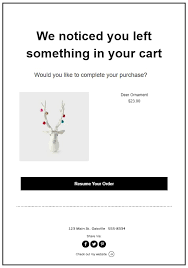
Let’s return to my midnight shopping example. Instead of completing my purchase and receiving the subsequent confirmation email, let’s say I exit the site with items still in my cart—and within 30 minutes, I receive an email reminding me about the forgotten items. This is called an “abandoned cart” email, and many online stores deploy them in hopes that shoppers return and complete their purchases. This is an example of an action-based email marketing automation.

marketing automation abandoned cart email

Source

Email automation campaigns are among the top three tactics used by email marketers to improve performance, and email marketing automation has many benefits. The best one (in my opinion) is how it saves precious time and energy by otherwise priceless tasks. Automated emails can help you generate leads and increase revenue, but that doesn’t mean your marketing team has to spend all their time sending and monitoring them. That’s what marketing automation is for.

Learn everything you need to know about email marketing in our free HubSpot Academy course.

Digital Marketing Automation

Although email marketing is a common use case for marketing automation, it’s not the only one. Let’s talk about other forms of digital marketing automation (both external and internal).

Social Media Marketing Automation

Anyone who works in marketing knows how time-intensive social media marketing can be. If you’re going to do it right, you’ve got to do, well, nonstop. Thankfully, marketing automation can help. Tools like HubSpot and Hootsuite allow you to schedule content, set social media monitoring filters, and even automate the response process — although this should never replace genuine, human interaction with your followers and customers.

Advertising Automation

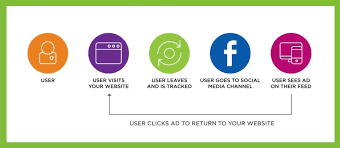
You’ve heard of retargeting, yes? Now … could you imagine having to go into every advertising platform and change the copy, graphics, and timing based on each customer’s individual actions or behavior? Whew, that’d be a lot. Retargeting is an example of advertising automation, as it automatically shifts and smartens its strategy in response to consumer behavior. If a customer visits your website, your retargeting automation will respond by displaying relevant ads on the sites they browse next.

marketing automation retargeting

Source

Mobile Marketing Automation

As SMS marketing becomes more popular and effective, companies are adding mobile marketing to their marketing automation tool belts. Like emails, text messages can also be automated and triggered based on time or actions, and they tend to have a higher (and faster) open rate than emails.

CRM with Marketing Automation

Ah, the CRM—a marketer’s best friend. Thankfully, your CRM and marketing automation can go hand-in-hand. A simple update in your database can trigger a whole host of internal tasks, including lead scoring and alerting your sales team to new prospects. You can also use your CRM to trigger email workflows, either based on user data or user actions.

marketing automation crm

Source

Marketing Automation Software

As a marketer, your marketing technology stack may or may not be your best friend … I know mine sure is.

Do you have a favorite tool or two? Let me guess — a marketing automation software (if you’re currently using one) just crossed your mind.

I don’t blame you. These tools sure make our lives easier and our customers happier. If you’re looking for new tools to add to your list, or you’re wanting to check out marketing automation for the first time, take a look at the marketing automation software tools we’ve compiled in this article. Here are a handful of of my favorites:

HubSpot

The HubSpot CRM, as mentioned above, provides many marketing automation features. As a standalone tool, HubSpot’s marketing automation allows you to automate a variety of tasks, from setting up simple email workflows to building a complex network of rules to target users with tailored emails, live chats, and more.

Drip

Drip specializes in e-commerce marketing automation. It’s mostly used for email marketing and provides email automation workflows, multi-channel marketing, full campaigns, and more.

ManyChat

ManyChat allows you to extend your marketing automation strategy beyond email. Use this tool to build a smart bot to engage with prospects and customers on Facebook Messenger and over SMS. While your marketing automation shouldn’t replace a human touch, ManyChat can help you get the conversation started with prospects — it also captures information from prospects and adds it to your CRM.

Sprout Social

I had to include at least one social media marketing automation tool on this shortlist. Sprout Social can help lighten the load of manual social media tasks — responding to messages, tracking engagement, and measuring audience sentiment. Moreover, Sprout Social provides easy onboarding documentation and resources so you can hit the ground running.

Marketing Automation Strategy

Your marketing automation strategy should vary depending on what tools you use and what goals you set. For example, if you choose to use HubSpot to nurture leads that download a free ebook, your strategy would focus on converting those leads using information relevant to why they perhaps downloaded the ebook—and how your product or service could help meet those needs.

Regardless of your marketing automation strategy, however, make note of these few marketing automation best practices:

  • Know your audience. You can’t create personalized marketing — whether automated or not — without knowing what your audience’s pain points are and how you can meet them. Build your buyer personas to get to know your audience before building your marketing automation workflows.
  • Know your customer journey. A key determinant of successful marketing automation is meeting your lead wherever they are. You can’t do this unless you know their journey to become your customer. Map out your customer journey and match your marketing automation to those lead stages.
  • Review on a regular basis. Although marketing automation is pretty hands-off, it is not a one-and-one strategy. Review your marketing automation workflows on a monthly, quarterly, and yearly basis. Your automation should change as your business, products, and customers do.

Check out this blog post for more marketing automation tips.

Automate Your Marketing to Grow Better

Marketing automation may seem like a lot to learn upfront … but imagine what it’ll feel like to kick back and relax once you’ve got everything in place. OK, maybe not relax, but marketing automation will certainly help you shorten that to-do list.

From email marketing to advertising and retargeting to internal tasks, marketing automation can help you save time, energy, and money — and make your customers’ lives easier and happier. It truly is a marketer’s best friend.


How to Implement & Succeed With Marketing Automation was originally posted by Local Sign Company Irvine, Ca. https://goo.gl/4NmUQV https://goo.gl/bQ1zHR http://www.pearltrees.com/anaheimsigns
Wednesday, September 30, 2020

How to Make the Best of Facebook Ad Targeting, According to HubSpot's Paid Ad Specialist

With a potential advertising reach of 1.9 billion users, Facebook is undeniably one of the most powerful platforms to market your products or services.

As an avid online shopper, I know the power of Facebook advertising firsthand. Consider, for instance, the ad I saw on my Facebook feed a few hours after completing a purchase on Free People's website:

Despite my recent Free People purchase (and dwindling clothing budget … ) I couldn't help but click. I'd just been on their website, but I hadn't seen these clothes yet.

Which leads me to my point: the power of targeted advertising.

With over 7 million advertisers on Facebook, it can be difficult for brands to stand out on Facebook amidst the masses.

Here, we'll dive into the various Facebook ad targeting options you might consider to get the highest ROI on your campaigns — plus, Facebook advertising tips from HubSpot's Paid Ads specialist, Nicole Ondracek.

Facebook Ad Targeting Options

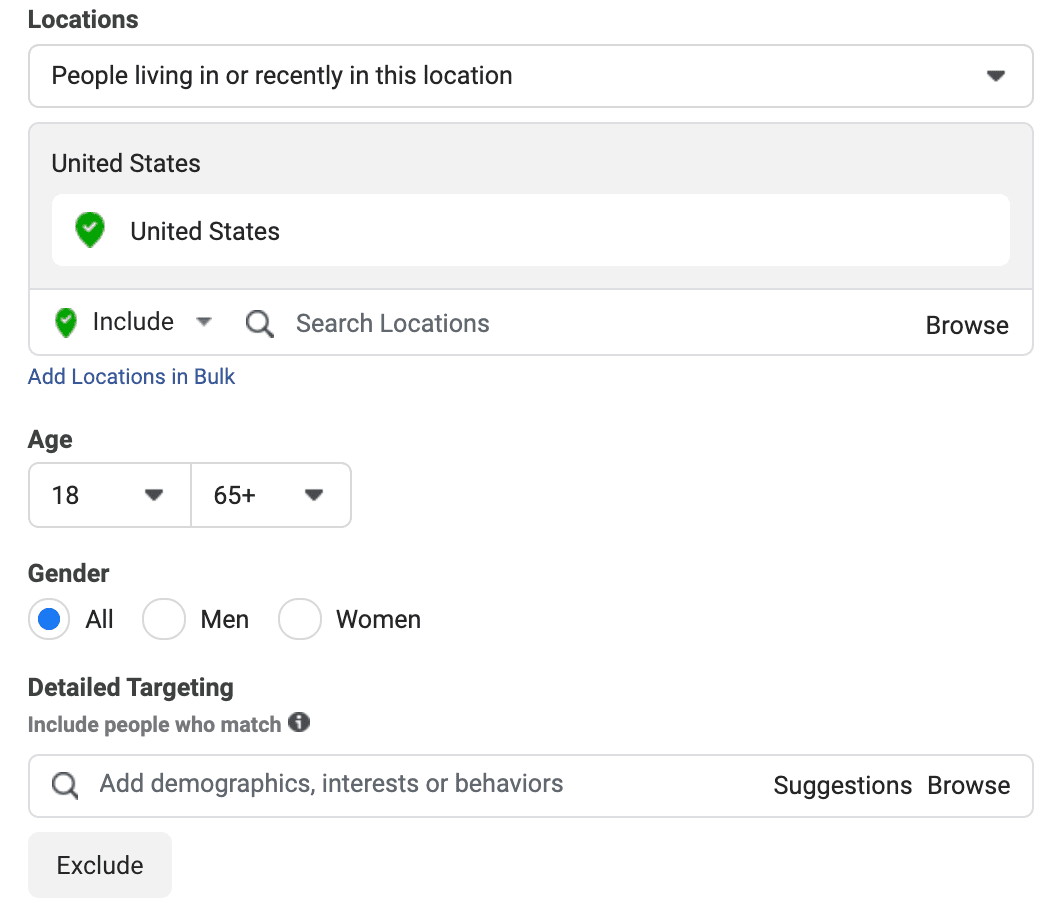
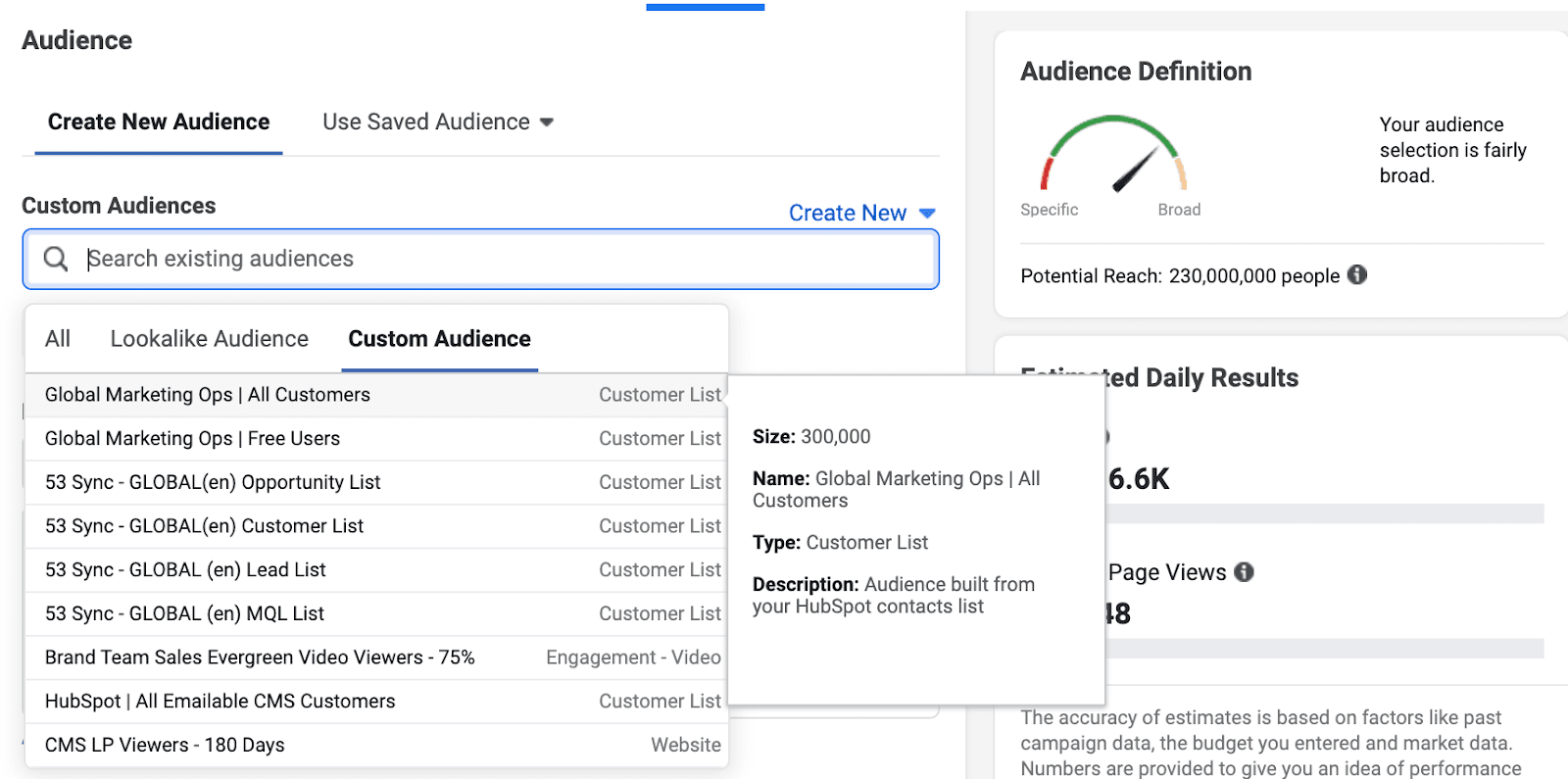
It's important to note, you'll find all these ad targeting options within your Facebook Ads Manager. Once you begin creating a new ad campaign, you'll have the option to "Create New Audience" or "Use Saved Audience".

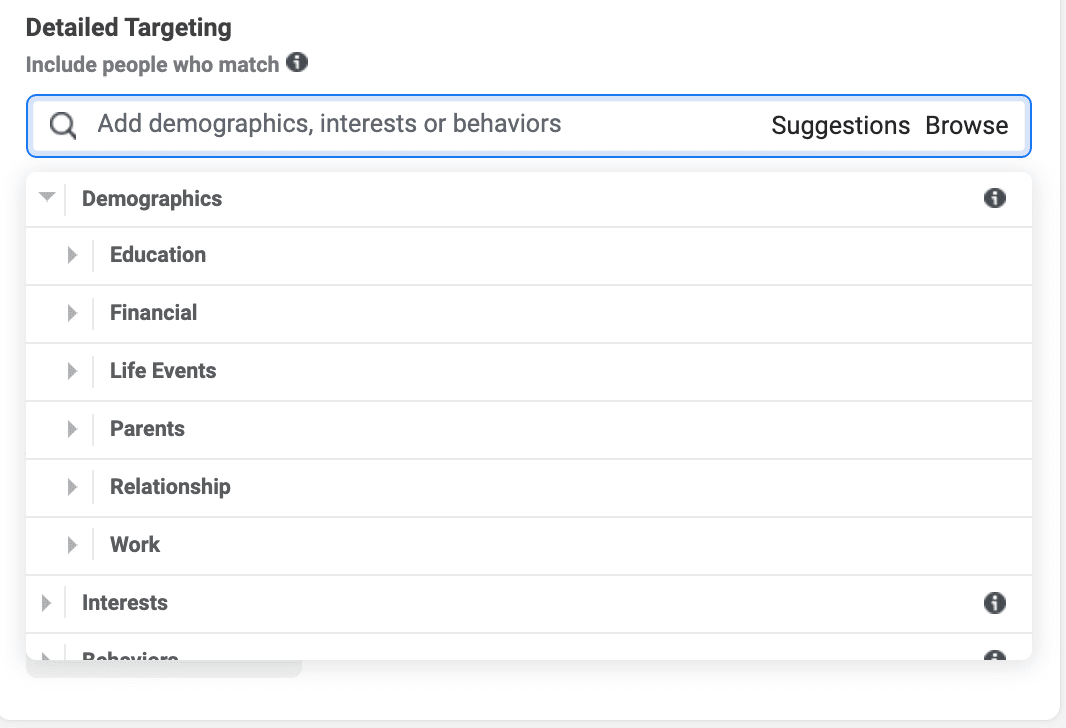
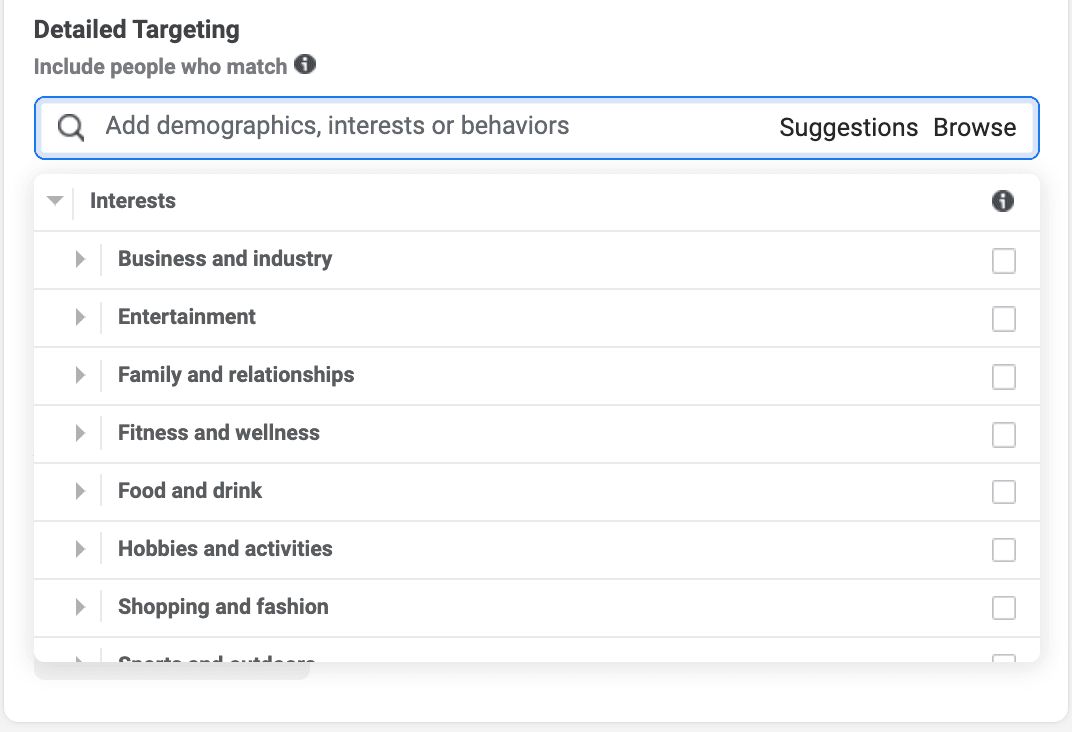
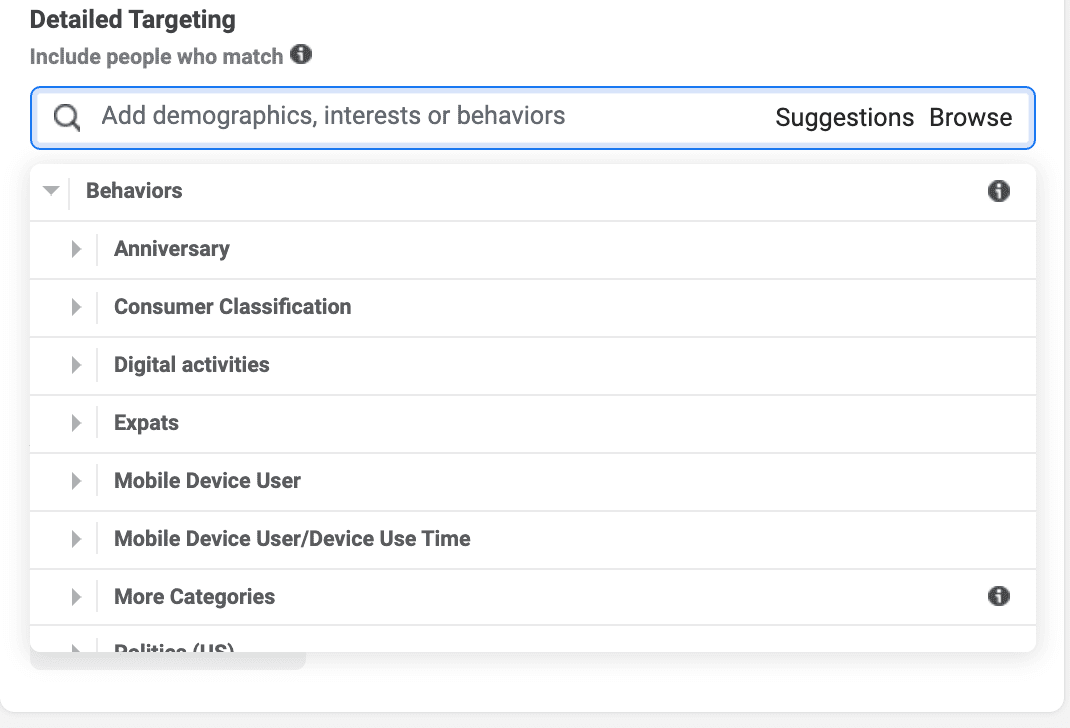
If you opt to create a new audience, you'll see a field for "Custom Audiences" at the top (in which you can add a custom or lookalike audience, both of which are described below), a section for demographics (including Location, Age, Gender, and Languages), and sections for more detailed targeting or connections.

1. Demographic

Demographic Facebook ad targeting options include the opportunity to segment your audience(s) based on age, location, language, work, education, and more. If you sell a product or service that pertains primarily to a certain demographic, this is a good ad targeting option for you.

For instance, maybe your audience is primarily millennial females, people who work in the medical industry, or anyone who lives in Spain — all of these factors can help you hyper-target to ensure you're reaching the prospects who are most willing to buy your product or service based on an ad they see on Facebook.

2. Interests

Consider how much you're able to learn about someone from their Facebook activity.

For instance, in the last six months I've Liked pages of various restaurants in Boston, MA; I've watched yoga videos via Facebook Live; and I've shopped for clothing on Facebook Marketplace. 

All of these activities suggest the types of hobbies I'm interested in, and, tangentially, what types of products or services I'd be interested in purchasing.

Perhaps you sell a product or service that doesn't pertain to an audience's demographic as much as it pertains to an audiences' interests.

A good example of this? Workout gear. Sure, you can guess that your audience is primarily 20 to 30-year-old women, for instance, but a more powerful opportunity for targeting would simply be to target anyone who's Liked fitness pages, or engaged with fitness videos, over the last couple months.

3. Behavior

There are plenty of user behaviors you'd want to keep track of before sending a Facebook ad their way — for instance, consider my example earlier, in which I'd shopped on Free People's website before receiving a Free People ad on Facebook.

Additionally, it's often most effective to target prospects who've already shown interest in your brand. For instance, you might find your Facebook ads perform better with audiences who've already read some of your blog posts or followed you on social media.

Ultimately, "behavior" can help you target audiences who've consumed certain types of content, visited certain websites, used certain browsers or devices, or even donated to certain charities.

This is a particularly good targeting option for ecommerce re-engagement ads, in which you display ads to users who've added items to their check-out cart on your website. Alternatively, you might consider serving ads to users who've visited a certain landing page on your website.

4. Connections

If you have a specific page, app, or event listed on Facebook that attracts visitors to whom you'd like to serve ads, you're in luck. With "Connections", you can do exactly that.

For instance, let's say you recently held a networking event and added 300+ users to the event-specific Facebook page — after-the-fact, you might consider sending specific ads towards those users, who are now more aware of your brand and likely interested in your offerings.

Additionally, you can expand your ad's potential by sending the ad to friends of people who've attended your event, as well.

5. Custom Audiences

If you already have a good list of leads in your database and want to reach them on Facebook, you could simply create a Custom Audience to attract and convert those leads.

A Custom Audience enables you to provide specific information you've gathered about your leads, such as a phone number or email, and then target those leads with ads.

This is a good targeting option if your goal is to up-sell to existing customers. For instance, perhaps you have a database of customers who currently use your product, but you've recently released new features in a Professional version.

One of the best opportunities to attract and convert existing customers is to use Custom Audiences to serve your Professional-product Facebook ads to those customers already in your database.


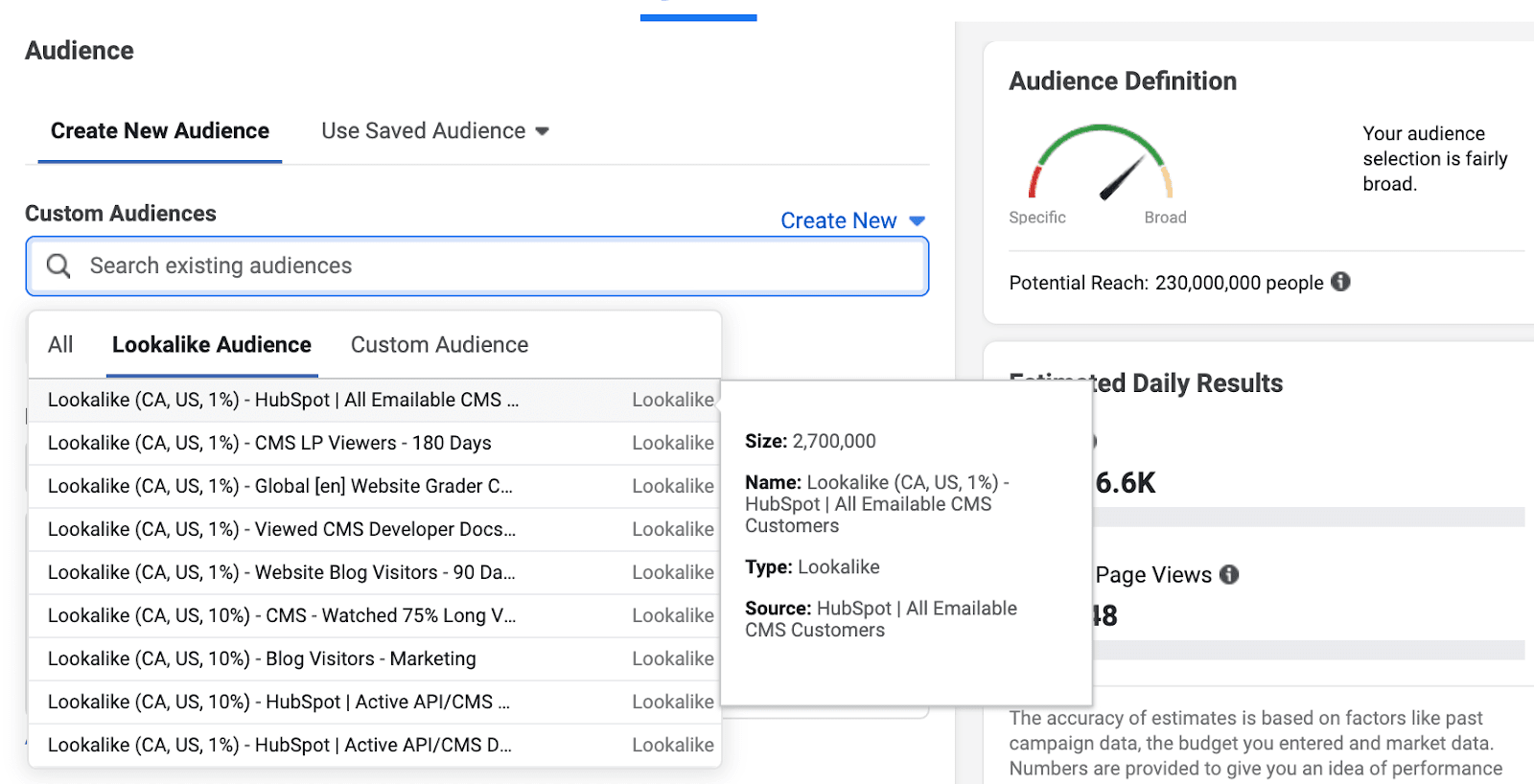
6. Lookalike Audiences

Lookalike Audiences is a fantastic opportunity to perform cold outreach towards prospects who look similar to your existing prospects and customers. As the name implies, Lookalike Audiences allows you to target ads towards users who match similar characteristics to people who've shown interest in your brand.

To further understand what it means for an audience to "look" like your existing database, consider the following example: let's say you upload your email subscriber list to Facebook as a custom audience.

Facebook then identifies the following consistent features about your list: users are primarily in their mid-to-late thirties, they live in the United States, they work in banking, and they've shown an interest in travel.

Facebook could then find users on Facebook who match all of these qualifications, since users with those criteria seem most interested in what your brand has to offer.

Similar to Custom Audiences, you'll need to upload a custom audience for Lookalike Audiences to work — for instance, perhaps you upload a list of email subscribers, event attendees, or website visitors.

Facebook Ad Targeting Tips

1. Repurpose your highest-performing content as a Facebook ad.

If you have a few high-performing pieces of content that already attract and convert leads, why not put some paid ad spend behind it?

We've seen success with this strategy at HubSpot. For instance, each quarter I send a list of top-performing and high-converting content to the paid ad team, and they reformat it into an advertisement for Facebook.

Ondracek adds, "This can apply to different goals throughout a customer's lifecycle. For example, if our goal is to drive more brand awareness to our site, we'll test a blog post that generates a large amount of site traffic. On the other hand, if our goal is more focused on generating leads and submissions, we'll instead test a high-converting content offer, since we care more about conversions than traffic."

Ondracek told me, "It's all about finding the right content that matches up to your campaign objective."

Of course, not every piece of content that performs well organically will perform well as a social ad, which is why you want to be highly selective and pay attention to metrics like social media views when choosing posts.

But, nonetheless, choosing these high-performers is a good starting point and ensures you're providing new audiences with content that already delights your existing audience.

2. Retarget ads to prospects most likely to convert.

With Facebook advertising, you're able to target prospects who've already shown interest in your content, which could be more effective than cold-targeting Facebook users who haven't shown any interest in your brand.

With retargeting, you can send ads towards prospects who've already watched a product demo, interacted with a blog post, or downloaded an ebook — which are all signs they're intrigued by your brand and could be interested in learning more.

For instance, let's say you work in the ecommerce industry and sell athletic apparel. You might consider creating a gated video on fitness tips from top health experts. Once you've collected an email list of users who've downloaded that video, you can target a follow-up "Top Workout Routines" Facebook to those same video viewers.

Ondracek says, "Retargeting is a really powerful approach, and we've found it works best when used to go after an audience similar to the seed list. For example, we've seen success retargeting visitors who have previously visited our pricing page with direct response product ads since they're already in that consideration stage and more likely to buy.

She adds, "On the flip side, when we tried retargeting awareness video ad viewers with these types of down funnel ads, we saw worse performance since these two audiences have completely different behaviors."

Of course, it's vital to note, you'll want to retarget ads that align well with your products or services. If people have shown interest in content that isn't high-converting and doesn't align with your product, you likely don't want to retarget those viewers, since there's no evidence they'll turn into qualified leads.

3. Leverage existing fans of your business.

Similar to the tip above, it's often more worthwhile to target users who've demonstrated their appreciation for your brand by liking your Facebook's business Page. Consider how you might convert those users by retargeting ads towards them.

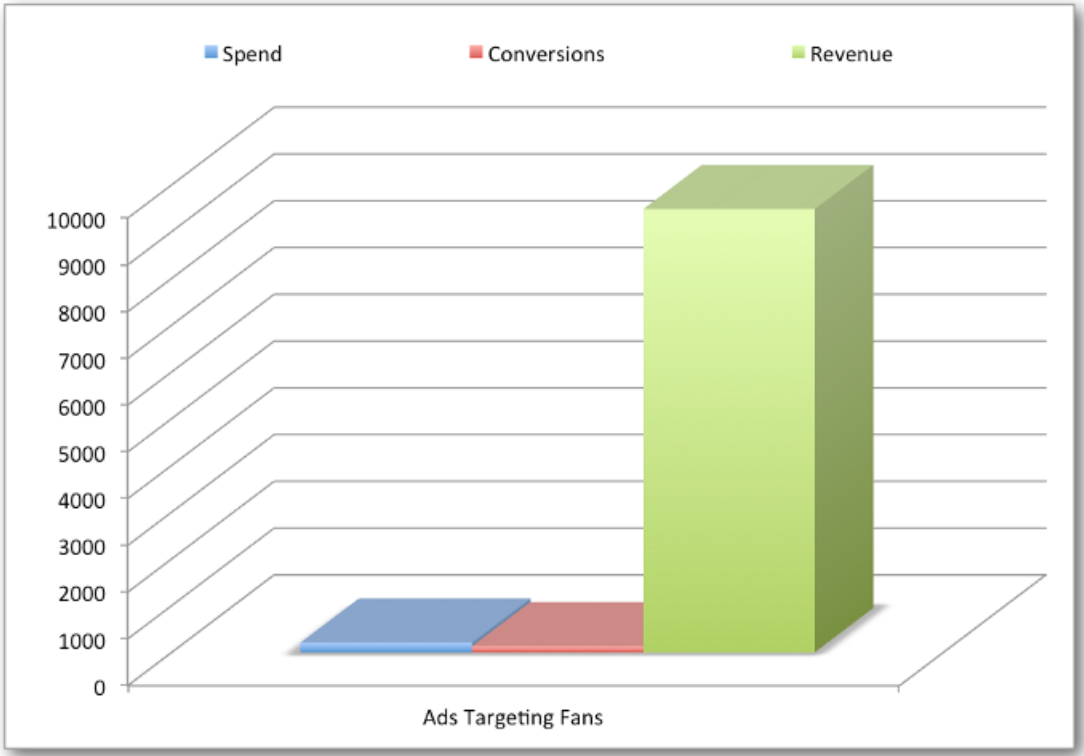
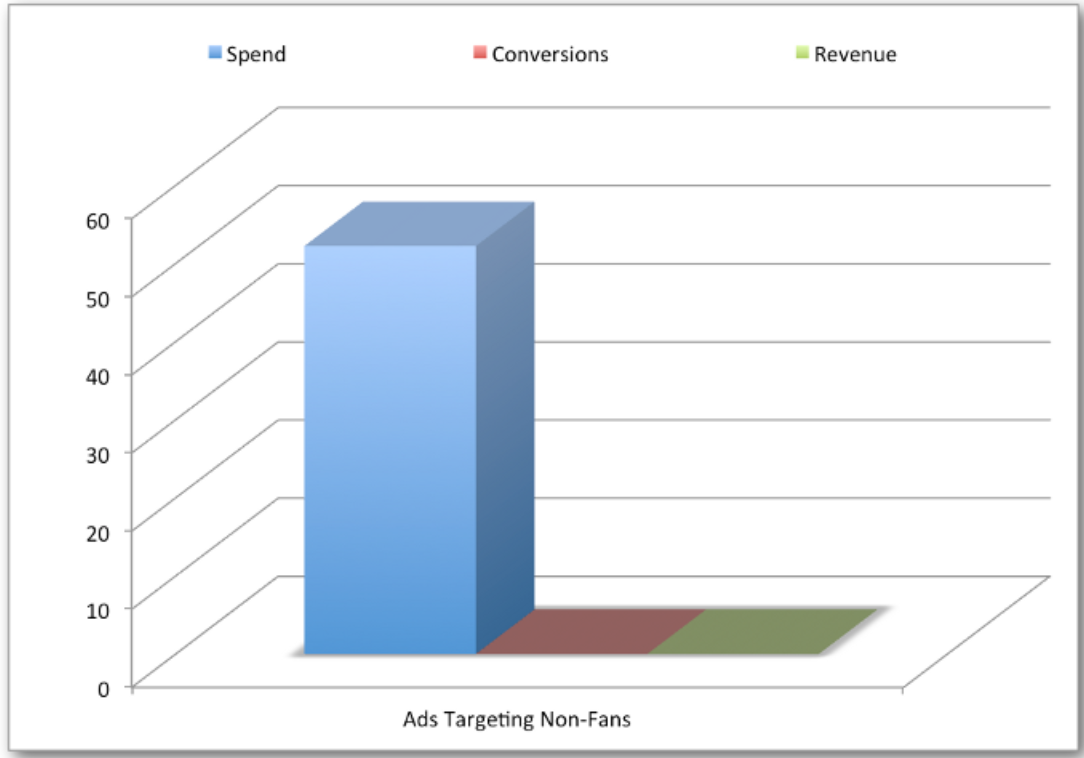
For instance, Facebook Ads expert Jon Loomer found his ads ROI increased dramatically when he targeted fans, rather than non-fans. In fact, his fan-targeted ads returned 129 conversions and resulted in $9,481.50 in revenue — 45.9X ROI. When he targeted non-fans, he didn't convert at all.

Image Source

Ultimately, it's much less obtrusive to target ads towards people who want to see content from your brand and have demonstrated an interest in your company. Save time and money by targeting your brand's fans first.

Additionally, Ondracek told me, "You can also get creative and try layering on some criteria here. For example, you could try targeting fans of your page who haven’t purchased a product to try and influence some buying power. Or on the other hand, you could try targeting fans who have previously purchased a product if you sell something that can be purchased multiple times —like clothing in the FreePeople ad."

4. Take advantage of custom audiences to up-sell and build loyalty with existing customers.

Targeting Facebook ads isn't just effective for attracting new prospects to your business — it's also a good strategy for retaining and up-selling your existing customers.

And, considering it's 5-25X more expensive to acquire a new customer than it is to retain an existing one, it makes sense to leverage the customers in your database already rather than only sending ads to brand-new prospects.

To up-sell via Facebook ads, think about your existing customers who might benefit from an additional feature, product, or service that you can offer them. For instance, perhaps you've just released new features on a Pro version of your product. More than likely, users of your free or beginner product would be interested in learning about those features, particularly if they're enjoying your product and considering an upgrade.

Alternatively, maybe you simply want to target helpful content towards existing customers to increase brand loyalty. You might consider creating a Custom Audience list of customers who've read your social media blog posts, for instance, and then serve ads on your upcoming social media webinar to that audience.

5. Create lookalikes of top-performing audiences to keep improving upon what works best.

Ondracek suggests that, once you find an audience that works well following the tips above, you can always create a lookalike of the same audience.

She says, "If, for example, you find targeting people who like your page works best, you can create a Lookalike of this same audience to test. This new audience allows you to expand your reach to new prospects and might even perform better."

Additionally, Ondracek told me, "At HubSpot, we tend to see the most positive results and improvements when testing with Lookalike Audiences. As digital platforms become more and more automated, you'll find yourself having to put more faith into the algorithms."

"And what's pretty cool is that these algorithms tend to work! When you upload a list of customers to Facebook and create a lookalike from them, Facebook's algorithm is going to do its best to target your ads to people most similar to your existing customers." 

Ondracek adds that you'll want to make sure you have some conversion tracking setup on your campaigns, so that Facebook will be able to tell who's actually converting and optimize to find more people similar to those users.

Of course, if you don't have enough data or conversions for the system to optimize, it's going to be harder for this approach to work — which is why you'll want to aim to run an audience test for at least two weeks, so there's enough data to work with.

Additionally, Ondracek says, "What's also great about Lookalikes is that if you find a Lookalike audience performing well, you can increase the size of it to test if a larger audience performs better or worse than a smaller one. In the Facebook interface, you have the option to test between 1-10% Lookalike audiences. The smaller the size, the more similar the audience is supposed to be to your seed list."

6. Keep an eye out for frequency.

Finally, when targeting your ads, you'll want to keep an eye on the frequency metric to make sure someone isn’t seeing your ad too often.

Ondracek advises, "If the frequency is too high, you risk hurting your brand perception. We can all name that one brand we see way too many ads for. On the other hand, it can be beneficial for someone to see your ad more than once to increase your brand awareness. You'll have to play around with a sweet spot that works best for your company, but aiming for a frequency of 3-4 can be a good place to start."

Ondracek adds, "If you do start to see the frequency increase, there are a few ways to solve for this. First, you can create a larger-sized lookalike audience as mentioned above, which will expand your reach. Second, you can create new custom audiences to add to your campaign. And, finally, you can add in interest or behavioral targeting since those are large pools of audiences to begin with."

"Additionally, you can swap out with new creative so the same audience is at least seeing some new fresher content."

"One of the most exciting parts of paid advertising is being able to continuously test and find what works best. There are so many different options and ways to target, so if you find an audience not working, don’t be afraid to try a new one."

Undoubtedly, there are endless opportunities for increasing customer lifetime value by retargeting Facebook ads in an effort to demonstrate your brand's empathy and commitment to helping customers with all their various needs.


How to Make the Best of Facebook Ad Targeting, According to HubSpot's Paid Ad Specialist was originally posted by Local Sign Company Irvine, Ca. https://goo.gl/4NmUQV https://goo.gl/bQ1zHR http://www.pearltrees.com/anaheimsigns
The 11 Best ClickFunnels Alternatives & Competitors in 2020

The marketing technology landscape is expanding rapidly, and it's becoming cheaper and easier for marketers to run powerful campaigns on their website or other channels.

So, if you want to build a powerful inbound marketing engine, what do you need?

Well, first off, you need a website.

It also helps to have dedicated landing pages, sales pages, splash pages, and lead capture forms. Additionally, you'll want messaging tools like email, push, or SMS to communicate with your leads and prospects.

All of these tools are invaluable in helping you build powerful inbound marketing systems and predictable revenue.

To help consolidate all of these marketing elements in one place and test new campaigns, there are powerful suites like ClickFunnels that you might try out — but ClickFunnels isn't for everyone.

Here, we'll explore 11 alternatives to ClickFunnels that will help you create high-quality campaigns and drive more revenue in 2020 and beyond.

But first — what is ClickFunnels?

What is ClickFunnels?

At its core, ClickFunnels is a company that tries to help you with all of the above. It's a full suite sales and website funnel building tool, primarily predicated on landing pages and basic marketing automation functionality. The magic is that you can set up pretty clever workflows and funnels without the help of developers.

This means you can move faster, test new campaigns rapidly, and therefore, drive more revenue.

Some of ClickFunnels features include:

  • Landing pages
    • Sales pages
    • Squeeze pages
    • Webinar pages (you need to integrate with a 3rd party tool)
    • A/B testing functionality
  • Email and SMS
    • Pre-designed templates
    • Automation and sequences
    • A/B testing
  • Shopping cart
    • Full integrated shopping cart platform to sell your products.
  • Lead capture forms
  • Analytics
    • Easily see your revenue, conversions, etc.
  • Contacts database
    • Lists and segmentation
    • Personalization

ClickFunnels also has a raving fan community that loves the company. This makes it easy to find help when you need it.

However, not everyone is a fan and the tool isn't for everyone.

While it has many features, sometimes you don't want or need every one of them, or you'd like to use a more powerful tool to accomplish something specific (such as email or landing pages). Additionally, there are often stronger point solutions for a given functionality.

Whatever your reason for seeking an alternative to this popular funnel and landing page building tool, this list should help you with your shopping.

1. HubSpot Marketing Hub

HubSpot's Marketing Hub includes a myriad of free tools that help marketers do everything from managing your paid ads to collecting leads, building landing pages, and setting up email marketing campaigns.

The coolest part is all of your contacts data is stored in the free CRM, so you can easily access insights and use CRM data to improve and personalize your campaigns.

As an alternative to ClickFunnels, the all-in-one aspect of HubSpot is a big selling point.

Specifically with regards to the landing pages functionality, you're able to build out beautiful pages — sales pages, squeeze pages, downsell pages, upsells, webinar funnels, etc. — using the simple drag-and-drop editor. There are several landing page templates available to get you started, as well.

Pros

  • Easy drag-and-drop builder
  • All-in-one platform that plugs into a free CRM
  • Get started for free
  • A/B testing functionality embedded in most features
  • Excellent customer support and documentation
  • Embed a calendar to book meetings on your landing page for free

Cons

  • Usage limits on free plan
  • No custom modules for free
  • Not as large a library of templates as other alternatives

Pricing: Starts free and then Starter Tier pricing begins at $50/month.

2. Leadpages

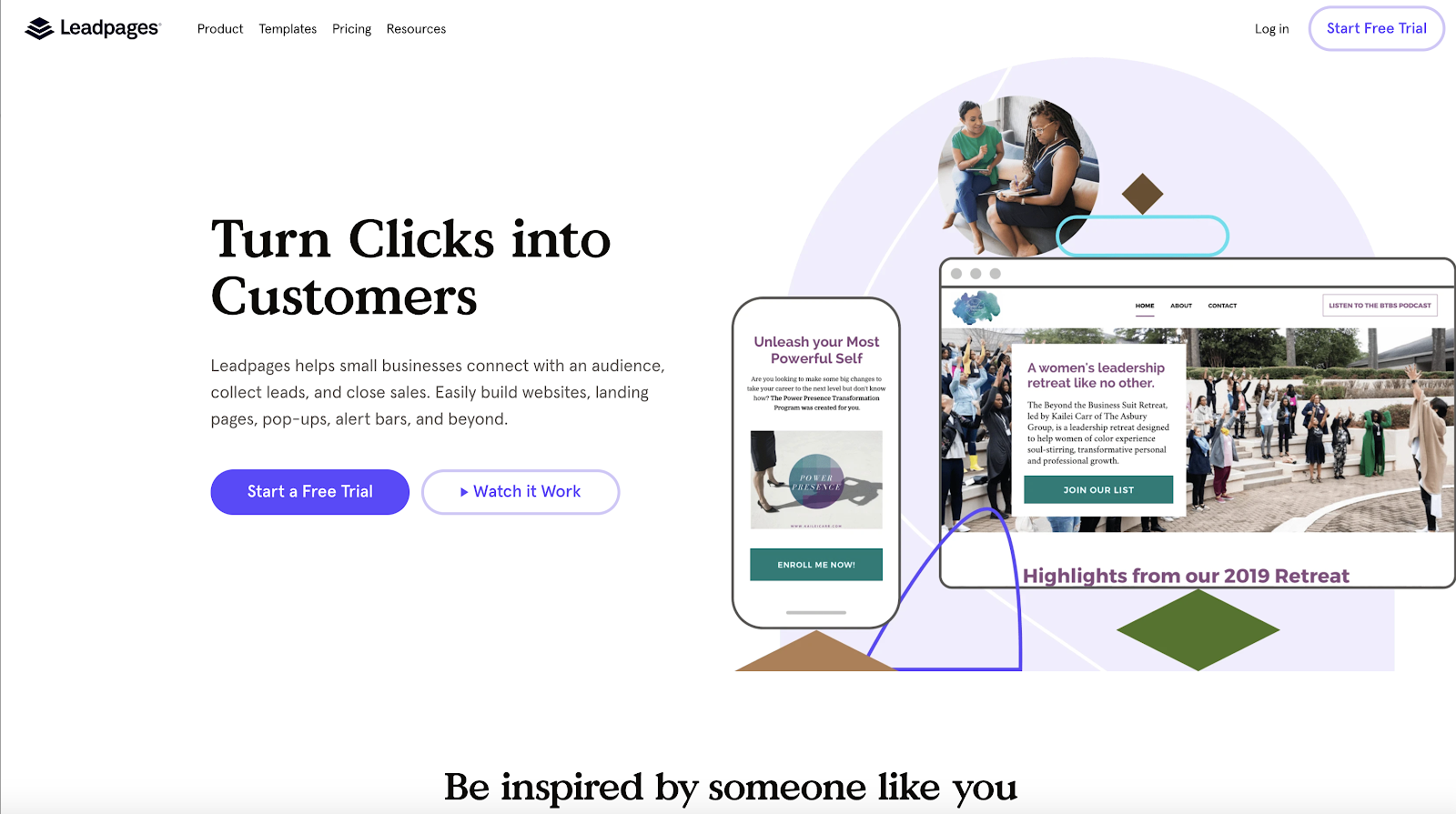
Leadpages is a strong contender in the marketing technology world, and it's an especially popular landing page builder.

Essentially, it allows you to build no code (or low code) websites and landing pages. It also includes handy tools for lead capture and funnel building, such as popup forms, alert bars, and an impressive list of native integrations.

Previously, Leadpages had also owned a marketing automation platform, Drip, though they have since diverged in Leadpages' recent acquisition. Still, you can easily integrate Drip with Leadpages (or basically whatever marketing automation tool you use).

Pros

  • Beautiful drag-and-drop page editors
  • Ability to build a full website or landing pages
  • Great lead capture tools
  • Affordable pricing

Cons

  • No email or campaigns functionality
  • Lack of robust native analytics reports
  • Not the most customizable/complex feature set

Pricing: Starts at $25/month

3. Unbounce

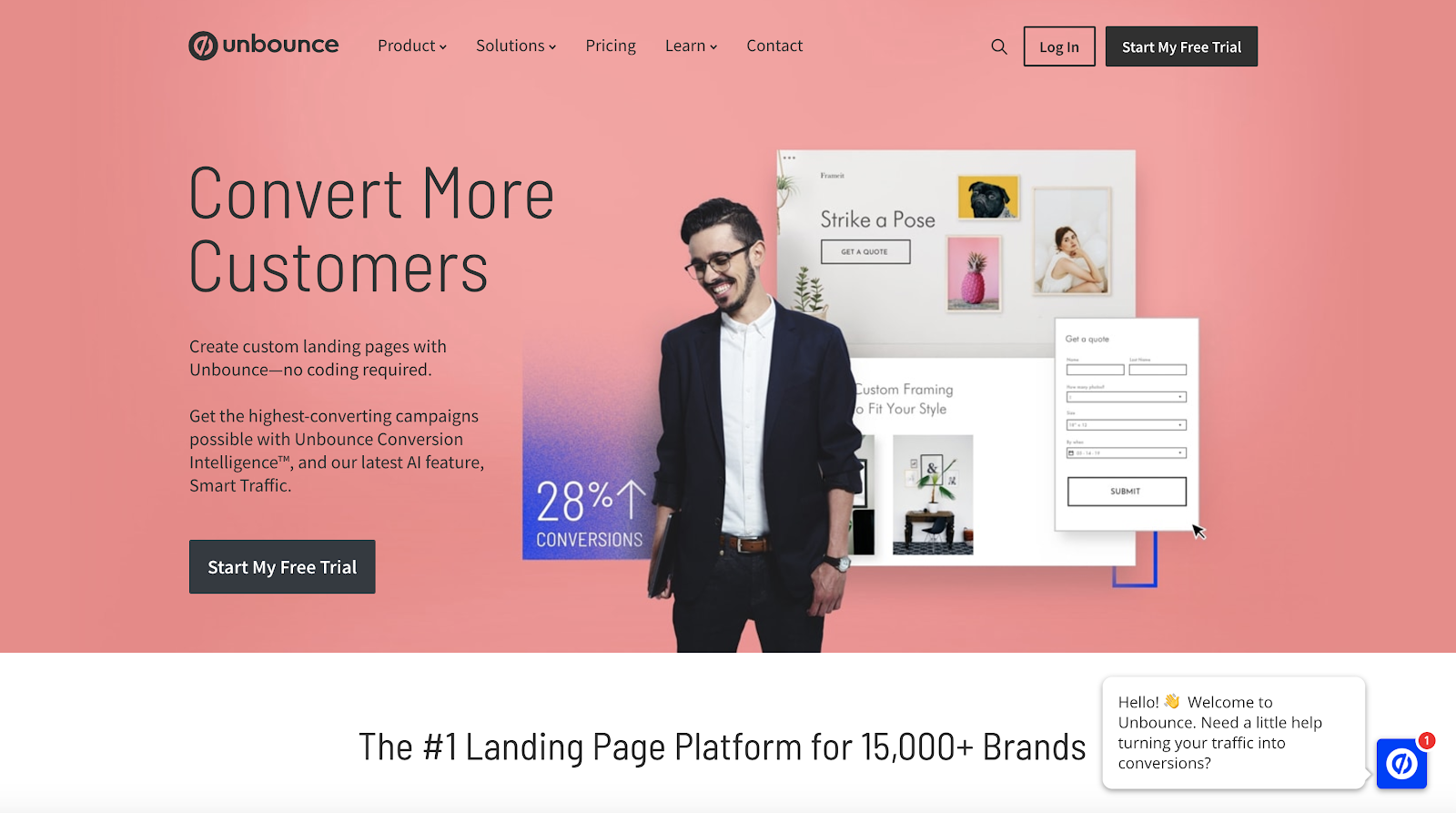
Unbounce is one of my favorite landing page builders.

Their landing page editor is easy to use, but the product is also one of the most powerful and flexible I've tried out. You'll be just as satisfied with the tool whether you're a marketer who can't code, a marketer who can code, a designer, or a developer. It's a great product for landing pages at scale.

While landing pages are their bread and butter, they also have some truly great lead capture tools, as well. The pop-up editor is the same WYSIWYG editor that their landing page editor uses, so it's easy to build beautiful pop-ups (not to mention, they've got great templates available, too).

Unbounce has also built a substantial community of users, agencies, and developers. So if you're looking for help with design, SEO, or PPC campaigns, there are so many agencies that specialize with Unbounce.

One of the coolest features they've recently launched is "smart traffic." This feature uses machine learning to dynamically deliver the right landing page to the right traffic (my guess is through reinforcement learning, but who knows).

Pros

  • Easy to use WYSIWYG editor
  • Huge community and brand support
  • Good customer support
  • Mobile-friendly editor
  • Strong lead capture tools
  • Smart traffic delivers ML-based landing page automation

Cons

  • Starting price is a bit more expensive than competitors
  • Drag-and-drop functionality can get a little buggy, so your best best is to work with a coder or designer

Pricing: Starts at $80/month

4. Instapage

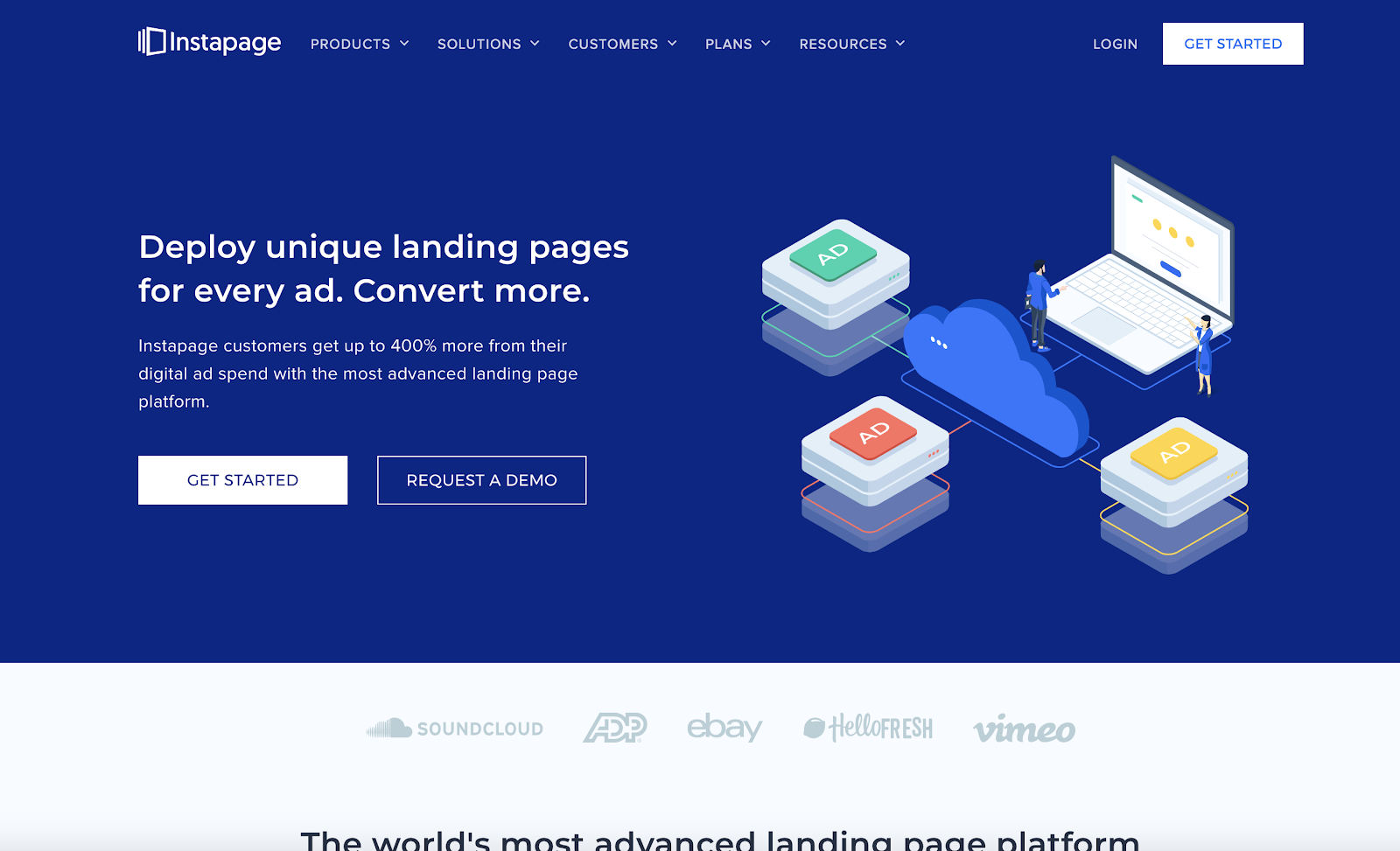
Instapage is one of the most popular landing page tools on the market.

They're well-respected among marketers, and offer one of the most scalable solutions when it comes to high-budget growth marketing programs. This includes programmatic personalization, solid experimentation functionality embedded within the product, and AdMaps to visualize the mapping between your pre-click experience on ads and your post-click experience on landing pages.

Underpinning all of this advanced technology is a user-friendly page builder that any marketer can master easily.

Pros

  • Powerful feature set great for high scale marketing teams
  • AdMap visualizations to link up ad creative to landing pages
  • Personalization and experimentation embedded in product
  • Strong reputation for lightning fast page speed

Cons

  • Higher price point than other alternatives
  • Lack of native messaging or campaigns features

Pricing: Starts at $199/month

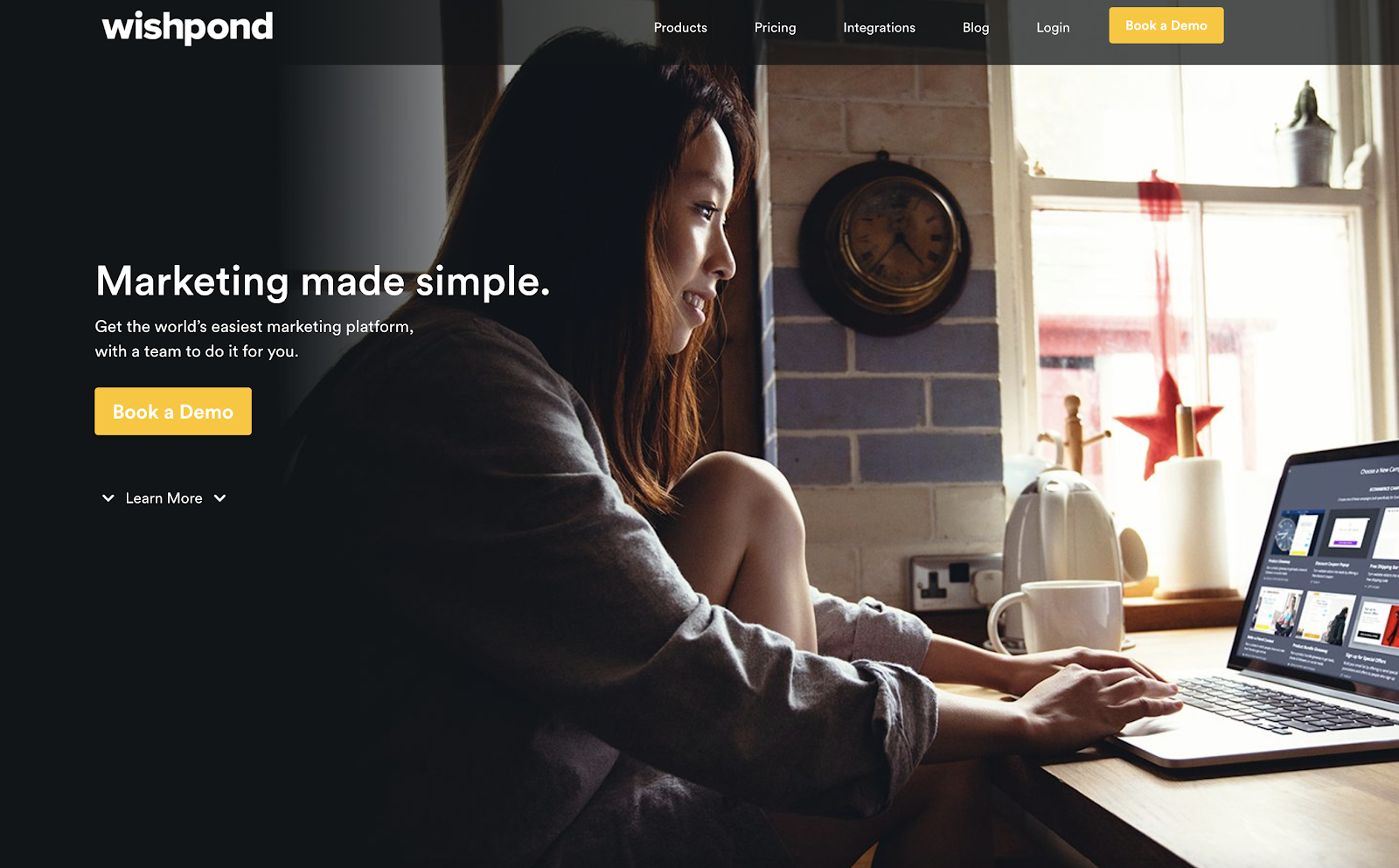
5. Wishpond

Wishpond is an all-in-one marketing platform that might be one of the easiest to use.

First off, they have a stunning array of features. They have ads tools for Instagram, Facebook, and Google, social media promotion tools, email marketing software, lead management, referral programs, landing pages, website pop-ups, cart abandonment triggers, forms, call tracking, and automation.

So if you want the full bucket of features and then some, Wishpond is an impressive platform.

The tools are all built for marketers, so they're easy to use without the help of a developer.

Pros

  • Every feature a marketer could wish for
  • Easy-to-use page editor
  • Great pop-up building and behavioral triggering

Cons

  • Too many features can get confusing and not all are best in breed
  • A/B testing functionality is limited

Pricing: Starts at $75/month

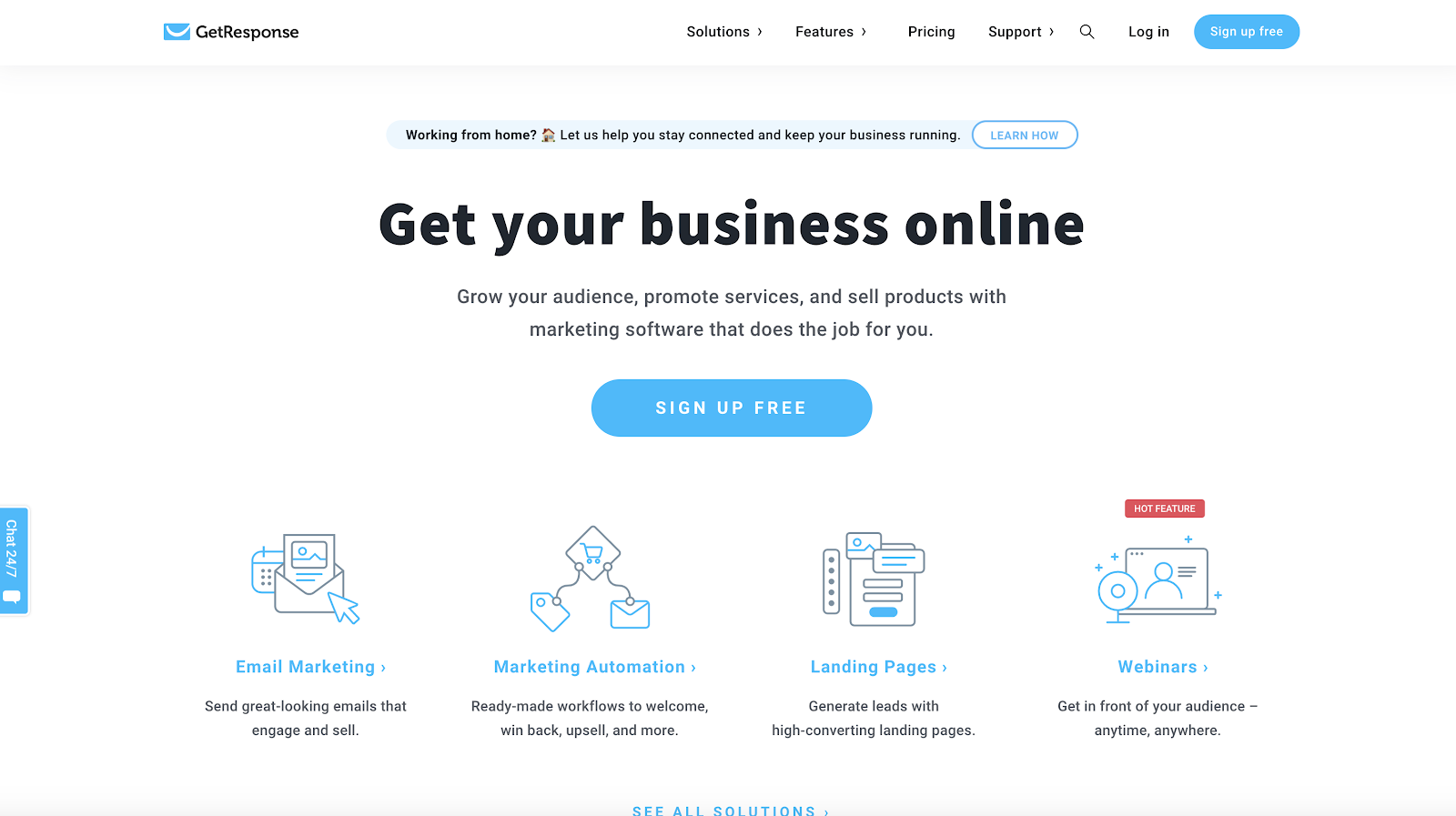
6. GetResponse

GetResponse is one of my favorite all-in-one marketing platforms. To be honest, I've mainly used them and love them for their email marketing solution. Great deliverability.

But their landing page builder is also impressive. They have some unique features, like robust marketing automation and webinars, as well as some standard tools like forms and pop-ups.

You can easily set up sales funnels or lead magnet funnels, and you can even manage and create social media ads in the platform. Sitting on all of this is a powerful set of analytics tools to visualize exactly how your funnels are performing.

Pros

  • Amazing email marketing tool
  • Easy-to-use page builder
  • Sales and lead magnet funnels
  • Integrated webinar functionality
  • Affordable entry price

Cons

  • Too many features leaves some neglected (lead capture tools aren't super strong)

Pricing: Starts at $15/month

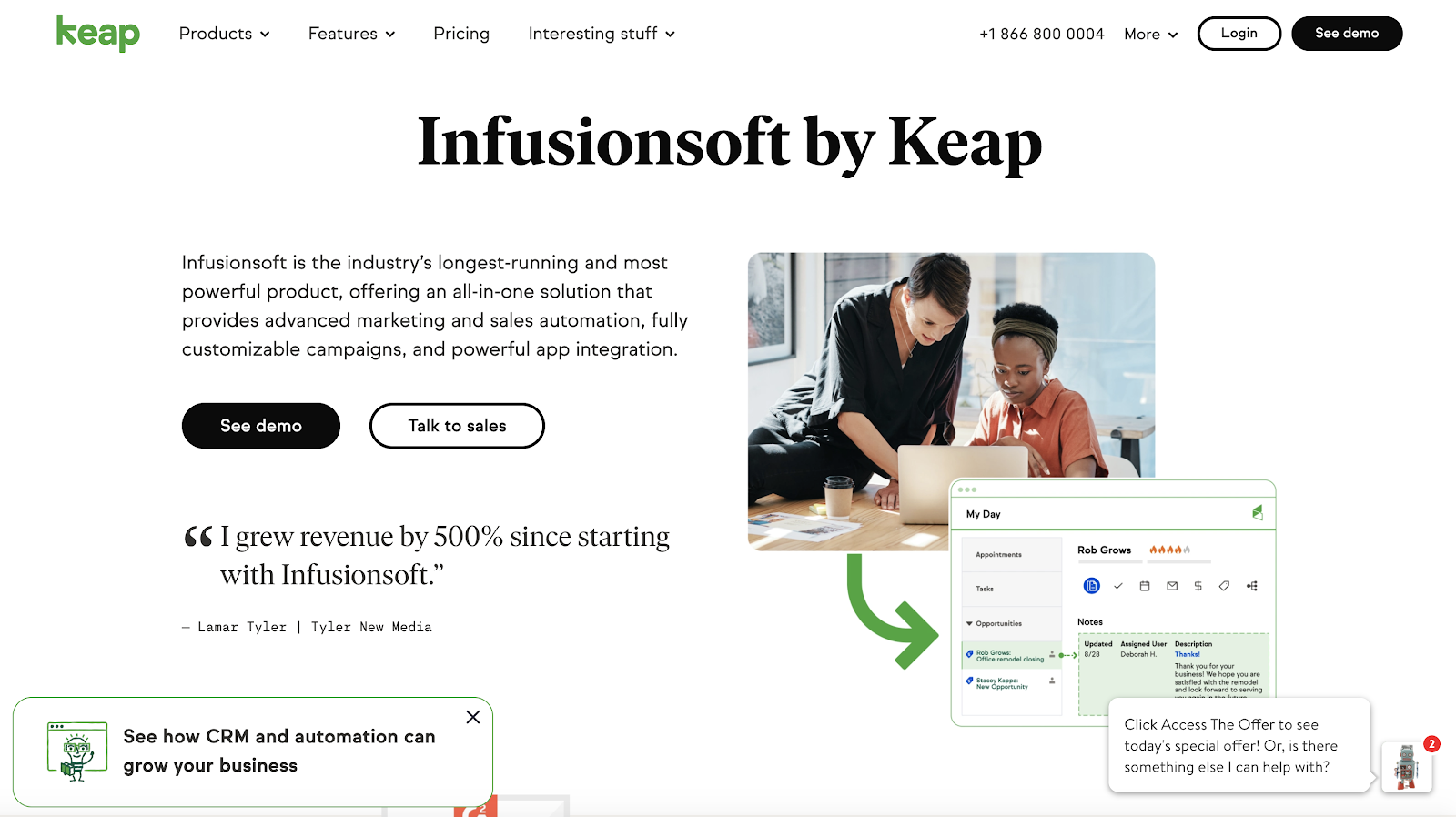
7. Keap

Keap, formerly known as Infusionsoft, is one of the premier marketing automation solutions out there.

Since rebranding and rolling up into Keap, the company has built out a robust platform complete with a CRM as well as various sales features like invoice management, an appointment scheduler, and a sales pipeline manager.

However, most marketers know this company for Infusionsoft, the powerful and long running marketing automation platform. This tool has the whole suite — landing pages, lead capture tools like forms and pop-ups, an email delivery service, automation functionality, and pretty good native analytics reports.

All of this makes it a wonderful solution to manage your sales funnel and online business in general.

Pros

  • Powerful and flexible automation features
  • Strong community and support network
  • Integration with Keap's CRM and sales tools

Cons

  • Can be a difficult learning curve with some features
  • More expensive than other tools on this list

Pricing: Starts at $199/month

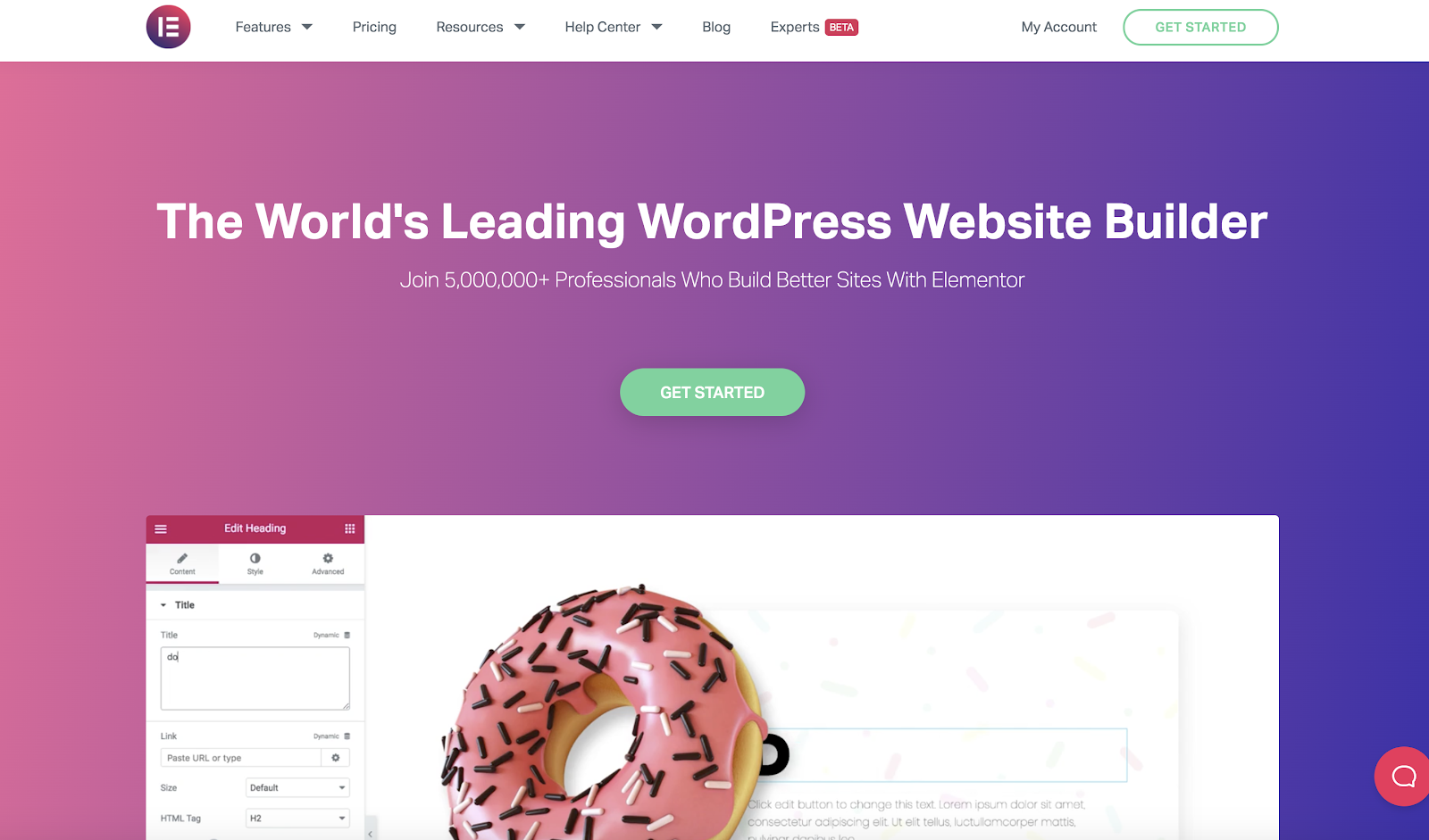
8. Elementor

Elementor is an insanely popular WordPress page builder.

While many ClickFunnels alternatives on this list are full featured marketing platforms, you can get pretty far with WordPress, a page builder like Elementor, and a messaging service (there are many free email marketing tools).

Elementor has over 5 million active installations on WordPress, and it's easy to see why. It's an incredibly easy-to-use landing page builder, and any marketer can use it to quickly get started building beautiful pages.

Moreover, it starts out free and is quite affordable even at the paid tiers.

If you need a simple and effective page builder to act as a funnel builder, Elementor is a great option.

Pros

  • Easy to use drag-and-drop editor
  • Hundreds of premium templates
  • Dozens of embedded widgets available
  • Plug-and-play with WordPress
  • Affordable

Cons

  • Only builds pages, so you'll have to use other tools for messaging and automation
  • Sometimes lacks flexibility and customization

Pricing: Starts free, next plan begins at $49/month

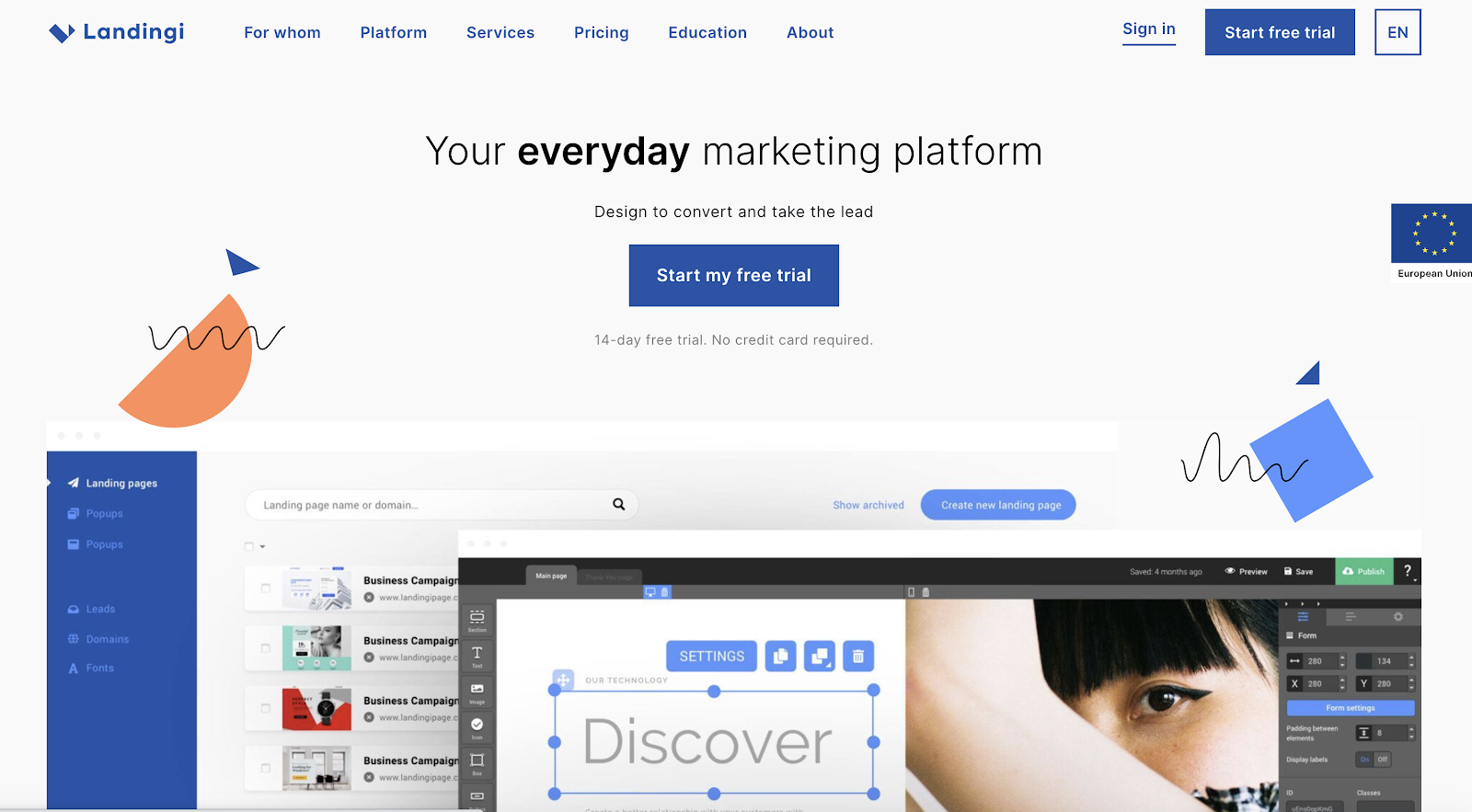
9. Landingi

In my opinion, Landingi is one of the most underrated landing page builders.

First off, it's easy to use. Additionally, they've got a powerful assortment of features, including a mobile-friendly design editor, pop-ups and lead capture functionality that you can use anywhere on your site, a ton of integrations, and optimization and testing capabilities in-app.

Plus, this tool was built as a mobile-first landing page builder. It can often be frustrating designing mobile-friendly pages, so if that's a concern for you, you should consider this tool.

Finally, if you're a WordPress user, they have a great WordPress plugin to help get you up and running.

Pros

  • Mobile focused, so you can easily design beautiful mobile pages
  • Lead capture and pop-up tools
  • A/B testing and optimization features
  • Easy to use

Cons

  • No module building, so it's not the most scalable solution if you need tons of landing pages
  • Not as feature rich as other solutions on this list

Pricing: Starts at $47/month

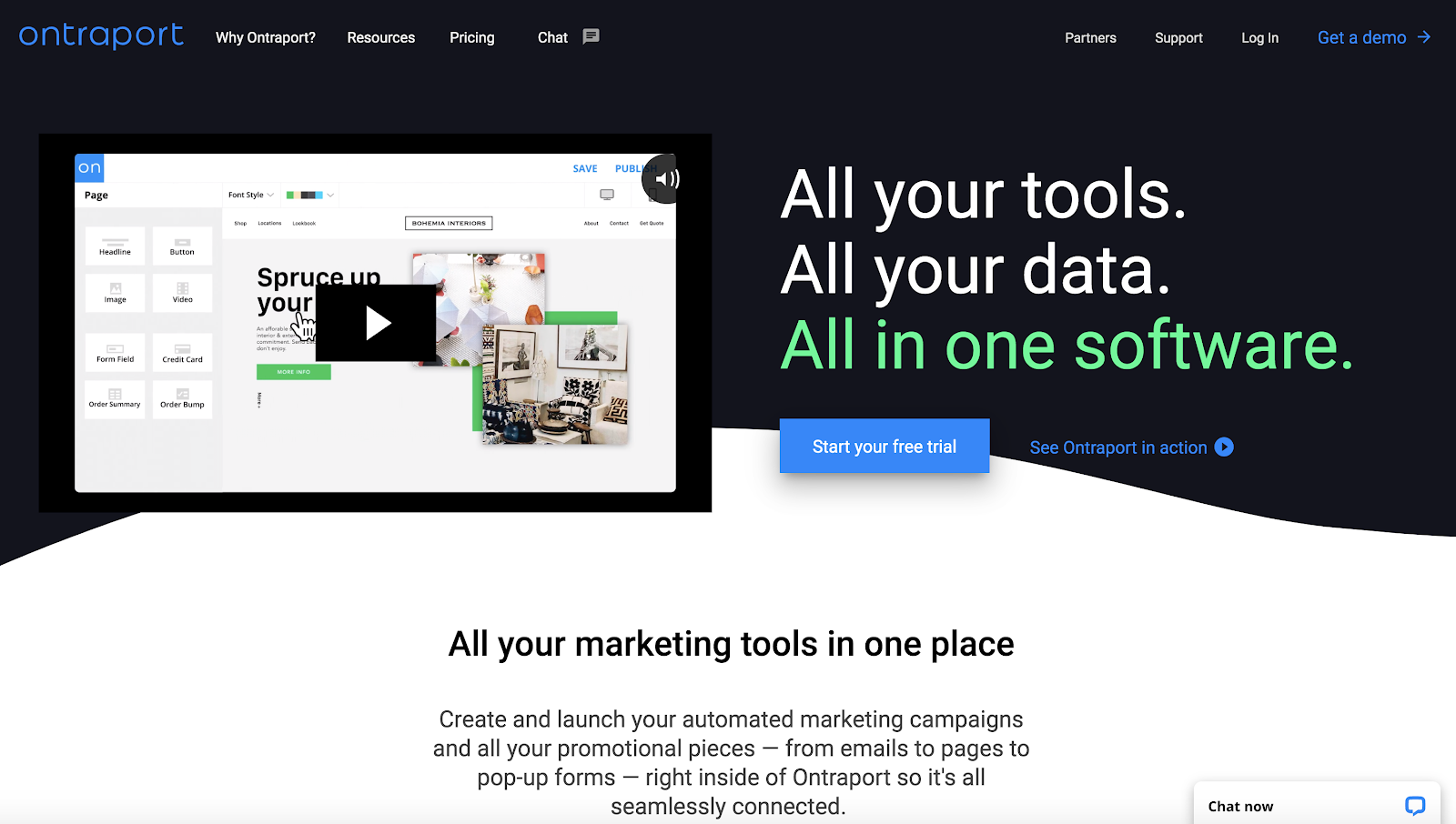
10. Ontraport

Ontraport is another all-in-one marketing solution.

It starts with the Ontraport CRM, where all your data lives. Then you have email and SMS tools to communicate with your prospects and your customers.

And of course, you have a great landing page builder. This also comes with embedded web forms and membership sites, which makes this a wonderful alternative to ClickFunnels.

Pros

  • All-in-one feature set that competes head to head with ClickFunnels and Infusionsoft
  • Solid page builder
  • Good customer support

Cons

  • Complains of buggy drag and drop functionality, especially creating emails
  • Limitations and lack of flexibility with certain tools, like designing emails or landing pages

Pricing: Starts at $79/month

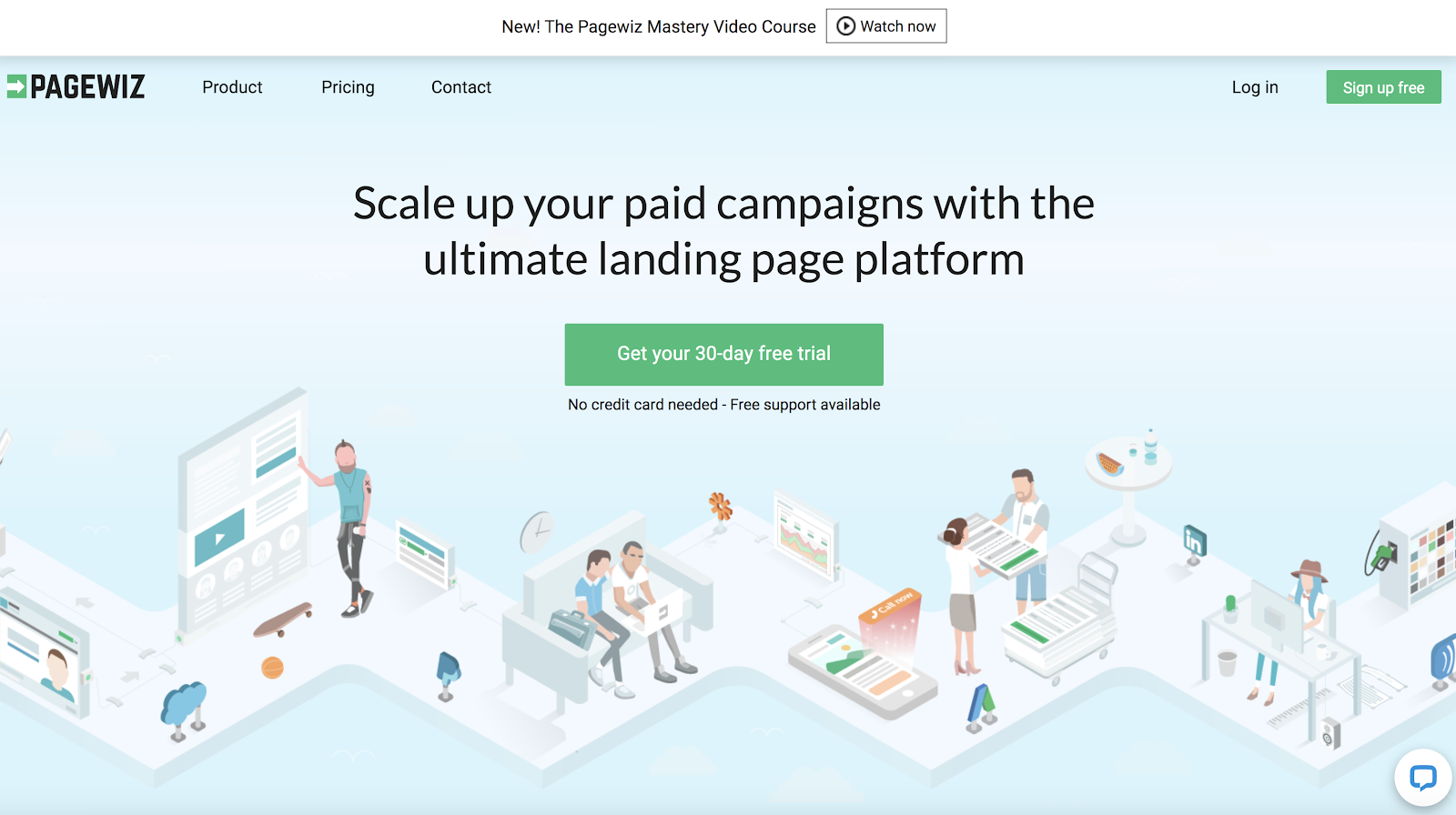
11. Pagewiz

Pagewiz is a dedicated landing page builder — and a powerful one, at that.

They're a product-led company, putting tons of resources into building a secure, easy-to-use, and flexible page builder. Therefore, if you want best in breed for your landing pages, this is a good bet.

Pagewiz comes replete with every feature you need to build perfect pages — a mobile responsive editor, good A/B testing functionality, video widgets, design features like parallax scrolling, and tons of ready-to-use templates.

You can also integrate with pretty much any other marketing tool you're currently using.

Pros

  • Great product reliability and rich feature set
  • Forms and lead capture capabilities
  • Mobile responsive editor
  • Easy to use WYSIWYG
    Many integrations

Cons

  • Not as much education, community or support materials for technical issues
  • Lack of additional messaging and campaigns features

Pricing: Starts at $29/month

The 5 Best Free ClickFunnels Alternatives

1. HubSpot Marketing Hub

2. Elementor

3. Wix

4. GrooveFunnels

5. BuilderAll

Finding the Best ClickFunnels Alternative

Whatever your reason for seeking a ClickFunnels alternative, know that there are many options on the market now and there will likely be more in the future. The marketing technology landscape continues to expand, not only giving marketers more options, but better and more powerful tools as well.

Some tools on this list serve specific purposes, such as landing pages (Unbounce, Instapage, etc.), but some have all-in-one platforms that have all the features ClickFunnels has, and in some cases, many more.

For an all around effective growth platform, HubSpot's Marketing Hub is a great solution. You can start out free on many of the tools, including the landing page builder, form builder, CRM, and email marketing platform.

Beyond that, the paid tiers increase the scope and power of what you're able to accomplish. The sky's the limit.


The 11 Best ClickFunnels Alternatives & Competitors in 2020 was originally posted by Local Sign Company Irvine, Ca. https://goo.gl/4NmUQV https://goo.gl/bQ1zHR http://www.pearltrees.com/anaheimsigns

Why Consumers Sign Up for Webinars [New Data]

In 2020, brands are leveraging virtual events more than ever.

And, although some marketers once believed that "webinars were dead,” many are now rethinking that statement as they find themselves scheduling and promoting this exact type of event.

Webinars, or online events often modeled like a class or seminar, often include a lesson, slide deck, interactive elements such as polls, and, occasionally, time for audience members to virtually ask questions.

Because of their educational format, webinars can offer a number of great perks to brands.

First, you can build a sense of credibility by hosting a webinar on a topic your company has expertise in. Second, webinars can enable your fans to interact with you digitally.

Lastly, and most importantly, webinar signups can lead to a bigger contact list, more prospects, or purchasing conversions.

But webinars aren't always easy to plan and execute.

Because webinars require viewers to sign up and remember to tune in, it takes clever marketing to ensure that a large audience actually attends. Additionally, with most brands going virtual in 2020, a number of competitors in your space might very well be planning a similar webinar that your audiences might be more drawn to.

Luckily, by researching your target audience, and learning more about what drives attendees to sign up for webinars, you can create and promote an event that effectively pulls in and delights your audiences.

So, where do you start?

To help you research the best webinar tactics for your brand, I surveyed 400 consumers about their webinar preferences and what motivates them to attend these virtual events. In this blog post, I'll highlight a few key findings that you can keep in mind as you develop and promote your webinar content.

What Consumers Say About Webinars in 2020

People want webinars that help them explore their passions.

When choosing which webinars to sign up for, are people drawn mostly to events that help them elevate their career, or are they attending them for more recreational purposes?

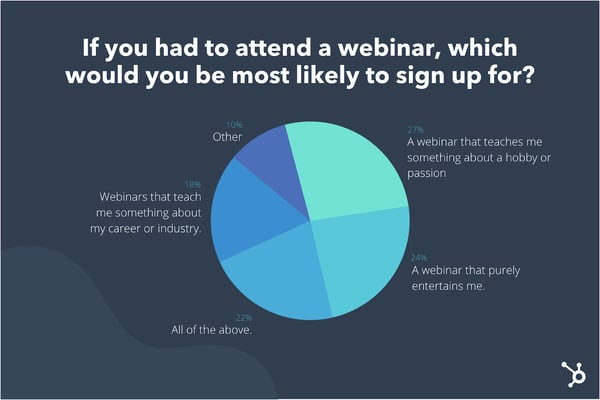
To learn more about consumers' motivations for attending a webinar, I asked 400 consumers, "Which webinars are you most likely to attend in 2020?", 27% chose, "Webinars that teach me more about a passion or hobby;" while 24% chose, "Webinars that entertain me."

which webinar would you sign up for?

Data Source

If you have a webinar strategy or series that aims to help people boost their careers or work tactics, don't panic. Nearly one-fifth of the group (18%) said they wanted to attend webinars that helped them learn more about their career or industry, while 22% said "All of the above." These results indicate that consumers will definitely still sign up for a webinar that tackles career, work, or industry-related topics.

Additionally, you should also keep in mind that this survey was delivered to a small general consumer pool of all ages and career levels. Had this been given primarily to executives or B2B business reps, the results might have leaned towards industry-related content.

Regardless of what industry you're in, or the size of this survey pool, marketers should keep the data above in mind when creating and promoting a webinar. Because people are naturally curious and want to learn, your webinar promotions should intrigue them by clearly stating what they'll learn, noting any experts that might be featured, and highlighting how attendees will be able to use the knowledge they'll gain from the event.

Webinar viewers sign up to learn something -- but prefer certain teaching styles over others.

Just like any in-person class, each professor -- or webinar host -- might have a slightly different teaching style.

While some hosts might come in with a great slide deck presentation, others might bring in an expert and have the audience ask them questions. Or, they might bring in a few experts and host a panel discussion where the audience just listens rather than asking questions.

There are many ways to format an informative webinar, but which teaching style actually intrigues people enough to get them to sign up?

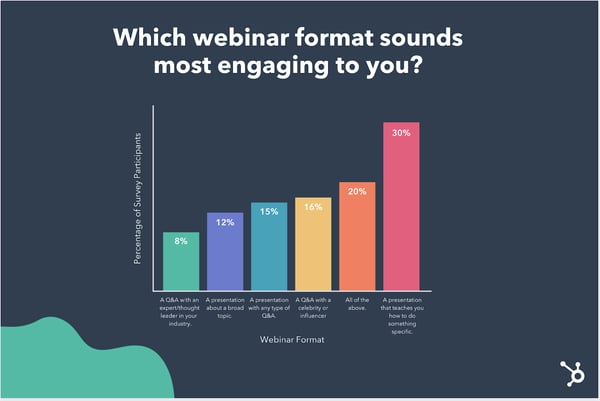
When I asked, "Which webinar format sounds most engaging to you?", 30% of participants said, "A presentation that teaches me how to do something specific." Meanwhile, 20% said "All of the above."

Which webinar format is most engaging?

Data Source

The results above hint that a simple how-to webinar with fewer frills could still engage audiences if you're feeling low on bandwidth and creativity. However, if you have the time to coordinate a webinar that feels more like a live Q&A, this could also be a great formatting option. 39% of people said they were drawn to one of the webinar formats that included a Q&A.

Although a more basic presentation or lecture styled webinar will still catch the attention of potential viewers, content marketers should still make sure their presentations educate audiences on something specific -- like a strategy -- rather than discussing an incredibly broad or very vague topic -- like an entire industry. Only 12% of respondents say they're driven to webinars that will feature a presenter discussing a broad topic.

Odds are, a person attending a webinar already knows the basics of their hobby, industry, or passion. But, they want to learn more or become an expert at something related to it. For example, as a content marketer, I might not attend a webinar with a broad topic of "Marketing," but I might attend webinars like, "Advanced Blogging Tips from Managing Editors," or "The Basics of SEO in Marketing."

As a marketer or webinar creator, you'll need to build a buyer persona for your target audience to determine the best expertise level to create valuable content around. If your audience is filled with beginners in a topic, you might want to create more granular webinars that discuss basic tasks or tactics. If your audience is made up of topic experts, your webinars might need to be more advanced.

Interactive Content: The Key to an Engaging Webinar?

In the modern classroom, teachers will often zest up a number of different class outlines by adding opportunities for students to interact or test their knowledge. These could include polling the class by asking them to raise their hands, pop quizzes, or allowing them to ask questions.

When it comes to online events, a number of tools and video software enable marketers to make their webinars more interactive and engaging. And, based on our research, it seems like consumers enjoy interactive webinars.

When asked, "Which element would you most like to see in a webinar?", "A host or presenter that takes questions from the audience," received 22% of the votes, followed by "No preference as long as the webinar feels interactive," with 19% of the votes. Another 20% say they'd like to see polls or quizzes.

Which element would you like to see in a webinar?

Data Source

If you're a marketer who regularly creates webinars, it might be worth it to consider where you can make your programming more interactive.

For example, if you're hosting an expert, consider leaving time for the audience to ask questions in the webinar tool's chat area. Or, if you're discussing a strategy that's common in your field, poll your audience to see if they've used the tactic.

Although polls or Q&A might seem like a super basic webinar element, they might make your audiences listen more actively and enjoy the content they're consuming more. This ultimately could lead to them engaging more with your brand, signing up for future webinars, or converting to a customer.

If you're marketing a webinar that has interactive content in it, be sure to promote that aspect. For example, in your messaging, emails, and follow-up emails, directly tell your audiences they'll be able to actively participate in quizzes, polls, or a Q&A during your event.

In a competitive webinar pool, anything you can do to make your webinar seem more active and engaging than others that are more basic could help boost signups and attendance during the actual event.

Creating and Promoting a Successful Webinar

While creating a unique and engaging webinar will be one crucial step in your virtual event strategy, the proper promotional tactics will also be vital.

Once you've created a webinar plan that will inform audiences, allow them to interact with you, and fuel your contact list, be sure to promote all of the great things your online event will cover.

As you promote your webinar, don't forget to note aspects that will make your event stand out -- such as polls or Q&As. This transparency will show audiences exactly what they can expect and differentiate you from competitors with vague webinar promotions.

To learn more about creating a truly compelling webinar, check out this ultimate guide. Want to learn how to promote your next online event? Here are a few great tips from HubSpot marketers.


Why Consumers Sign Up for Webinars [New Data] was originally posted by Local Sign Company Irvine, Ca. https://goo.gl/4NmUQV https://goo.gl/bQ1zHR http://www.pearltrees.com/anaheimsigns